



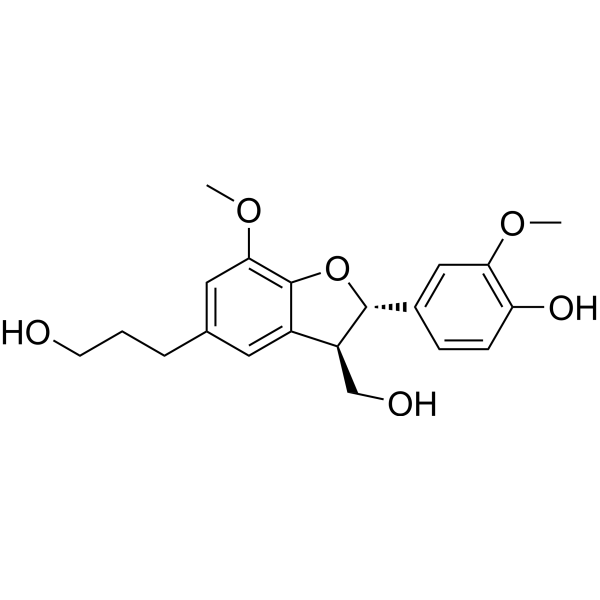
Dihydrodehydrodiconiferyl alcohol

Based on 1 Customer Validation
Dihydrodehydrodiconiferyl alcohol (compound 2) is a kind of neolignan. Dihydrodehydrodiconiferyl alcohol can be isolated from Anogeissus acuminata. Dihydrodehydrodiconiferyl alcohol has specific cytotoxic activity on melanoma cancer cell line.
For research use only. We do not sell to patients.
- Purity : 99.45%
- CAS No.: 28199-69-1
- Formula: C20H24O6
- Molecular Weight:360.40
-
Storage:
4°C, protect from light
* In solvent : -80°C, 6 months; -20°C, 1 month (protect from light)

To place orders, for customer services and technical support, please contact: MedChemExpress USA
Tel: 609-228-6898 E-mail: [email protected] [email protected]


-
 Biological Activity
-
Chemical Information
- Protocols
- Purity & Documentation
- References
-
 Help & FAQs




Biological Activity
Description
Cellular Effect
|
Cell Line

|
Type | Value | Description | References |
|---|---|---|---|---|
| A549 | IC50 |
22.4 μM
Compound: 3
|
Anticancer activity against human A549 cells by SRB assay
Anticancer activity against human A549 cells by SRB assay
|
[PMID: 21420296] |
| BV-2 | IC50 |
28.8 μM
Compound: 3
|
Antiinflammatory activity in mouse BV2 cells assessed as inhibition of lipopolysaccharide induced NO production
Antiinflammatory activity in mouse BV2 cells assessed as inhibition of lipopolysaccharide induced NO production
|
[PMID: 21420296] |
| HepG2 2.2.15 | CC50 |
180.07 μM
Compound: 16
|
Cytotoxicity against human HepG2(2.2.15) cells after 12 days by MTT assay
Cytotoxicity against human HepG2(2.2.15) cells after 12 days by MTT assay
|
[PMID: 23434030] |
| HepG2 2.2.15 | IC50 |
>1000 μM
Compound: 16
|
Antiviral activity against Hepatitis B virus infected in human HepG2.2.15 cells assessed as inhibition of HBeAg secretion after 12 days by ELISA
Antiviral activity against Hepatitis B virus infected in human HepG2.2.15 cells assessed as inhibition of HBeAg secretion after 12 days by ELISA
|
[PMID: 23434030] |
| HepG2 2.2.15 | IC50 |
>1000 μM
Compound: 16
|
Antiviral activity against Hepatitis B virus infected in human HepG2.2.15 cells assessed as inhibition of HBsAg secretion after 12 days by ELISA
Antiviral activity against Hepatitis B virus infected in human HepG2.2.15 cells assessed as inhibition of HBsAg secretion after 12 days by ELISA
|
[PMID: 23434030] |
| HepG2 2.2.15 | IC50 |
>1000 μM
Compound: 16
|
Antiviral activity against Hepatitis B virus infected in human HepG2.2.15 cells assessed as inhibition of HBV DNA replication after 72 hrs by PCR analysis
Antiviral activity against Hepatitis B virus infected in human HepG2.2.15 cells assessed as inhibition of HBV DNA replication after 72 hrs by PCR analysis
|
[PMID: 23434030] |
| RAW264.7 | IC50 |
9.8 μM
Compound: 8
|
Inhibition of LPS-induced nitric oxide production in mouse RAW264.7 cells preincubated with compound for 1 hr before exposure to LPS measured after 24 hrs by Griess reaction method
Inhibition of LPS-induced nitric oxide production in mouse RAW264.7 cells preincubated with compound for 1 hr before exposure to LPS measured after 24 hrs by Griess reaction method
|
[PMID: 21435874] |
| RAW264.7 | IC50 |
38.7 μM
Compound: 18
|
Antiinflammatory activity against mouse RAW264.7 cells assessed as inhibition of LPS-induced NO production after 24 hrs by Griess method
Antiinflammatory activity against mouse RAW264.7 cells assessed as inhibition of LPS-induced NO production after 24 hrs by Griess method
|
[PMID: 24035341] |
| RAW264.7 | IC50 |
60.4 μM
Compound: 15
|
Antiinflammatory activity in mouse RAW264.7 cells assessed as inhibition of LPS/IFNgamma-induced NO production by measuring NO level preincubated for 2 hrs and followed by LPS/IFNgamma addition and measured after 24 hrs by Griess assay
Antiinflammatory activity in mouse RAW264.7 cells assessed as inhibition of LPS/IFNgamma-induced NO production by measuring NO level preincubated for 2 hrs and followed by LPS/IFNgamma addition and measured after 24 hrs by Griess assay
|
[PMID: 31350127] |
| RAW264.7 | IC50 |
>50 μM
Compound: 21
|
Antiinflammatory activity in mouse RAW264.7 assessed as inhibition of LPS-induced NO production preincubated for 30 mins followed by LPS stimulation measured after 24 hrs by Griess reagent based assay
Antiinflammatory activity in mouse RAW264.7 assessed as inhibition of LPS-induced NO production preincubated for 30 mins followed by LPS stimulation measured after 24 hrs by Griess reagent based assay
|
[PMID: 33939429] |
| SK-MEL-2 | IC50 |
23.34 μM
Compound: 3
|
Anticancer activity against human SK-MEL-2 cells by SRB assay
Anticancer activity against human SK-MEL-2 cells by SRB assay
|
[PMID: 21420296] |
| SK-OV-3 | IC50 |
>30 μM
Compound: 3
|
Anticancer activity against human SKOV3 cells by SRB assay
Anticancer activity against human SKOV3 cells by SRB assay
|
[PMID: 21420296] |
| XF498 | IC50 |
13.42 μM
Compound: 3
|
Anticancer activity against human XF498 cells by SRB assay
Anticancer activity against human XF498 cells by SRB assay
|
[PMID: 21420296] |


Chemical Information
-
CAS No. 28199-69-1
-
Appearance Solid
-
Molecular Weight 360.40
-
Formula C20H24O6
-
Color White to off-white
-
SMILES
OC[C@H]1C2=CC(CCCO)=CC(OC)=C2O[C@@H]1C3=CC(OC)=C(C=C3)O
-
Structure Classification
-
Initial Source
-
Shipping
Room temperature in continental US; may vary elsewhere.
-
Storage
4°C, protect from light
* In solvent : -80°C, 6 months; -20°C, 1 month (protect from light)

Protocols
-
Cell Cytotoxicity Assay
Cytotoxicity assays are usually based on the assessment of cell membrane damage, which can also be indirectly detected by measuring cell viability. Detection methods include MTT assay, CKK-8 assay, LDH assay and ATP assay, etc.
-
Cell Viability Determination by MTT Colorimetric Assay
The following protocol uses the MTT colorimetric assay as a classic literature-established method for assessing cell viability/metabolic activity in cultured mammalian cells. MTT[3-(4,5-dimethylthiazol-2-yl)-2,5-diphenyltetrazolium bromide] is reduced by metabolically active cells to a colored formazan product; the amount of formazan is quantified spectrophotometrically and provides an indirect measure of metabolically active viable cells. Importantly, MTT reduction reflects cellular oxidoreductase/metabolic activity rather than an absolute direct count of living cells, so changes in cellular metabolism can alter the signal independently of cell number.


Purity & Documentation
-
Data Sheet (264 KB)
-
SDS (251 KB)
- English - EN (251 KB)
- Français - FR (251 KB)
- Deutsch - DE (251 KB)
- Norwegian - NO (251 KB)
- Español - ES (251 KB)
- Swedish - SV (251 KB)
- Italian - IT (251 KB)
- Korean - KR (251 KB)
- Portuguese - PT (251 KB)
-
Handling Instructions (2659 KB)
References

Calculators
Concentration (start) × Volume (start) = Concentration (final) × Volume (final)


Dihydrodehydrodiconiferyl alcohol Related Classifications
HY-129144 Related Classifications
 Powered by Bioz