



Eltrombopag-13C4
Based on 1 publication(s) in Google Scholar
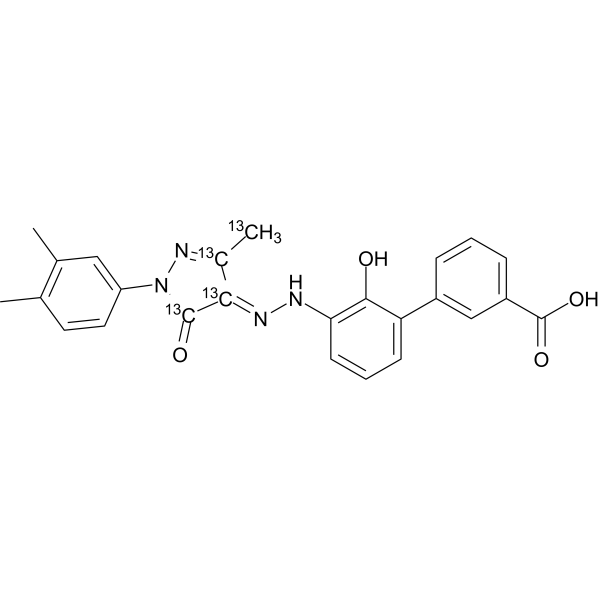
Eltrombopag-13C4 (SB-497115-13C4) is 13C-labeled Eltrombopag. Eltrombopag is an orally active thrombopoietin-receptor non-peptide agonist with platelet-stimulating activity for the study of chronic immune thrombocytopenia. Eltrombopag also has strong inhibitory effects on multidrug-resistant Staphylococcus aureus (Staphylococcus aureus) and can induce apoptosis (apoptosis) in liver cancer cells.
For research use only. We do not sell to patients.
- Purity : 97.89%
- CAS No.: 1217230-31-3
- Formula: C2113C4H22N4O4
- Molecular Weight:446.44
-
Storage:Powder -20°C, 3 years , 4°C, 2 years ; In solvent -80°C, 6 months , -20°C, 1 month

To place orders, for customer services and technical support, please contact: MedChemExpress USA
Tel: 609-228-6898 E-mail: [email protected] [email protected]


-
 Biological Activity
-
Chemical Information
-
Solvent & Solubility
- Protocols
- Purity & Documentation
- References
-
 Help & FAQs


Publications Citing Use of MedChemExpress (MCE) Eltrombopag-13C4
More

Biological Activity
Description
IC50 & Target
Thrombopoietin Receptor, Staphylococcus aureus, Apoptosis[1][3][5]
Application
1. This compound can be used as a tracer
2. This compound can be used as an internal standard for quantitative analysis by NMR, GC-MS, or LC-MS.


Chemical Information
-
CAS No. 1217230-31-3
-
Unlabeled CAS 496775-61-2
-
Appearance Solid
-
Molecular Weight 446.44
-
Formula C2113C4H22N4O4
-
Color Light yellow to orange
-
SMILES
O=[13C](/[13C]1=N/NC(C=CC=C2C3=CC(C(O)=O)=CC=C3)=C2O)N(C(C=C4)=CC(C)=C4C)N=[13C]1[13CH3]
-
Synonyms
SB-497115-13C4
-
Shipping
Room temperature in continental US; may vary elsewhere.
-
Storage
Powder -20°C 3 years 4°C 2 years In solvent -80°C 6 months -20°C 1 month


Publications (1)
-
Journal Impact Factor
-
Most Recent
-
J Pharm Biomed Anal
Simultaneous analysis of avatrombopag, eltrombopag, and hetrombopag in human plasma by UPLC-MS/MS for therapeutic drug monitoring. [Abstract]2023 Oct 25:235:115683. PMID: 37647792


Solvent & Solubility
In Vitro:
DMSO : ≥ 20 mg/mL (44.80 mM; Hygroscopic DMSO has a significant impact on the solubility of product, please use newly opened DMSO)
DMF : ≥ 1 mg/mL (2.24 mM)
Ethanol : ≥ 0.1 mg/mL (0.22 mM)
* "≥" means soluble, but saturation unknown.
Please refer to the solubility information to select the appropriate solvent. Once prepared, please aliquot and store the solution to prevent product inactivation from repeated freeze-thaw cycles.
Storage method and period of stock solution: -80°C, 6 months; -20°C, 1 month. When stored at -80°C, please use it within 6 months. When stored at -20°C, please use it within 1 month.
Please refer to the solubility information to select the appropriate solvent. Once prepared, please aliquot and store the solution to prevent product inactivation from repeated freeze-thaw cycles.
Storage method and period of stock solution: -80°C, 6 months; -20°C, 1 month. When stored at -80°C, please use it within 6 months. When stored at -20°C, please use it within 1 month.
Concentration (start) × Volume (start) = Concentration (final) × Volume (final)

Protocols
-
Detection of Apoptosis
Apoptosis, also called programmed cell death, is generally characterized by distinct morphological characteristics.
-
TUNEL staining for apoptotic DNA fragmentation
TUNEL staining detects DNA strand breaks by using terminal deoxynucleotidyl transferase to add labeled nucleotides to exposed 3′-OH DNA termini, generating either microscopic staining in fixed cells or tissue sections, or fluorescence/cytometric signal in cell suspensions. TUNEL positivity reflects DNA fragmentation but should not be interpreted alone as definitive apoptosis, because TUNEL can also label necrotic, autolytic, mechanically damaged, or DNA-repair-associated DNA breaks.
-
Annexin V plus membrane-impermeant dye apoptosis staining
Annexin V-based apoptosis assays rely on the detection of phosphatidylserine (PS) externalization from the inner leaflet of the plasma membrane to the outer leaflet, an early biochemical hallmark of apoptosis. Fluorescently labeled Annexin V binds PS in a calcium-dependent manner, enabling identification of early apoptotic cells by flow cytometry or fluorescence microscopy. When combined with a membrane-impermeant DNA-binding dye (e. g. , propidium iodide), this approach allows discrimination between viable (Annexin V−/dye−), early apoptotic (Annexin V+/dye−), and late apoptotic or necrotic (Annexin V+/dye+) cell populations by assessing membrane integrity and PS exposure.
-
Apoptosis Solutions
Apoptosis is a regulated, generally non-lytic cell-death pathway that removes unwanted, damaged, infected, or abnormal cells through coordinated morphological changes, caspase activation, DNA fragmentation, and membrane remodeling. The intrinsic apoptosis pathway is controlled mainly by mitochondrial outer membrane permeabilization, BCL-2 family proteins, cytochrome c release, apoptosome formation, caspase-9 activation, and downstream executioner caspase-3/7 activation. The extrinsic apoptosis pathway is initiated by death receptors such as Fas, TNFR, and TRAIL receptors, which recruit adaptor proteins and activate caspase-8 before engaging executioner caspases or mitochondrial amplification through BID cleavage. Apoptosis is linked to many phenotypes, including cancer cell killing, tissue homeostasis, immune regulation, neurodegeneration, infection response, and treatment-induced cytotoxicity; unresolved questions include how apoptosis interacts with necroptosis, pyroptosis, ferroptos
-
Liver Cancer Modeling
Liver cancer can be classified into primary liver cancer and secondary liver cancer. Secondary liver cancer is the metastatic liver cancer. Primary liver cancer includes hepatocellular carcinoma (HCC), intrahepatic cholangiocarcinoma (ICC) and fibrolamellar HCC, of which HCC is the most common form, accounting for approximately 90% of primary liver cancers[1]. HCC mouse models include chemical agent-induced models, transplanted tumor models, and genetic engineered models.


Purity & Documentation
-
Data Sheet (274 KB)
-
SDS (252 KB)
- English - EN (252 KB)
- Français - FR (252 KB)
- Deutsch - DE (252 KB)
- Norwegian - NO (252 KB)
- Español - ES (252 KB)
- Swedish - SV (252 KB)
- Italian - IT (252 KB)
- Korean - KR (252 KB)
- Portuguese - PT (252 KB)
-
Handling Instructions (2659 KB)
References
[1]. Erickson-Miller CL, et al. Preclinical activity of eltrombopag (SB-497115), an oral, nonpeptide thrombopoietin receptor agonist. Stem Cells. 2009 Feb;27(2):424-30. [Content Brief]
[2]. Erickson-Miller CL, et al. Discovery and characterization of a selective, nonpeptidyl thrombopoietin receptor agonist. Exp Hematol. 2005 Jan;33(1):85-93. [Content Brief]
[3]. Lee H, et al. Repurposing Eltrombopag for Multidrug Resistant Staphylococcus aureus Infections. Antibiotics (Basel). 2021 Nov 9;10(11):1372. [Content Brief]
[4]. Juan Zhu, et al. Identification of Eltrombopag as a Repurposing Drug Against Staphylococcus epidermidis and its Biofilms. Curr Microbiol. 2021 Feb 21. [Content Brief]
[5]. Kurokawa T, et al. The Eltrombopag antitumor effect on hepatocellular carcinoma. Int J Oncol. 2015 Nov;47(5):1696-702. [Content Brief]


Complete Stock Solution Preparation Table
Please refer to the solubility information to select the appropriate solvent. Once prepared, please aliquot and store the solution to prevent product inactivation from repeated freeze-thaw cycles.
Storage method and period of stock solution: -80°C, 6 months; -20°C, 1 month. When stored at -80°C, please use it within 6 months. When stored at -20°C, please use it within 1 month.
| Optional Solvent | Concentration Solvent Mass | 1 mg | 5 mg | 10 mg | 25 mg |
|---|---|---|---|---|---|
| DMF / DMSO | 1 mM | 2.2399 mL | 11.1997 mL | 22.3994 mL | 55.9986 mL |
| DMSO | 5 mM | 0.4480 mL | 2.2399 mL | 4.4799 mL | 11.1997 mL |
| 10 mM | 0.2240 mL | 1.1200 mL | 2.2399 mL | 5.5999 mL | |
| 15 mM | 0.1493 mL | 0.7466 mL | 1.4933 mL | 3.7332 mL | |
| 20 mM | 0.1120 mL | 0.5600 mL | 1.1200 mL | 2.7999 mL | |
| 25 mM | 0.0896 mL | 0.4480 mL | 0.8960 mL | 2.2399 mL | |
| 30 mM | 0.0747 mL | 0.3733 mL | 0.7466 mL | 1.8666 mL | |
| 40 mM | 0.0560 mL | 0.2800 mL | 0.5600 mL | 1.4000 mL |


Eltrombopag-13C4 Related Classifications
HY-15306S Related Classifications
 Powered by Bioz