



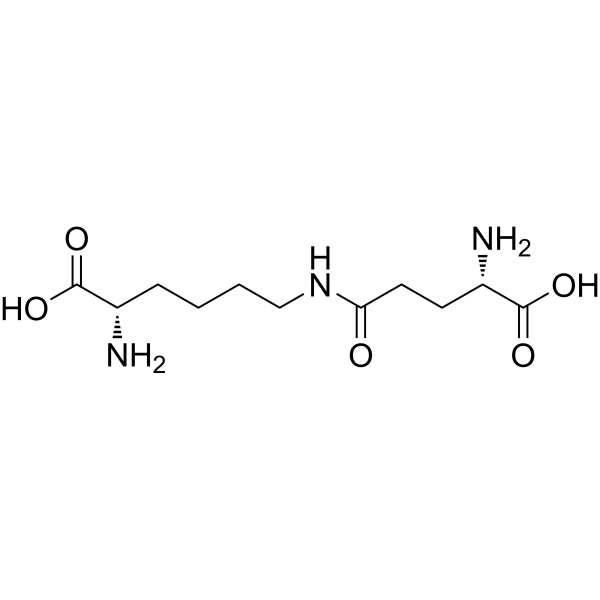
Epsilon-(gamma-glutamyl)-lysine

Based on 1 Customer Validation
Epsilon-(gamma-glutamyl)-lysine (H-Glu (H-Lys-OH)-OH) is an isodipeptide formed during the proteolytic degradation of proteins containing Nε-(γ-glutamyl)-lysine cross-links. Epsilon-(gamma-glutamyl)-lysine serves as a substrate for γ-glutamylamine cyclotransferase, which specifically cleaves it. Epsilon-(gamma-glutamyl)-lysine is applicable to studies related to transglutaminase-mediated protein cross-linking and turnover, γ-glutamylamine cyclotransferase activity, glaucoma, and tissue scar formation.
For research use only. We do not sell to patients.
- Purity : 99.90%
- CAS No.: 17105-15-6
- Formula: C11H21N3O5
- Molecular Weight:275.30
-
Storage:
Sealed storage, away from moisture.
Powder -80°C, 2 years , -20°C, 1 year* In solvent : -80°C, 6 months; -20°C, 1 month (sealed storage, away from moisture)

To place orders, for customer services and technical support, please contact: MedChemExpress USA
Tel: 609-228-6898 E-mail: [email protected] [email protected]


-
 Biological Activity
-
Chemical Information
-
Solvent & Solubility
- Purity & Documentation
- References
-
 Help & FAQs


All Endogenous Metabolite Isoforms
More

Biological Activity
Description
IC50 & Target
[1]|
γ-glutamylamine cyclotransferase |
In Vitro
Epsilon-(gamma-glutamyl)-lysine (H-Glu (H-Lys-OH)-OH) is specifically cleaved in the presence of γ-glutamyl cyclotransferase (25 μg/mL) at 37°C for 3 h. The radiolabeled heterodipeptide peak almost completely disappears, while a lysine peak appears, indicating that Epsilon-(gamma-glutamyl)-lysine is a substrate of this enzyme[1].
When exogenously radiolabeled ε-(γ-glutamyl)-lysine is added to pre-fusion CHO cells (24 h), it can be fully recovered in the unmodified form of Nε-(γ-glutamyl)-lysine, indicating that this heterodipeptide is not taken up by CHO cells nor modified in the culture medium[1].
The content of ε-(γ-glutamyl)-lysine in the free protein fraction reaches 188-238 pmol/107 cells, and that in the culture medium reaches 35-48 pmol/mL when CHO cells are cultured for 48 h. Its content increases with the rise of cell density, peaking at 460 pmol/107 cells in the free protein fraction and 61 pmol/mL in the culture medium respectively when cells are confluent[1].
The formation of ε-(gamma-glutamyl)-lysine in CHO cells and culture medium is inhibited by intracellular protein degradation inhibitors; Methylamine (20 mM) almost completely prevents its occurrence, Leupeptin (HY-18234) (0.2 mM) also exerts a significant inhibitory effect, while Chymostatin (HY-P3042) (0.2 mM) shows a weaker effect. Meanwhile, protein-bound Nε-(γ-glutamyl)-lysine increases, which supports that the free heterodipeptide originates from proteolytic degradation of cross-linked proteins[1].
Epsilon-(gamma-glutamyl)-lysine exists as protein cross-links in renal tissues of human diabetic nephropathy (DN). Its immunofluorescence intensity increases from 3.02 mV/μm2 in normal renal tissues to 14.68 mV/μm2 in DN renal tissues. It mainly distributes in the extracellular regions around glomeruli and renal tubules, and correlates with the degree of renal scarring and the estimated glomerular filtration rate[2].
Epsilon-(gamma-glutamyl)-lysine exists in the form of protein cross-links in all examined scar tissues of failed filtering blebs after glaucoma filtering surgery. Its staining is most prominent at the edge of the Tenon's capsule and shows almost complete colocalization with fibronectin, suggesting that it can reflect tissue transglutaminase-mediated extracellular matrix cross-linking[3].
Epsilon-(gamma-glutamyl)-lysine cross-links show weak staining in the untreated incision area of the ex vivo trabeculectomy model using human donor eyes[3].
MedChemExpress (MCE) has not independently confirmed the accuracy of these methods. They are for reference only. .


Chemical Information
-
CAS No. 17105-15-6
-
Appearance Solid
-
Molecular Weight 275.30
-
Formula C11H21N3O5
-
Color White to off-white
-
SMILES
OC([C@@H](N)CCC(NCCCC[C@H](N)C(O)=O)=O)=O
-
Synonyms
H-Glu(H-Lys-OH)-OH; γ-Glu-ε-Lys
-
Structure Classification
-
Initial Source
-
Shipping
Room temperature in continental US; may vary elsewhere.
-
Storage
Sealed storage, away from moisture
Powder -80°C 2 years -20°C 1 year * In solvent : -80°C, 6 months; -20°C, 1 month (sealed storage, away from moisture)


Solvent & Solubility
In Vitro:
DMSO : 50 mg/mL (181.62 mM; Need ultrasonic; Hygroscopic DMSO has a significant impact on the solubility of product, please use newly opened DMSO)
Please refer to the solubility information to select the appropriate solvent. Once prepared, please aliquot and store the solution to prevent product inactivation from repeated freeze-thaw cycles.
Storage method and period of stock solution: -80°C, 6 months; -20°C, 1 month (sealed storage, away from moisture). When stored at -80°C, please use it within 6 months. When stored at -20°C, please use it within 1 month.
Please refer to the solubility information to select the appropriate solvent. Once prepared, please aliquot and store the solution to prevent product inactivation from repeated freeze-thaw cycles.
Storage method and period of stock solution: -80°C, 6 months; -20°C, 1 month (sealed storage, away from moisture). When stored at -80°C, please use it within 6 months. When stored at -20°C, please use it within 1 month.
Concentration (start) × Volume (start) = Concentration (final) × Volume (final)


Purity & Documentation
-
Data Sheet (277 KB)
-
SDS (254 KB)
- English - EN (254 KB)
- Français - FR (254 KB)
- Deutsch - DE (254 KB)
- Norwegian - NO (254 KB)
- Español - ES (254 KB)
- Swedish - SV (254 KB)
- Italian - IT (254 KB)
- Korean - KR (254 KB)
- Portuguese - PT (254 KB)
-
Handling Instructions (2659 KB)
References
[2]. El Nahas AM, et al. Elevated ε-(γ-Glutamyl)lysine in Human Diabetic Nephropathy Results from Increased Expression and Cellular Release of Tissue Transglutaminase. Nephron Clin Pract. 2004;97:c108-c117. [Content Brief]
[3]. Priglinger SG, et al. Potential role of tissue transglutaminase in glaucoma filtering surgery. Investigative ophthalmology & visual science. 2006 Sep;47(9):3835-45. [Content Brief]


Complete Stock Solution Preparation Table
Please refer to the solubility information to select the appropriate solvent. Once prepared, please aliquot and store the solution to prevent product inactivation from repeated freeze-thaw cycles.
Storage method and period of stock solution: -80°C, 6 months; -20°C, 1 month (sealed storage, away from moisture). When stored at -80°C, please use it within 6 months. When stored at -20°C, please use it within 1 month.
| Optional Solvent | Concentration Solvent Mass | 1 mg | 5 mg | 10 mg | 25 mg |
|---|---|---|---|---|---|
| DMSO | 1 mM | 3.6324 mL | 18.1620 mL | 36.3240 mL | 90.8100 mL |
| 5 mM | 0.7265 mL | 3.6324 mL | 7.2648 mL | 18.1620 mL | |
| 10 mM | 0.3632 mL | 1.8162 mL | 3.6324 mL | 9.0810 mL | |
| 15 mM | 0.2422 mL | 1.2108 mL | 2.4216 mL | 6.0540 mL | |
| 20 mM | 0.1816 mL | 0.9081 mL | 1.8162 mL | 4.5405 mL | |
| 25 mM | 0.1453 mL | 0.7265 mL | 1.4530 mL | 3.6324 mL | |
| 30 mM | 0.1211 mL | 0.6054 mL | 1.2108 mL | 3.0270 mL | |
| 40 mM | 0.0908 mL | 0.4541 mL | 0.9081 mL | 2.2703 mL | |
| 50 mM | 0.0726 mL | 0.3632 mL | 0.7265 mL | 1.8162 mL | |
| 60 mM | 0.0605 mL | 0.3027 mL | 0.6054 mL | 1.5135 mL | |
| 80 mM | 0.0454 mL | 0.2270 mL | 0.4541 mL | 1.1351 mL | |
| 100 mM | 0.0363 mL | 0.1816 mL | 0.3632 mL | 0.9081 mL |


Epsilon-(gamma-glutamyl)-lysine Related Classifications
HY-113089 Related Classifications
 Powered by Bioz
Keywords