



ERα degrader-2

Based on 1 Customer Validation
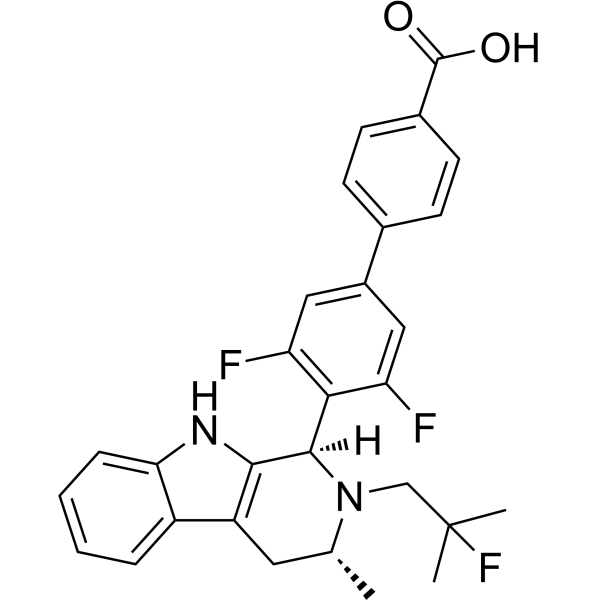
ERα degrader-2 is a selective estrogen receptor degrader (SERD) with potent binding affinity with ERα (IC50=17.1 nM), good degradation efficacy (EC50=0.3 nM). ERα degrader-2 exhibits favorable pharmacokinetic properties and excellent agentgability, can be used for HER+ breast cancer research.
Nos produits utilisent uniquement pour la recherche. Nous ne vendons pas aux patients.
- Pureté : 98.30%
- CAS No.: 2235396-63-9
- Formule: C29H27F3N2O2
- Masse moléculaire:492.53
-
Stockage:
4°C, sealed storage, away from moisture and light
* In solvent : -80°C, 6 months; -20°C, 1 month (sealed storage, away from moisture and light)

To place orders, for customer services and technical support, please contact: MedChemExpress USA
Tel: 609-228-6898 E-mail: [email protected] [email protected]


-
 Activité biologique
-
Chemical Information
-
Solvant et solubilité
- Protocole
- Pureté et documentation
- Références
-
 Help & FAQs




Activité biologique
Description
IC50 & Target
[1]|
ERα 4.6 nM (IC50) |
Cellular Effect
|
Cell Line

|
Type | Value | Description | References |
|---|---|---|---|---|
| ES-2 | IC50 |
17.1 nM
Compound: D24
|
Displacement of Fluormone ES2 from full length human ERalpha incubated for 60 min by fluorescent polarization assay
Displacement of Fluormone ES2 from full length human ERalpha incubated for 60 min by fluorescent polarization assay
|
[PMID: 34056898] |
| MCF7 | IC50 |
0.27 nM
Compound: D24
|
Antiproliferative activity against human MCF7 cells assessed as inhibition of cell proliferation incubated for 5 days by Cell Titer Glo assay
Antiproliferative activity against human MCF7 cells assessed as inhibition of cell proliferation incubated for 5 days by Cell Titer Glo assay
|
[PMID: 34056898] |
In Vitro
ERα degrader-2 (0.01-40 nM) decreases ERα expression and not fully degrades ERα in MCF-7 cells even at a higher biochemical concentration in MCF7 cells[1].
MedChemExpress (MCE) has not independently confirmed the accuracy of these methods. They are for reference only. Further protocols information, click here.
In Vivo
MedChemExpress (MCE) has not independently confirmed the accuracy of these methods. They are for reference only.
-
Animal Model:MCF-7 human breast cancer xenograft model in nude mice[1]
-
Dosage:2 mg/kg; 6 mg/kg
-
Administration:Oral administration; 2-6 mg/kg; QD; 21 days
-
Result:Exhibited in vivo efficacy in breast cancer xenograft model.


Chemical Information
-
CAS No. 2235396-63-9
-
Appearance Solid
-
Masse moléculaire 492.53
-
Formule C29H27F3N2O2
-
Color Brown to reddish brown
-
SMILES
CC(C)(F)CN1[C@@](C2=C(C=C(C3=CC=C(C=C3)C(O)=O)C=C2F)F)([H])C4=C(C[C@H]1C)C5=CC=CC=C5N4
-
Livraison
Room temperature in continental US; may vary elsewhere.
-
Stockage
4°C, sealed storage, away from moisture and light
* In solvent : -80°C, 6 months; -20°C, 1 month (sealed storage, away from moisture and light)


Solvant et solubilité
In Vitro:
DMSO : < 1 mg/mL (insoluble or slightly soluble)

Protocole
-
Research Protocol for Endocrine Diseases
Endocrine diseases often arise from disrupted hormone production, hormone signaling, or target-tissue responsiveness; for diabetes-focused endocrine disease models, insulin signaling regulates glucose uptake, hepatic glucose output, lipid metabolism, and β-cell compensation. Type 2 diabetes develops through interacting defects in insulin resistance, β-cell dysfunction, adipose inflammation, hepatic glucose overproduction, altered incretin signaling, and ectopic lipid metabolism. A major unresolved question is whether endocrine dysfunction is driven primarily by target-tissue insulin resistance, intrinsic β-cell failure, immune/inflammatory stress, or combined multi-organ failure that differs by disease stage.
-
Breast Cancer Modeling
Breast cancer is a heterogeneous cancer, and it has been distinguished into four subtypes: luminal A, luminal B, HER2-positive and basal-like. Molecular mutations, epigenetic alterations, hormone exposure and immune microenvironment are related to the progression of breast cancer.


Pureté et documentation
-
Fiche technique (278 KB)
-
SDS (252 KB)
- English - EN (252 KB)
- Français - FR (252 KB)
- Deutsch - DE (252 KB)
- Norwegian - NO (252 KB)
- Español - ES (252 KB)
- Swedish - SV (252 KB)
- Italian - IT (252 KB)
- Korean - KR (252 KB)
- Portuguese - PT (252 KB)
-
Instruction de manipulation (2659 KB)
Références

Calculators
Concentration (start) × Volume (start) = Concentration (final) × Volume (final)


ERα degrader-2 Related Classifications
HY-132194 Related Classifications
 Powered by Bioz