



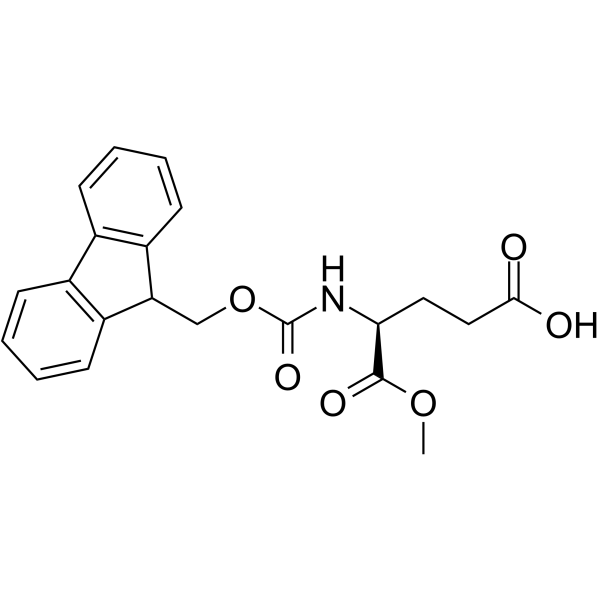
Fmoc-Glu-OMe

Based on 1 Customer Validation
Fmoc-Glu-OMe is a glutamic acid derivative. Fmoc-Glu-OMe exhibits significant antibacterial activity and excellent gelation properties in silver nitrate (AgNO3) solution. Fmoc-Glu-OMe promotes wound healing in rat models and eliminates bacteria in MRSA-infected rat wound models. Fmoc-Glu-OMe can be used in studies related to wound infections and MRSA-infected wounds.
For research use only. We do not sell to patients.
- Purity : 99.74%
- CAS No.: 145038-49-9
- Formula: C21H21NO6
- Molecular Weight:383.40
-
Storage:Powder -20°C, 3 years , 4°C, 2 years ; In solvent -80°C, 6 months , -20°C, 1 month

To place orders, for customer services and technical support, please contact: MedChemExpress USA
Tel: 609-228-6898 E-mail: [email protected] [email protected]


-
 Biological Activity
-
Chemical Information
-
Solvent & Solubility
- Purity & Documentation
- References
-
 Help & FAQs




Biological Activity
Description
IC50 & Target
Bacteria[1]
In Vitro
Fmoc-Glu-OMe hydrogel exhibits measurable antibacterial activity against E. coli[1].
Fmoc-Glu-OMe hydrogel (FHAg-15) (FHAg-15 hydrogel at pH 6.0; 16 h) exhibits potent broad-spectrum antibacterial activity against E. coli, S. aureus, P. aeruginosa, and methicillin-resistant S. aureus (MRSA) in vitro, as determined by the disk diffusion assay[2].
Fmoc-Glu-OMe hydrogel (FHAg-15) (FHAg-15 hydrogel; 24 h) potently inhibits biofilm formation of Staphylococcus aureus (to 7.6% of the control level) and Escherichia coli (to 29.8% of the control level) in vitro[2].
Fmoc-Glu-OMe hydrogel (FHAg-15) (pH 4.0-7.4; 24 h; 48 h) significantly promotes NIH-3 T3 cell migration and in vitro wound healing under pH 6.0 and 7.4 conditions[2].
MedChemExpress (MCE) has not independently confirmed the accuracy of these methods. They are for reference only.
In Vivo
MedChemExpress (MCE) has not independently confirmed the accuracy of these methods. They are for reference only.
-
Animal Model:Sprague Dawley (male, 180-220 g, MRSA-infected full-thickness wound model)[2]
-
Dosage:500 μL FHAg-10 hydrogel (formulated with Fmoc-Glu-OMe, HEC, 10 mM AgNO3); 500 μL FHAg-15 hydrogel (formulated with Fmoc-Glu-OMe, HEC, 15 mM AgNO3)
-
Administration:topical
-
Result:Achieved a wound healing rate of 54.75% on day 6 and 93.01% on day 12 (FHAg-10 hydrogel).
Achieved a wound healing rate of 67.1% on day 6 and 97.07% on day 12, with visible scabbing (FHAg-15 hydrogel).
Achieved a 99.9% bacterial eradication rate against MRSA by day 6 (FHAg-15 hydrogel).
Showed only scattered inflammatory cells by day 6, and complete healing with skin tissue regeneration and no inflammatory cells by day 12 via histological analysis (FHAg-15 hydrogel).


Chemical Information
-
CAS No. 145038-49-9
-
Appearance Solid
-
Molecular Weight 383.40
-
Formula C21H21NO6
-
Color White to off-white
-
Shipping
Room temperature in continental US; may vary elsewhere.
-
Storage
Powder -20°C 3 years 4°C 2 years In solvent -80°C 6 months -20°C 1 month


Solvent & Solubility
In Vitro:
DMSO : 100 mg/mL (260.82 mM; Need ultrasonic; Hygroscopic DMSO has a significant impact on the solubility of product, please use newly opened DMSO)
Please refer to the solubility information to select the appropriate solvent. Once prepared, please aliquot and store the solution to prevent product inactivation from repeated freeze-thaw cycles.
Storage method and period of stock solution: -80°C, 6 months; -20°C, 1 month. When stored at -80°C, please use it within 6 months. When stored at -20°C, please use it within 1 month.
Please refer to the solubility information to select the appropriate solvent. Once prepared, please aliquot and store the solution to prevent product inactivation from repeated freeze-thaw cycles.
Storage method and period of stock solution: -80°C, 6 months; -20°C, 1 month. When stored at -80°C, please use it within 6 months. When stored at -20°C, please use it within 1 month.
Concentration (start) × Volume (start) = Concentration (final) × Volume (final)


Purity & Documentation
-
Data Sheet (275 KB)
-
SDS (396 KB)
- English - EN (396 KB)
- Français - FR (396 KB)
- Deutsch - DE (396 KB)
- Norwegian - NO (396 KB)
- Español - ES (396 KB)
- Swedish - SV (396 KB)
- Italian - IT (396 KB)
- Korean - KR (396 KB)
- Portuguese - PT (396 KB)
-
Handling Instructions (2659 KB)
References
[1]. Zhang Z, et al. The in situ synthesis of Ag/amino acid biopolymer hydrogels as mouldable wound dressings. Chem Commun (Camb). 2015;51(87):15862-15865. [Content Brief]
[2]. Song Y, et al. Hydroxyethyl cellulose-guided self-assembled pH-independent antibacterial hydrogel for MRSA-infected wound therapy. Int J Biol Macromol. 2026;349:150978. [Content Brief]


Complete Stock Solution Preparation Table
Please refer to the solubility information to select the appropriate solvent. Once prepared, please aliquot and store the solution to prevent product inactivation from repeated freeze-thaw cycles.
Storage method and period of stock solution: -80°C, 6 months; -20°C, 1 month. When stored at -80°C, please use it within 6 months. When stored at -20°C, please use it within 1 month.
| Optional Solvent | Concentration Solvent Mass | 1 mg | 5 mg | 10 mg | 25 mg |
|---|---|---|---|---|---|
| DMSO | 1 mM | 2.6082 mL | 13.0412 mL | 26.0824 mL | 65.2061 mL |
| 5 mM | 0.5216 mL | 2.6082 mL | 5.2165 mL | 13.0412 mL | |
| 10 mM | 0.2608 mL | 1.3041 mL | 2.6082 mL | 6.5206 mL | |
| 15 mM | 0.1739 mL | 0.8694 mL | 1.7388 mL | 4.3471 mL | |
| 20 mM | 0.1304 mL | 0.6521 mL | 1.3041 mL | 3.2603 mL | |
| 25 mM | 0.1043 mL | 0.5216 mL | 1.0433 mL | 2.6082 mL | |
| 30 mM | 0.0869 mL | 0.4347 mL | 0.8694 mL | 2.1735 mL | |
| 40 mM | 0.0652 mL | 0.3260 mL | 0.6521 mL | 1.6302 mL | |
| 50 mM | 0.0522 mL | 0.2608 mL | 0.5216 mL | 1.3041 mL | |
| 60 mM | 0.0435 mL | 0.2174 mL | 0.4347 mL | 1.0868 mL | |
| 80 mM | 0.0326 mL | 0.1630 mL | 0.3260 mL | 0.8151 mL | |
| 100 mM | 0.0261 mL | 0.1304 mL | 0.2608 mL | 0.6521 mL |


Fmoc-Glu-OMe Related Classifications
HY-W041988 Related Classifications
 Powered by Bioz