



FTO-IN-8

Based on 1 Customer Validation
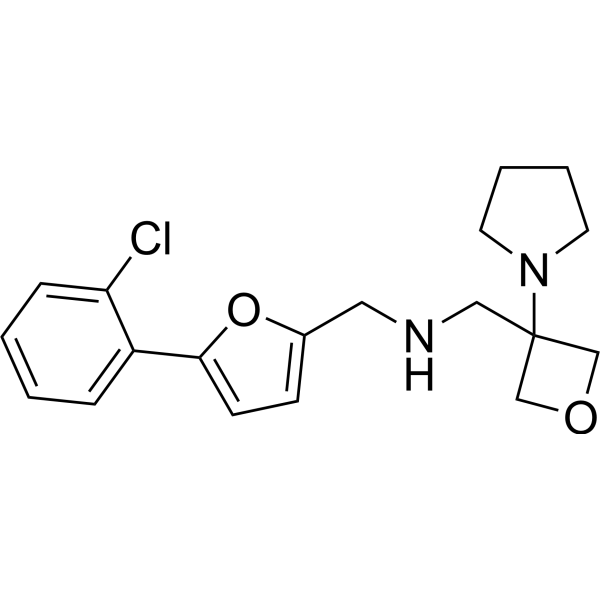
FTO-IN-8 (FTO-43) is a N6-methyladenosine demethylase (FTO) (fat mass- and obesity-associated protein) inhibitor with the IC50 value of 5.5 μM. FTO-IN-8 has anti-cancer cell proliferative activity.
For research use only. We do not sell to patients.
- Purity : 95.04%
- CAS No.: 2640366-38-5
- Formula: C19H23ClN2O2
- Molecular Weight:346.85
-
Storage:Pure form -20°C, 3 years , 4°C, 2 years ; In solvent -80°C, 6 months , -20°C, 1 month

To place orders, for customer services and technical support, please contact: MedChemExpress USA
Tel: 609-228-6898 E-mail: [email protected] [email protected]


-
 Biological Activity
-
Chemical Information
-
Solvent & Solubility
- Protocols
- Purity & Documentation
- References
-
 Help & FAQs




Biological Activity
Description
Cellular Effect
|
Cell Line

|
Type | Value | Description | References |
|---|---|---|---|---|
| AGS | EC50 |
20.3 μM
Compound: FTO-43 N; TR-FTO-43 N
|
Cytotoxicity against human AGS cells assessed as inhibition of proliferation measured after 24 to 72 hrs by CCK-8 assay
Cytotoxicity against human AGS cells assessed as inhibition of proliferation measured after 24 to 72 hrs by CCK-8 assay
|
[PMID: 35939803] |
| CCD-841CoN | EC50 |
>50 μM
Compound: FTO-43 N; TR-FTO-43 N
|
Cytotoxicity against human CCD-841CoN cells assessed as inhibition of proliferation measured after 24 to 72 hrs by CCK-8 assay
Cytotoxicity against human CCD-841CoN cells assessed as inhibition of proliferation measured after 24 to 72 hrs by CCK-8 assay
|
[PMID: 35939803] |
| KATO III stomach cancer cell line | EC50 |
35.9 μM
Compound: FTO-43 N; TR-FTO-43 N
|
Cytotoxicity against human KATO III stomach cancer cell line assessed as inhibition of proliferation measured after 24 to 72 hrs by CCK-8 assay
Cytotoxicity against human KATO III stomach cancer cell line assessed as inhibition of proliferation measured after 24 to 72 hrs by CCK-8 assay
|
[PMID: 35939803] |
| SNU-16 | EC50 |
17.7 μM
Compound: FTO-43 N; TR-FTO-43 N
|
Cytotoxicity against human SNU-16 cells assessed as inhibition of proliferation measured after 24 to 72 hrs by CCK-8 assay
Cytotoxicity against human SNU-16 cells assessed as inhibition of proliferation measured after 24 to 72 hrs by CCK-8 assay
|
[PMID: 35939803] |
In Vitro
FTO-IN-8 (FTO-43) (0-50 μM, 24-72 h) inhibits the proliferation of cancer cells with no cytotoxicity to normal colonic cells[1].
FTO-IN-8 (FTO-43) can increase m6A and m6Am levels and inhibits Wnt/PI3K-Akt signaling in gastric cancer AGS cells[1].
MedChemExpress (MCE) has not independently confirmed the accuracy of these methods. They are for reference only.
-
Cell Line:AGS, SNU16, and KATOIII cell lines
-
Concentration:0-50 μM
-
Incubation Time:24, 48, 72 hours
-
Result:Inhibited the growth of SNU16, KATOIII and AGS with the EC50 values of 17.7 μM, 35.9 μM and 20.3 μM, respectively.


Chemical Information
-
CAS No. 2640366-38-5
-
Appearance Oil
-
Molecular Weight 346.85
-
Formula C19H23ClN2O2
-
Color Light yellow to yellow
-
SMILES
ClC1=CC=CC=C1C2=CC=C(CNCC3(N4CCCC4)COC3)O2
-
Shipping
Room temperature in continental US; may vary elsewhere.
-
Storage
Pure form -20°C 3 years 4°C 2 years In solvent -80°C 6 months -20°C 1 month


Solvent & Solubility
In Vitro:
DMSO : ≥ 100 mg/mL (288.31 mM; Hygroscopic DMSO has a significant impact on the solubility of product, please use newly opened DMSO)
* "≥" means soluble, but saturation unknown.
Please refer to the solubility information to select the appropriate solvent. Once prepared, please aliquot and store the solution to prevent product inactivation from repeated freeze-thaw cycles.
Storage method and period of stock solution: -80°C, 6 months; -20°C, 1 month. When stored at -80°C, please use it within 6 months. When stored at -20°C, please use it within 1 month.
Please refer to the solubility information to select the appropriate solvent. Once prepared, please aliquot and store the solution to prevent product inactivation from repeated freeze-thaw cycles.
Storage method and period of stock solution: -80°C, 6 months; -20°C, 1 month. When stored at -80°C, please use it within 6 months. When stored at -20°C, please use it within 1 month.
Concentration (start) × Volume (start) = Concentration (final) × Volume (final)


Purity & Documentation
-
Data Sheet (274 KB)
-
SDS (251 KB)
- English - EN (251 KB)
- Français - FR (251 KB)
- Deutsch - DE (251 KB)
- Norwegian - NO (251 KB)
- Español - ES (251 KB)
- Swedish - SV (251 KB)
- Italian - IT (251 KB)
- Korean - KR (251 KB)
- Portuguese - PT (251 KB)
-
Handling Instructions (2659 KB)
References


Complete Stock Solution Preparation Table
Please refer to the solubility information to select the appropriate solvent. Once prepared, please aliquot and store the solution to prevent product inactivation from repeated freeze-thaw cycles.
Storage method and period of stock solution: -80°C, 6 months; -20°C, 1 month. When stored at -80°C, please use it within 6 months. When stored at -20°C, please use it within 1 month.
| Optional Solvent | Concentration Solvent Mass | 1 mg | 5 mg | 10 mg | 25 mg |
|---|---|---|---|---|---|
| DMSO | 1 mM | 2.8831 mL | 14.4155 mL | 28.8309 mL | 72.0773 mL |
| 5 mM | 0.5766 mL | 2.8831 mL | 5.7662 mL | 14.4155 mL | |
| 10 mM | 0.2883 mL | 1.4415 mL | 2.8831 mL | 7.2077 mL | |
| 15 mM | 0.1922 mL | 0.9610 mL | 1.9221 mL | 4.8052 mL | |
| 20 mM | 0.1442 mL | 0.7208 mL | 1.4415 mL | 3.6039 mL | |
| 25 mM | 0.1153 mL | 0.5766 mL | 1.1532 mL | 2.8831 mL | |
| 30 mM | 0.0961 mL | 0.4805 mL | 0.9610 mL | 2.4026 mL | |
| 40 mM | 0.0721 mL | 0.3604 mL | 0.7208 mL | 1.8019 mL | |
| 50 mM | 0.0577 mL | 0.2883 mL | 0.5766 mL | 1.4415 mL | |
| 60 mM | 0.0481 mL | 0.2403 mL | 0.4805 mL | 1.2013 mL | |
| 80 mM | 0.0360 mL | 0.1802 mL | 0.3604 mL | 0.9010 mL | |
| 100 mM | 0.0288 mL | 0.1442 mL | 0.2883 mL | 0.7208 mL |


FTO-IN-8 Related Classifications
HY-151106 Related Classifications
 Powered by Bioz