



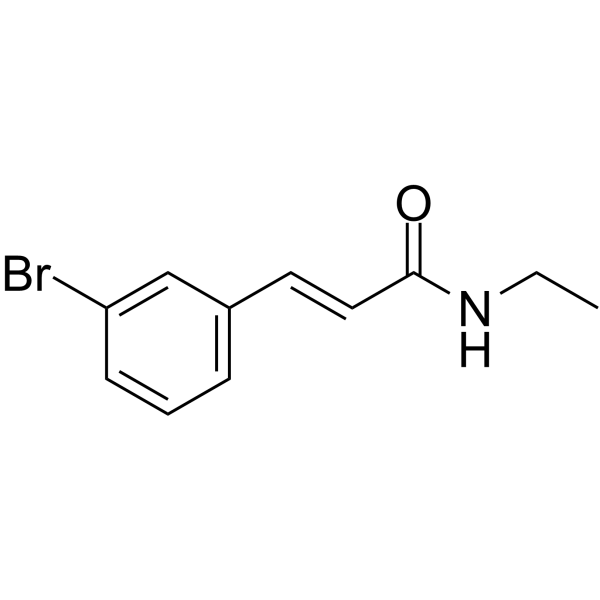
Cinromide
Based on 2 publication(s) in Google Scholar
Cinromide is an anticonvulsant agent. Cinromide inhibits epithelial neutral amino acid transporter B0AT1 (SLC6A19) with an IC50 of 0.5 μM.
Para uso exclusivo en investigación. No vendemos a pacientes.
- Pureza : 99.83%
- No. CAS: 58473-74-8
- Fòrmula: C11H12BrNO
- Peso molecular:254.12
-
Almacenamiento:Powder -20°C, 3 years , 4°C, 2 years ; In solvent -80°C, 2 years , -20°C, 1 year

To place orders, for customer services and technical support, please contact: MedChemExpress USA
Tel: 609-228-6898 E-mail: [email protected] [email protected]


-
 Actividad biológica
-
Chemical Information
-
Solvente y solubilidad
- Pureza y Documentación
- Referencias
-
 Help & FAQs



Publications Citing Use of MedChemExpress (MCE) Cinromide
More

Actividad biológica
Descripciòn
In Vitro
Cinromide (10-100 μM) inhibits 5-HT-induced contractions in rat fundus strips by 46%. Cinromide (100 μM) inhibits monoamine oxidase prepared from both liver and brain of rats[3].
MedChemExpress (MCE) has not independently confirmed the accuracy of these methods. They are for reference only. .
In Vivo
MedChemExpress (MCE) has not independently confirmed the accuracy of these methods. They are for reference only.


Chemical Information
-
No. CAS 58473-74-8
-
Appearance Solid
-
Peso molecular 254.12
-
Fòrmula C11H12BrNO
-
Color White to off-white
-
SMILES
O=C(NCC)/C=C/C1=CC=CC(Br)=C1
-
Synonyms
trans-3-Bromo-N-ethylcinnamamide
-
Envío
Room temperature in continental US; may vary elsewhere.
-
Almacenamiento
Powder -20°C 3 years 4°C 2 years In solvent -80°C 2 years -20°C 1 year


Publications (2)
-
Journal Impact Factor
-
Most Recent
-
Anal Chem
Exposome-Scale Investigation of Cl-/Br-Containing Chemicals Using High-Resolution Mass Spectrometry, Multistage Machine Learning, and Cloud Computing. [Abstract]2025 Jun 3;97(21):11099-11109. PMID: 40401576 -
Front Pharmacol
Ca2+-Permeable Channels/Ca2+ Signaling in the Regulation of Ileal Na+/Gln Co-Transport in Mice. [Abstract]2022 Feb 23;13:816133. PMID: 35281933


Solvente y solubilidad
In Vitro:
DMSO : 250 mg/mL (983.79 mM; Need ultrasonic; Hygroscopic DMSO has a significant impact on the solubility of product, please use newly opened DMSO)
Please refer to the solubility information to select the appropriate solvent. Once prepared, please aliquot and store the solution to prevent product inactivation from repeated freeze-thaw cycles.
Storage method and period of stock solution: -80°C, 2 years; -20°C, 1 year. When stored at -80°C, please use it within 2 years. When stored at -20°C, please use it within 1 year.
Please refer to the solubility information to select the appropriate solvent. Once prepared, please aliquot and store the solution to prevent product inactivation from repeated freeze-thaw cycles.
Storage method and period of stock solution: -80°C, 2 years; -20°C, 1 year. When stored at -80°C, please use it within 2 years. When stored at -20°C, please use it within 1 year.
Concentration (start) × Volume (start) = Concentration (final) × Volume (final)
In Vivo:
Select the appropriate dissolution method based on your experimental animal and administration route.
- For the following dissolution methods, please ensure to first prepare a clear stock solution using an In Vitro approach and then sequentially add co-solvents:
- To ensure reliable experimental results, the clarified stock solution can be appropriately stored based on storage conditions. As for the working solution for In Vivo experiments, it is recommended to prepare freshly and use it on the same day.
- The percentages shown for the solvents indicate their volumetric ratio in the final prepared solution. If precipitation or phase separation occurs during preparation, heat and/or sonication can be used to aid dissolution.
Add each solvent one by one: 10% DMSO 40% PEG300 5% Tween-80 45% Saline
Solubility: ≥ 2.08 mg/mL (8.19 mM); Clear solution
This protocol yields a clear solution of ≥ 2.08 mg/mL (saturation unknown).
Taking 1 mL working solution as an example, add 100 μL DMSO stock solution (20.8 mg/mL) to 400 μL PEG300, and mix evenly; then add 50 μL Tween-80 and mix evenly; then add 450 μL Saline to adjust the volume to 1 mL.
Preparation of Saline: Dissolve 0.9 g sodium chloride in ddH₂O and dilute to 100 mL to obtain a clear Saline solution.
Add each solvent one by one: 10% DMSO 90% (20% SBE-β-CD in Saline)
Solubility: ≥ 2.08 mg/mL (8.19 mM); Clear solution
This protocol yields a clear solution of ≥ 2.08 mg/mL (saturation unknown).
Taking 1 mL working solution as an example, add 100 μL DMSO stock solution (20.8 mg/mL) to 900 μL 20% SBE-β-CD in Saline, and mix evenly.
Preparation of 20% SBE-β-CD in Saline (4°C, storage for one week): 2 g SBE-β-CD powder is dissolved in 10 mL Saline, completely dissolve until clear.
In Vivo Dissolution Calculator
Please enter the basic information of animal experiments:
-
-
-
-
Recommended: Prepare an additional quantity of animals to account for potential losses during experiments.
Please enter your animal formula composition:
-
%DMSO +
Recommended: Keep the proportion of DMSO in working solution below 2% if your animal is weak.
-
%+
-
+%Tween-80 + +
-
%Saline +
The co-solvents required include: DMSO, . All of co-solvents are available by MedChemExpress (MCE). , Tween 80. All of co-solvents are available by MedChemExpress (MCE).
Working solution concentration: 0.22 mg/mL
Method for preparing stock solution: mg drug dissolved in μL DMSO. Stock solution concentration: mg/mL.
1. Take μL DMSO stock solution;
2. Add μL .
μL , mix evenly;
3. Then add μL Tween 80, mix evenly;
4. Then add μL
Please ensure that the stock solution in the first step is dissolved to a clear state, and add co-solvents in sequence. You can use ultrasonic heating (ultrasonic cleaner, recommended frequency 20-40 kHz), vortexing, etc. to assist dissolution.


Pureza y Documentación
-
Ficha de datos (273 KB)
-
SDS (393 KB)
- English - EN (393 KB)
- Français - FR (393 KB)
- Deutsch - DE (393 KB)
- Norwegian - NO (393 KB)
- Español - ES (393 KB)
- Swedish - SV (393 KB)
- Italian - IT (393 KB)
- Korean - KR (393 KB)
- Portuguese - PT (393 KB)
-
Instrucciones de manejo (2659 KB)
Referencias
[1]. Chiu P, et al. The effect of cinromide on "kindled" seizures in the rat. Neuropharmacology. 1982;21(3):273-276. [Content Brief]
[2]. Yadav A, et al. Novel Chemical Scaffolds to Inhibit the Neutral Amino Acid Transporter B0AT1 (SLC6A19), a Potential Target to Treat Metabolic Diseases. Front Pharmacol. 2020;11:140. Published 2020 Feb 28. [Content Brief]
[3]. Soroko FE, et al. Cinromide (3-bromo-N-ethylcinnanamide), novel anticonvulsant agent. J Pharm Pharmacol. 1981 Nov;33(11):741-3. [Content Brief]
[4]. Fromm GH, et al. Effect of cinromide on inhibitory and excitatory mechanisms. Epilepsia. 1983 Aug;24(4):394-400. [Content Brief]


Complete Stock Solution Preparation Table
Please refer to the solubility information to select the appropriate solvent. Once prepared, please aliquot and store the solution to prevent product inactivation from repeated freeze-thaw cycles.
Storage method and period of stock solution: -80°C, 2 years; -20°C, 1 year. When stored at -80°C, please use it within 2 years. When stored at -20°C, please use it within 1 year.
| Optional Solvent | Concentration Solvent Mass | 1 mg | 5 mg | 10 mg | 25 mg |
|---|---|---|---|---|---|
| DMSO | 1 mM | 3.9351 mL | 19.6757 mL | 39.3515 mL | 98.3787 mL |
| 5 mM | 0.7870 mL | 3.9351 mL | 7.8703 mL | 19.6757 mL | |
| 10 mM | 0.3935 mL | 1.9676 mL | 3.9351 mL | 9.8379 mL | |
| 15 mM | 0.2623 mL | 1.3117 mL | 2.6234 mL | 6.5586 mL | |
| 20 mM | 0.1968 mL | 0.9838 mL | 1.9676 mL | 4.9189 mL | |
| 25 mM | 0.1574 mL | 0.7870 mL | 1.5741 mL | 3.9351 mL | |
| 30 mM | 0.1312 mL | 0.6559 mL | 1.3117 mL | 3.2793 mL | |
| 40 mM | 0.0984 mL | 0.4919 mL | 0.9838 mL | 2.4595 mL | |
| 50 mM | 0.0787 mL | 0.3935 mL | 0.7870 mL | 1.9676 mL | |
| 60 mM | 0.0656 mL | 0.3279 mL | 0.6559 mL | 1.6396 mL | |
| 80 mM | 0.0492 mL | 0.2459 mL | 0.4919 mL | 1.2297 mL | |
| 100 mM | 0.0394 mL | 0.1968 mL | 0.3935 mL | 0.9838 mL |


Cinromide Related Classifications
HY-B1274 Related Classifications
 Powered by Bioz