



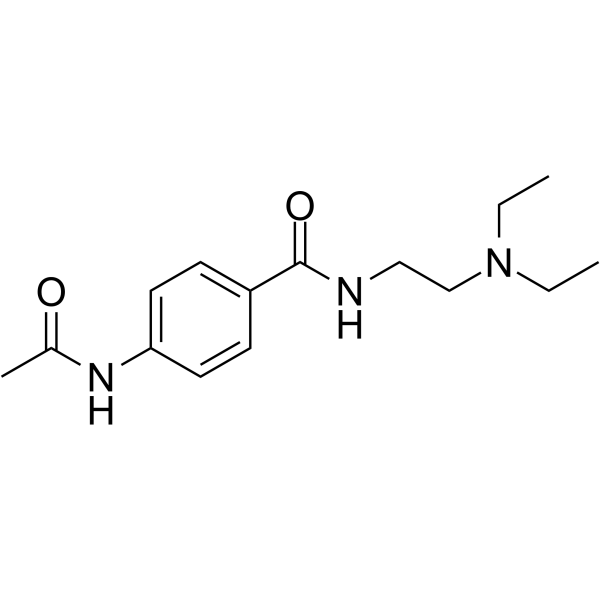
N-Acetylprocainamide
Based on 1 publication(s) in Google Scholar
N-Acetylprocainamide is a class III antiarrhythmic, which blocks K+ channels.
Para uso exclusivo en investigación. No vendemos a pacientes.
- Pureza: 99.89%
- No. CAS: 32795-44-1
- Fòrmula: C15H23N3O2
- Peso molecular:277.36
-
Almacenamiento:Powder -20°C, 3 years , 4°C, 2 years ; In solvent -80°C, 2 years , -20°C, 1 year

To place orders, for customer services and technical support, please contact: MedChemExpress USA
Tel: 609-228-6898 E-mail: [email protected] [email protected]


-
 Actividad biológica
-
Chemical Information
-
Solvente y solubilidad
- Pureza y Documentación
- Referencias
-
 Help & FAQs
-

Membrane Transporter/Ion Channel Compound Library
HY-L011
-
Metabolism/Protease Compound Library
HY-L012
-
FDA-Approved Drug Library
HY-L022
-
Drug Repurposing Compound Library
HY-L035
-
Anti-Cardiovascular Disease Compound Library
HY-L046
-
FDA Approved & Pharmacopeial Drug Library
HY-L066
-
Anti-Alzheimer's Disease Compound Library
HY-L069
-
Neurodegenerative Disease-related Compound Library
HY-L086
-
Drug Metabolite Library
HY-L098
-
Rare Diseases Drug Library
HY-L102
-
Potassium Channel Compound Library
HY-L119
-
Human Metabolite Library
HY-L123
-
Off-patent Drug Library
HY-L141
-
Membrane Protein-targeted Compound Library
HY-L149
-
Membrane Receptor-targeted Compound Library
HY-L150
-
Ion Channel Compound Library
HY-L166
-
Bioactive Compound Library Max
HY-L181
-
MCE Bioactive Compound Library
HY-L001V
-
Drug Repurposing Compound Library Plus
HY-L035P
-
FDA-Approved Drug Library Plus
HY-L022P
-
FDA-Approved Drug Library Mini
HY-L022M
-
Bioactive Compound Library
HY-L001
-
High-Throughput Bioactive Compound Library
HY-L205
-
Mass Spectrometry Human Metabolite Library
HY-L215


Publications Citing Use of MedChemExpress (MCE) N-Acetylprocainamide
More

Actividad biológica
K+ channel[1]
|
Cell Line

|
Type | Value | Description | References |
|---|---|---|---|---|
| MDCK | IC50 |
5 μM
Compound: N-acetyl procainamide
|
TP_TRANSPORTER: inhibition of TEA uptake (TEA: 50 uM) in OCT2-expressing MDCK cells
TP_TRANSPORTER: inhibition of TEA uptake (TEA: 50 uM) in OCT2-expressing MDCK cells
|
[PMID: 11758759] |
| MDCK | IC50 |
8.8 μM
Compound: N-acetyl procainamide
|
TP_TRANSPORTER: inhibition of TEA uptake (TEA: 50 uM) in OCT1-expressing MDCK cells
TP_TRANSPORTER: inhibition of TEA uptake (TEA: 50 uM) in OCT1-expressing MDCK cells
|
[PMID: 11758759] |
N-Acetylprocainamide is a K+ blocker. N-Acetylprocainamide decreases the tensions induced by K+ and methacholine. The pIC50 values for N-acetylprocainamide against the contractions induced by 0.3 and 1 μM methacholine are 2.80 ± 0.03 and 2.65 ± 0.02, respectively. And such a relaxant effect of N-Acetylprocainamide is inhibited by K+ channel blockers[1]. N-Acetylprocainamide shows no effect on Na+ absorption or Cl- secretion[2].
MedChemExpress (MCE) has not independently confirmed the accuracy of these methods. They are for reference only.


Chemical Information
-
No. CAS 32795-44-1
-
Appearance Solid
-
Peso molecular 277.36
-
Fòrmula C15H23N3O2
-
Color White to off-white
-
SMILES
O=C(NCCN(CC)CC)C1=CC=C(NC(C)=O)C=C1
-
Synonyms
Acecainide; NAPA
-
Envío
Room temperature in continental US; may vary elsewhere.
-
Almacenamiento
Powder -20°C 3 years 4°C 2 years In solvent -80°C 2 years -20°C 1 year


Publications (1)
-
Journal Impact Factor
-
Most Recent
-
ACS Omega
Computational Approaches to Identify Molecules Binding to Mycobacterium tuberculosis KasA. [Abstract]2020 Nov 15;5(46):29935-29942. PMID: 33251429


Solvente y solubilidad
DMSO : ≥ 100 mg/mL (360.54 mM; Hygroscopic DMSO has a significant impact on the solubility of product, please use newly opened DMSO)
* "≥" means soluble, but saturation unknown.
Please refer to the solubility information to select the appropriate solvent. Once prepared, please aliquot and store the solution to prevent product inactivation from repeated freeze-thaw cycles.
Storage method and period of stock solution: -80°C, 2 years; -20°C, 1 year. When stored at -80°C, please use it within 2 years. When stored at -20°C, please use it within 1 year.
Please refer to the solubility information to select the appropriate solvent. Once prepared, please aliquot and store the solution to prevent product inactivation from repeated freeze-thaw cycles.
Storage method and period of stock solution: -80°C, 2 years; -20°C, 1 year. When stored at -80°C, please use it within 2 years. When stored at -20°C, please use it within 1 year.
Concentration (start) × Volume (start) = Concentration (final) × Volume (final)
Select the appropriate dissolution method based on your experimental animal and administration route.
- For the following dissolution methods, please ensure to first prepare a clear stock solution using an In Vitro approach and then sequentially add co-solvents:
- To ensure reliable experimental results, the clarified stock solution can be appropriately stored based on storage conditions. As for the working solution for In Vivo experiments, it is recommended to prepare freshly and use it on the same day.
- The percentages shown for the solvents indicate their volumetric ratio in the final prepared solution. If precipitation or phase separation occurs during preparation, heat and/or sonication can be used to aid dissolution.
Add each solvent one by one: 10% DMSO 40% PEG300 5% Tween-80 45% Saline
Solubility: ≥ 2.5 mg/mL (9.01 mM); Clear solution
This protocol yields a clear solution of ≥ 2.5 mg/mL (saturation unknown).
Taking 1 mL working solution as an example, add 100 μL DMSO stock solution (25.0 mg/mL) to 400 μL PEG300, and mix evenly; then add 50 μL Tween-80 and mix evenly; then add 450 μL Saline to adjust the volume to 1 mL.
Preparation of Saline: Dissolve 0.9 g sodium chloride in ddH₂O and dilute to 100 mL to obtain a clear Saline solution.
Add each solvent one by one: 10% DMSO 90% (20% SBE-β-CD in Saline)
Solubility: ≥ 2.5 mg/mL (9.01 mM); Clear solution
This protocol yields a clear solution of ≥ 2.5 mg/mL (saturation unknown).
Taking 1 mL working solution as an example, add 100 μL DMSO stock solution (25.0 mg/mL) to 900 μL 20% SBE-β-CD in Saline, and mix evenly.
Preparation of 20% SBE-β-CD in Saline (4°C, storage for one week): 2 g SBE-β-CD powder is dissolved in 10 mL Saline, completely dissolve until clear.
Please enter the basic information of animal experiments:
-
-
-
-
Recommended: Prepare an additional quantity of animals to account for potential losses during experiments.
Please enter your animal formula composition:
-
%DMSO +
Recommended: Keep the proportion of DMSO in working solution below 2% if your animal is weak.
-
%+
-
+%Tween-80 + +
-
%Saline +
The co-solvents required include: DMSO, . All of co-solvents are available by MedChemExpress (MCE). , Tween 80. All of co-solvents are available by MedChemExpress (MCE).
Working solution concentration: 0.22 mg/mL
Method for preparing stock solution: mg drug dissolved in μL DMSO. Stock solution concentration: mg/mL.
1. Take μL DMSO stock solution;
2. Add μL .
μL , mix evenly;
3. Then add μL Tween 80, mix evenly;
4. Then add μL
Please ensure that the stock solution in the first step is dissolved to a clear state, and add co-solvents in sequence. You can use ultrasonic heating (ultrasonic cleaner, recommended frequency 20-40 kHz), vortexing, etc. to assist dissolution.


Pureza y Documentación
-
Ficha de datos (271 KB)
-
SDS (393 KB)
- English - EN (393 KB)
- Français - FR (393 KB)
- Deutsch - DE (393 KB)
- Norwegian - NO (393 KB)
- Español - ES (393 KB)
- Swedish - SV (393 KB)
- Italian - IT (393 KB)
- Korean - KR (393 KB)
- Portuguese - PT (393 KB)
-
Instrucciones de manejo (2659 KB)
Referencias
[1]. Nakahara T, et al. Role of K+ channels in N-acetylprocainamide-induced relaxation of bovine tracheal smooth muscle. Eur J Pharmacol. 2001 Mar 9;415(1):73-8. [Content Brief]
[2]. Plass H, et al. Class I antiarrhythmics inhibit Na+ absorption and Cl- secretion in rabbit descending colon epithelium. Naunyn Schmiedebergs Arch Pharmacol. 2005 Jun;371(6):492-9. [Content Brief]


Complete Stock Solution Preparation Table
Please refer to the solubility information to select the appropriate solvent. Once prepared, please aliquot and store the solution to prevent product inactivation from repeated freeze-thaw cycles.
Storage method and period of stock solution: -80°C, 2 years; -20°C, 1 year. When stored at -80°C, please use it within 2 years. When stored at -20°C, please use it within 1 year.
| Optional Solvent | Concentration Solvent Mass | 1 mg | 5 mg | 10 mg | 25 mg |
|---|---|---|---|---|---|
| DMSO | 1 mM | 3.6054 mL | 18.0271 mL | 36.0542 mL | 90.1356 mL |
| 5 mM | 0.7211 mL | 3.6054 mL | 7.2108 mL | 18.0271 mL | |
| 10 mM | 0.3605 mL | 1.8027 mL | 3.6054 mL | 9.0136 mL | |
| 15 mM | 0.2404 mL | 1.2018 mL | 2.4036 mL | 6.0090 mL | |
| 20 mM | 0.1803 mL | 0.9014 mL | 1.8027 mL | 4.5068 mL | |
| 25 mM | 0.1442 mL | 0.7211 mL | 1.4422 mL | 3.6054 mL | |
| 30 mM | 0.1202 mL | 0.6009 mL | 1.2018 mL | 3.0045 mL | |
| 40 mM | 0.0901 mL | 0.4507 mL | 0.9014 mL | 2.2534 mL | |
| 50 mM | 0.0721 mL | 0.3605 mL | 0.7211 mL | 1.8027 mL | |
| 60 mM | 0.0601 mL | 0.3005 mL | 0.6009 mL | 1.5023 mL | |
| 80 mM | 0.0451 mL | 0.2253 mL | 0.4507 mL | 1.1267 mL | |
| 100 mM | 0.0361 mL | 0.1803 mL | 0.3605 mL | 0.9014 mL |


N-Acetylprocainamide Related Classifications
HY-B1109 Related Classifications
 Powered by Bioz