



CLH304a

Based on 1 Customer Validation
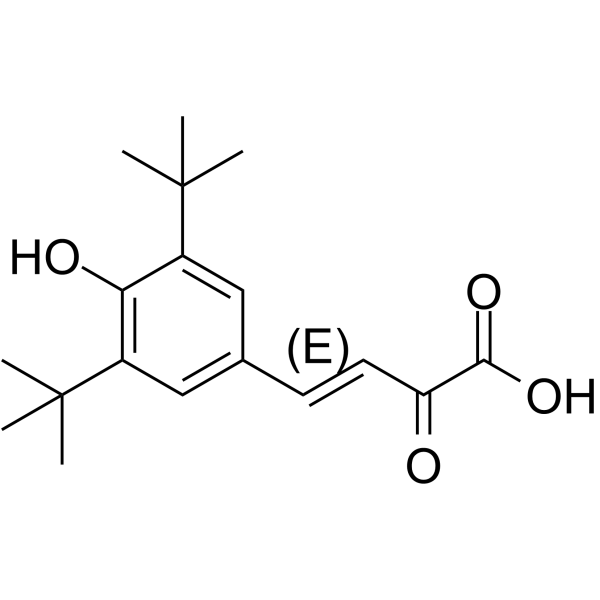
CLH304a (compound 14) is a specific and noncompetitive GABAB receptor negative allosteric modulator (NAM). CLH304a decreases GABA-induced IP3 production with an IC50 of 37.9 μM. CLH304a has no effect on other GPCR Class C members such as mGluR1, mGluR2, and mGluR5. CLH304a acts on the heptahelical domain of GB2 subunits and non-competitively inhibits the effect of agonists with inverse agonist properties. CLH304a inhibits Baclofen (HY-B0007)-induced ERK1/2 phosphorylation in HEK293 cells overexpressing GABAB receptor.
Para uso exclusivo en investigación. No vendemos a pacientes.
- Pureza : 99.64%
- No. CAS: 1611483-29-4
- Fòrmula: C18H24O4
- Peso molecular:304.38
-
Almacenamiento:Powder -20°C, 3 years ; In solvent -80°C, 6 months , -20°C, 1 month

To place orders, for customer services and technical support, please contact: MedChemExpress USA
Tel: 609-228-6898 E-mail: [email protected] [email protected]


-
 Actividad biológica
-
Chemical Information
-
Solvente y solubilidad
- Protocolo
- Pureza y Documentación
- Referencias
-
 Help & FAQs




Actividad biológica
Descripciòn
Cellular Effect
|
Cell Line

|
Type | Value | Description | References |
|---|---|---|---|---|
| HEK293 | IC50 |
37.9 μM
Compound: 14
|
Negative allosteric modulation of recombinant HA-tagged GB1 subunit/Flag-tagged GB2 subunit receptor (unknown origin) expressed in HEK293 cells co-expressing Gqi9 G-protein assessed as inhibition of GABA-induced IP production by liquid scintillation count
Negative allosteric modulation of recombinant HA-tagged GB1 subunit/Flag-tagged GB2 subunit receptor (unknown origin) expressed in HEK293 cells co-expressing Gqi9 G-protein assessed as inhibition of GABA-induced IP production by liquid scintillation count
|
[PMID: 25050158] |
| HEK293 | IC50 |
37.9 μM
Compound: 22
|
Negative allosteric modulator activity at GABA-B receptor (unknown origin) expressed in HEK293 cells assessed as inhibition of GABA-induced inositol phosphate production
Negative allosteric modulator activity at GABA-B receptor (unknown origin) expressed in HEK293 cells assessed as inhibition of GABA-induced inositol phosphate production
|
[PMID: 25856547] |
In Vitro
(E)-GABAB receptor antagonist 1 (compound 14) decreases agonist GABA-induced maximal effect of IP3 production in HEK293 cells overexpressing GABAB receptors and Gqi9 proteins without changing the EC50[1].
MedChemExpress (MCE) has not independently confirmed the accuracy of these methods. They are for reference only.


Chemical Information
-
No. CAS 1611483-29-4
-
Appearance Solid
-
Peso molecular 304.38
-
Fòrmula C18H24O4
-
Color Light yellow to yellow
-
SMILES
O=C(C(/C=C/C1=CC(C(C)(C)C)=C(C(C(C)(C)C)=C1)O)=O)O
-
Synonyms
(E)-GABAB receptor antagonist 1
-
Envío
Room temperature in continental US; may vary elsewhere.
-
Almacenamiento
Powder -20°C 3 years In solvent -80°C 6 months -20°C 1 month


Solvente y solubilidad
In Vitro:
DMSO : ≥ 100 mg/mL (328.54 mM; Hygroscopic DMSO has a significant impact on the solubility of product, please use newly opened DMSO)
* "≥" means soluble, but saturation unknown.
Please refer to the solubility information to select the appropriate solvent. Once prepared, please aliquot and store the solution to prevent product inactivation from repeated freeze-thaw cycles.
Storage method and period of stock solution: -80°C, 6 months; -20°C, 1 month. When stored at -80°C, please use it within 6 months. When stored at -20°C, please use it within 1 month.
Please refer to the solubility information to select the appropriate solvent. Once prepared, please aliquot and store the solution to prevent product inactivation from repeated freeze-thaw cycles.
Storage method and period of stock solution: -80°C, 6 months; -20°C, 1 month. When stored at -80°C, please use it within 6 months. When stored at -20°C, please use it within 1 month.
Concentration (start) × Volume (start) = Concentration (final) × Volume (final)
In Vivo:
Select the appropriate dissolution method based on your experimental animal and administration route.
- For the following dissolution methods, please ensure to first prepare a clear stock solution using an In Vitro approach and then sequentially add co-solvents:
- To ensure reliable experimental results, the clarified stock solution can be appropriately stored based on storage conditions. As for the working solution for In Vivo experiments, it is recommended to prepare freshly and use it on the same day.
- The percentages shown for the solvents indicate their volumetric ratio in the final prepared solution. If precipitation or phase separation occurs during preparation, heat and/or sonication can be used to aid dissolution.
Add each solvent one by one: 10% DMSO 40% PEG300 5% Tween-80 45% Saline
Solubility: ≥ 2.5 mg/mL (8.21 mM); Clear solution
This protocol yields a clear solution of ≥ 2.5 mg/mL (saturation unknown).
Taking 1 mL working solution as an example, add 100 μL DMSO stock solution (25.0 mg/mL) to 400 μL PEG300, and mix evenly; then add 50 μL Tween-80 and mix evenly; then add 450 μL Saline to adjust the volume to 1 mL.
Preparation of Saline: Dissolve 0.9 g sodium chloride in ddH₂O and dilute to 100 mL to obtain a clear Saline solution.
In Vivo Dissolution Calculator
Please enter the basic information of animal experiments:
-
-
-
-
Recommended: Prepare an additional quantity of animals to account for potential losses during experiments.
Please enter your animal formula composition:
-
%DMSO +
Recommended: Keep the proportion of DMSO in working solution below 2% if your animal is weak.
-
%+
-
+%Tween-80 + +
-
%Saline +
The co-solvents required include: DMSO, . All of co-solvents are available by MedChemExpress (MCE). , Tween 80. All of co-solvents are available by MedChemExpress (MCE).
Working solution concentration: 0.22 mg/mL
Method for preparing stock solution: mg drug dissolved in μL DMSO. Stock solution concentration: mg/mL.
1. Take μL DMSO stock solution;
2. Add μL .
μL , mix evenly;
3. Then add μL Tween 80, mix evenly;
4. Then add μL
Please ensure that the stock solution in the first step is dissolved to a clear state, and add co-solvents in sequence. You can use ultrasonic heating (ultrasonic cleaner, recommended frequency 20-40 kHz), vortexing, etc. to assist dissolution.


Pureza y Documentación
-
Ficha de datos (273 KB)
-
SDS (251 KB)
- English - EN (251 KB)
- Français - FR (251 KB)
- Deutsch - DE (251 KB)
- Norwegian - NO (251 KB)
- Español - ES (251 KB)
- Swedish - SV (251 KB)
- Italian - IT (251 KB)
- Korean - KR (251 KB)
- Portuguese - PT (251 KB)
-
Instrucciones de manejo (2659 KB)
Referencias
[1]. Chen LH, et al. Discovery of a Negative Allosteric Modulator of GABAB Receptors. ACS Med Chem Lett. 2014 May 27;5(7):742-7. [Content Brief]
[2]. Bing Sun, et al. A negative allosteric modulator modulates GABAB-receptor signalling through GB2 subunits. Biochem J. 2016 Mar 15;473(6):779-87. [Content Brief]


Complete Stock Solution Preparation Table
Please refer to the solubility information to select the appropriate solvent. Once prepared, please aliquot and store the solution to prevent product inactivation from repeated freeze-thaw cycles.
Storage method and period of stock solution: -80°C, 6 months; -20°C, 1 month. When stored at -80°C, please use it within 6 months. When stored at -20°C, please use it within 1 month.
| Optional Solvent | Concentration Solvent Mass | 1 mg | 5 mg | 10 mg | 25 mg |
|---|---|---|---|---|---|
| DMSO | 1 mM | 3.2854 mL | 16.4268 mL | 32.8537 mL | 82.1342 mL |
| 5 mM | 0.6571 mL | 3.2854 mL | 6.5707 mL | 16.4268 mL | |
| 10 mM | 0.3285 mL | 1.6427 mL | 3.2854 mL | 8.2134 mL | |
| 15 mM | 0.2190 mL | 1.0951 mL | 2.1902 mL | 5.4756 mL | |
| 20 mM | 0.1643 mL | 0.8213 mL | 1.6427 mL | 4.1067 mL | |
| 25 mM | 0.1314 mL | 0.6571 mL | 1.3141 mL | 3.2854 mL | |
| 30 mM | 0.1095 mL | 0.5476 mL | 1.0951 mL | 2.7378 mL | |
| 40 mM | 0.0821 mL | 0.4107 mL | 0.8213 mL | 2.0534 mL | |
| 50 mM | 0.0657 mL | 0.3285 mL | 0.6571 mL | 1.6427 mL | |
| 60 mM | 0.0548 mL | 0.2738 mL | 0.5476 mL | 1.3689 mL | |
| 80 mM | 0.0411 mL | 0.2053 mL | 0.4107 mL | 1.0267 mL | |
| 100 mM | 0.0329 mL | 0.1643 mL | 0.3285 mL | 0.8213 mL |


CLH304a Related Classifications
HY-129636 Related Classifications
 Powered by Bioz