



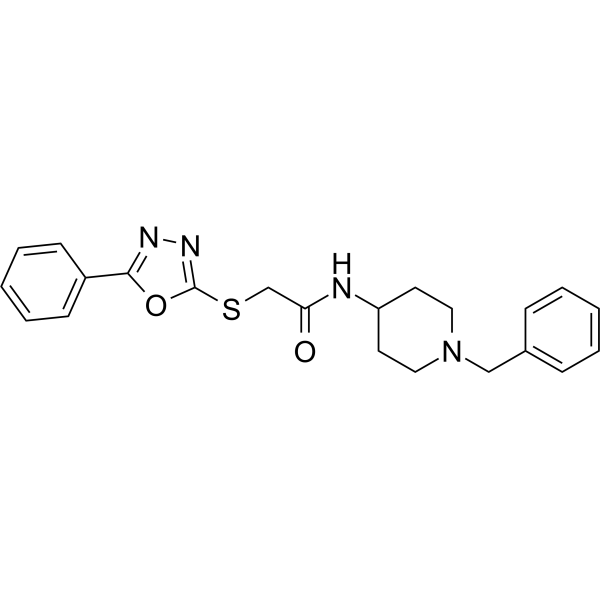
hAChE/hBACE-1-IN-2
hAChE/hBACE-1-IN-2 is a potent, orally active, blood-brain barrier transboundary triple inhibitor of hAChE, hBChE, and HACE-1 with IC50s of 0.113 μM, 1.48 μM and 0.38 μM, respectively. hAChE/hBACE-1-IN-2 has antioxidant activity. hAChE/hBACE-1-IN-2 also inhibits Aβ11-42 aggregation. hAChE/hBACE-1-IN-2 can be used to study Alzheimer's disease.
For research use only. We do not sell to patients.
- Formula: C22H24N4O2S
- Molecular Weight:408.52
-
Storage:
Please store the product under the recommended conditions in the Certificate of Analysis.

To place orders, for customer services and technical support, please contact: MedChemExpress USA
Tel: 609-228-6898 E-mail: [email protected] [email protected]


-
 Biological Activity
-
Chemical Information
- Protocols
- Purity & Documentation
- References
-
 Help & FAQs




Biological Activity
Description
IC50 & Target
|
hAChE 0.113 μM (IC50) |
hBACE-1 0.38 μM (IC50) |
hBCHE 1.48 μM (IC50) |
In Vitro
hAChE/hBACE-1-IN-2 (compound 5f) (10-80 μM; 72 h) is considered similar to Donepezil (HY-14566) in terms of safety in SH-SY5Y neuroblastoma cell lines[1].
hAChE/hBACE-1-IN-2 (compound 5f) (20 μM; 48 h, 72 h) has the potential of anti-Aβ1-42 aggregation potential in SH-SY5Y neuroblastoma cell lines[1].
MedChemExpress (MCE) has not independently confirmed the accuracy of these methods. They are for reference only. Further protocols information, click here.
-
Cell Line:SH-SY5Y cell lines (The SH-SY5Y cells were sequentially treated with RA and BDNF for 6 days)
-
Concentration:10, 20, 40, and 80 μM
-
Incubation Time:48-72 h
-
Result:Indicated a similar reduction in the differentiated neuroblastoma cell population at a maximum 80 μM concentration.
-
Cell Line:Aβ1-42 treated SH-SY5Y cells (incubated with Aβ1-42 (10μM) for 24 h)
-
Concentration:20 μM
-
Incubation Time:48-72 h
-
Result:The cells incubated the cell viability to 65% and 75% after 48 h and 72 h.
In Vivo
hAChE/hBACE-1-IN-2 (500 mg/kg, p.o., 14 days) is well tolerated and has no apparent toxicity in Swiss albino mice, including brain, liver, kidneys, and heart abnormalities[1].
hAChE/hBACE-1-IN-2 (10 mg/kg, p.o., 14 days) crosses the blood-brain barrier, reduces AchE levels or substrate hydrolysis in hippocampal and cortical brain homogenates, delays oxidative stress and reduces the potential for pro-inflammatory cytokine levels in a mouse model induced by Scopolamine (HY-N0296)[1].
hAChE/hBACE-1-IN-2 (10 mg/kg, p.o., 14 days) inhibits BACE-1, Aβ, APP/Aβ, and tau protein, protect brain tissue in different brain regions in the Aβ-induced model[1].
MedChemExpress (MCE) has not independently confirmed the accuracy of these methods. They are for reference only.
-
Animal Model:Swiss albino mice[1]
-
Dosage:500 mg/kg
-
Administration:Oral administration (p.o.), 14 days
-
Result:Showed no signs or symptoms of toxicity over the 14 days
-
Animal Model:Scopolamine-induced cognitive deficit mouse model[1]
-
Dosage:2.5 mg, 5 mg, and 10 mg/kg
-
Administration:Oral administration (p.o.), 14 days
-
Result:Elevated plus maze test showed significant reductions in transfer latency and time spent in open arms, similar to the effects observed with Scopolamine (HY-N0296)-induced dementia reversal.


Chemical Information
-
Molecular Weight 408.52
-
Formula C22H24N4O2S
-
SMILES
O=C(CSC1=NN=C(C2=CC=CC=C2)O1)NC3CCN(CC3)CC4=CC=CC=C4
-
Shipping
Room temperature in continental US; may vary elsewhere.
-
Storage
Please store the product under the recommended conditions in the Certificate of Analysis.

Protocols
-
Alzheimer’s Disease Modeling
Alzheimer’s Disease (AD) is a neurodegenerative disorder characterized by a progressive decline in cognitive functions and loss of specific types of neurons and synapses. Alzheimer's symptoms can be simulated in mice by injecting drugs (such as Aβ) or genetically modified.


Purity & Documentation
References

Calculators
Concentration (start) × Volume (start) = Concentration (final) × Volume (final)


hAChE/hBACE-1-IN-2 Related Classifications
HY-149288 Related Classifications
 Powered by Bioz