



HBC
Based on 4 publication(s) in Google Scholar
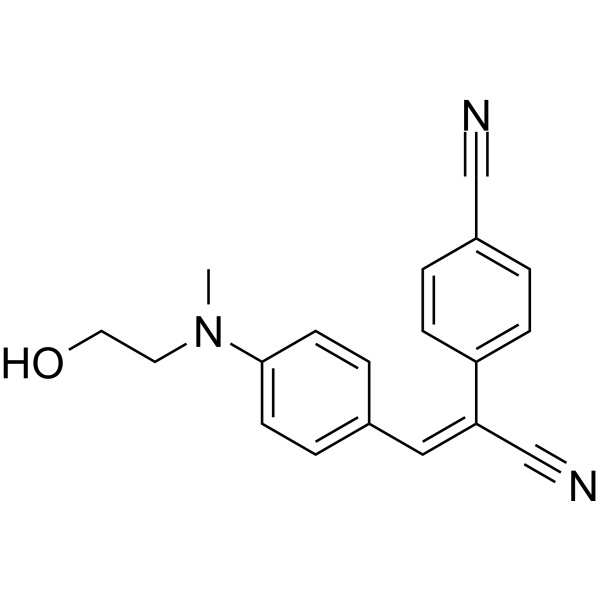
HBC (HBC 530) is a GFP fluorophore-like synthetic dye, with a structurally rigid electron acceptor and a strong electron donor. HBC has a low fluorescence background, and when combined with Pepper (RNA aptamer), HBC forms a tight complex and activates and emits bright fluorescence (Kd of ~3.5 nM). HBC emission peaks vary in different complexes and covers the spectrum from cyan to red. HBC can be used in the live cell imaging of RNA (Em/Ex = 530/485 nm).
For research use only. We do not sell to patients.
- Purity : 99.36%
- CAS No.: 156840-13-0
- Formula: C19H17N3O
- Molecular Weight:303.36
-
Storage:
4°C, protect from light
* In solvent : -80°C, 6 months; -20°C, 1 month (protect from light)

To place orders, for customer services and technical support, please contact: MedChemExpress USA
Tel: 609-228-6898 E-mail: [email protected] [email protected]


-
 Biological Activity
-
Chemical Information
-
Solvent & Solubility
- Purity & Documentation
- References
-
 Help & FAQs


-
HY-110251
DFHBI-1TRNA Aptamers Probe -

HY-D2348A
ACE TFAFluorescent Dye -
HY-10583
Y-27632 dihydrochlorideROCK Inhibitor -
HY-136277
DFHOFluorogenic Ligand -
HY-15559
Hoechst 33342DNA Fluorescent Stain -
HY-15371
ForskolinAdenylate Cyclase Activator -
HY-10997
IbrutinibBtk Inhibitor -
HY-17394
CisplatinDNA Alkylator -
HY-Y0873
PEG300Neutral Polymer -

HY-Y1891
Tween 80 -
HY-50907
ABT-737Bcl-2 Family Inhibitor/BH3 Mimetic -
HY-111330
Hydroxyphenyl FluoresceinROS Probe
Publications Citing Use of MedChemExpress (MCE) HBC
More Customer Validation & Images

-
Bio/Physico-chemical Assay
-
Bio/Physico-chemical Assay
-
Bio/Physico-chemical Assay
-
Bio/Physico-chemical Assay
-
Cell Imaging/Staining


Biological Activity
Description
In Vitro
Native polyacrylamide gel electrophoresis (PAGE) analysis
Native PAGE conditions included 8% PAGE gels (29:1 acrylamide:bisacrylamide) using TBE buffer.
The samples are run at 40 V for at least 2 h in pre-cooled buffer in an ice bath.
For staining, gels are incubated in buffer (40 mM HEPES, pH 7.5, 100 mM KCl, 5 mM MgCl2) containing 10 μM HBC for 15 min.
Gels are then imaged to detect Pepper-HBC complexes. The stained gels are analyzed at 488/30 nm excitation and 535/30 nm emission.
Next, counterstaining with 1× SYBR Gold is performed for 15 min followed by gel imaging to detect all RNA species in each lane.
SYBR Gold-stained bands are imaged using ultraviolet excitation (302 nm) and 590/30 nm emission.
Mammalian cell flow cytometry
293T/17 cells are transfected with the corresponding plasmids. Empty plasmid without expression of aptamer is used as the control. Untransfected cells are used as a negative control.
After 30 h, the cells are digested and resuspended in the 4% FBS/1× PBS solution containing 0.2 μM HBC and 5 mM MgSO4.
The fluorescence is analyzed using a cytometer with two channels: Ex=488/8 nm, Em=525/40 nm and Ex=561/10 nm, Em=610/20 nm.
To study the correlation between mRNA and protein, cells are transfected with plasmids expressing different mRNAs tagged with 4Pepper and cultured for 24 h.
The cells are digested and resuspended in the 4% FBS/1× PBS solution containing 0.2 μM HBC and 5 mM MgSO4.
Cells expressing SNAP-4Pepper are pre-treated with 0.2 μM SNAP-Cell 647-SiR (NEB).
Ex=405/10 nm, Em=450/45 nm, Ex=488/8 nm, Em=525/40 nm, Ex=561/10 nm, Em=610/20 nm and Ex=638 nm, Em=660/20 nm channels are used for blue fluorescent protein, Pepper530, mCherry and SNAP-SiR, respectively.
MedChemExpress (MCE) has not independently confirmed the accuracy of these methods. They are for reference only.
Clinical Trial
| NCT Number | Sponsor | Condition | Start Date |
Phase

|
|---|---|---|---|---|
| NCT01329991 | 2011-05 | PHASE1 |
Emission (Em)
530
Excitation (Ex)
485


Chemical Information
-
CAS No. 156840-13-0
-
Appearance Solid
-
Molecular Weight 303.36
-
Formula C19H17N3O
-
Color Orange to red
-
SMILES
N#CC1=CC=C(/C(C#N)=C\C2=CC=C(N(CCO)C)C=C2)C=C1
-
Synonyms
HBC 530
-
Shipping
Room temperature in continental US; may vary elsewhere.
-
Storage
4°C, protect from light
* In solvent : -80°C, 6 months; -20°C, 1 month (protect from light)


Publications (4)
-
Journal Impact Factor
-
Most Recent
-
Nature
2025 Apr;640(8057):249-257. PMID: 39972138
HBC purchased from MedChemExpress. Usage Cited in: Nature. 2025 Apr;640(8057):249-257. [Abstract]
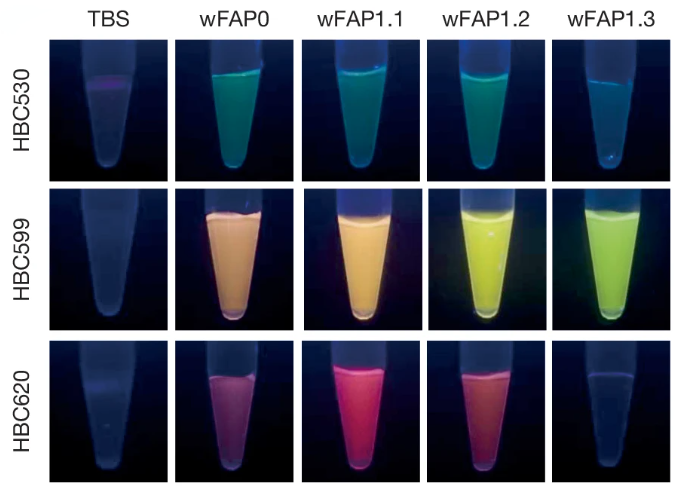
Fluorescence activation of three HBC derivatives (HBC530, HBC599 and HBC620) by different wFAPs. Solutions containing the HBC dyes, with or without wFAPs, were illuminated with 365 nm light.
HBC purchased from MedChemExpress. Usage Cited in: Nature. 2025 Apr;640(8057):249-257. [Abstract]
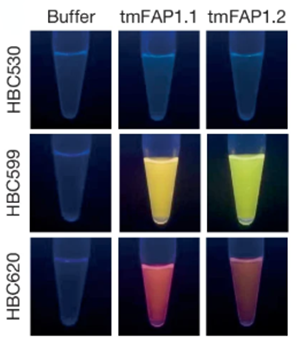
Activation of the fluorescence of HBC dyes (HBC530, HBC599 and HBC620) by tmFAP1.1 and tmFAP1.2. Detergent solutions containing HBC dyes, with or without tmFAPs, were illuminated with 365 nm light.All tmFAPs were solubilized in TBS buffer (pH 7.4) with 1.1% n-octyl-β-d-glucopyranoside.
-
Trends Biotechnol
2026 Jun 22:S0167-7799(26)00237-4. PMID: 42331684 -
HBC purchased from MedChemExpress. Usage Cited in: Aggregate. 2026 Feb 4;7(2):e70284.
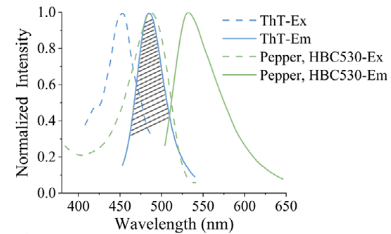
Excitation and emission spectra of ThT and HBC530 using Pepper.
HBC purchased from MedChemExpress. Usage Cited in: Aggregate. 2026 Feb 4;7(2):e70284.
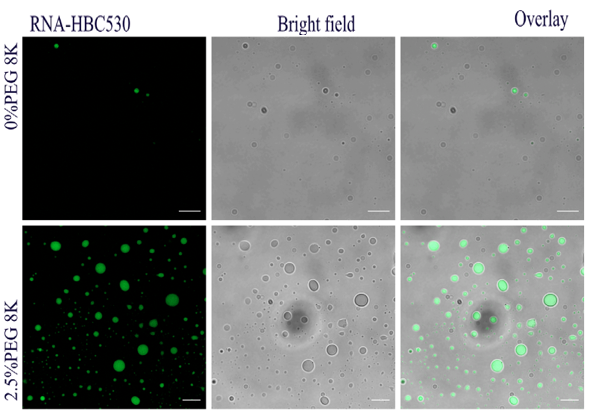
Confocal fluorescence imaging of F-FARCONwith and without 2.5% PEG 8K. Fluorescence images were taken in solutions containing 2 µM RNA, 1 mM MgCl 2 and 20 µM HBC530 after annealing.
-
Anal Chim Acta
The catalytic hairpin assembly induces a conformational change of the RNA aptamer enabled in situ imaging of circRNAs in tumor cells. [Abstract]2025 Jun 22:1356:344048. PMID: 40288881
HBC purchased from MedChemExpress. Usage Cited in: Anal Chim Acta. 2025 Jun 22:1356:344048. [Abstract]
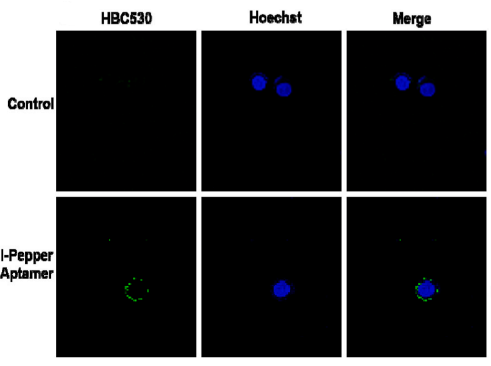
In situ imaging of circMTO1 in LO2 cells with and without inert pepper aptamer (i-pepper aptamer). The cells were transfected with H1, H2, inert Pepper aptamer, and RiboLock RNase Inhibitor for 6 h with transfection reagent, and then incubated with HBC530 for 4 h. The magnification of the confocal microscope was 20 ×.
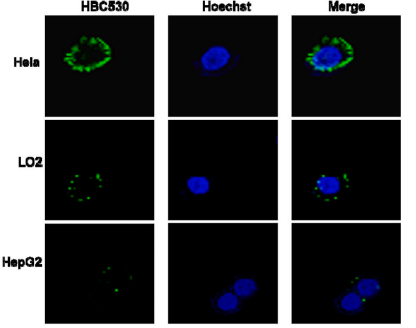
HBC purchased from MedChemExpress. Usage Cited in: Anal Chim Acta. 2025 Jun 22:1356:344048. [Abstract]
In situ imaging of circMTO1 in HeLa cells, LO2 cells, HepG2 cells.


Solvent & Solubility
In Vitro:
DMSO : 125 mg/mL (412.05 mM; Need ultrasonic; Hygroscopic DMSO has a significant impact on the solubility of product, please use newly opened DMSO)
Please refer to the solubility information to select the appropriate solvent. Once prepared, please aliquot and store the solution to prevent product inactivation from repeated freeze-thaw cycles.
Storage method and period of stock solution: -80°C, 6 months; -20°C, 1 month (protect from light). When stored at -80°C, please use it within 6 months. When stored at -20°C, please use it within 1 month.
Please refer to the solubility information to select the appropriate solvent. Once prepared, please aliquot and store the solution to prevent product inactivation from repeated freeze-thaw cycles.
Storage method and period of stock solution: -80°C, 6 months; -20°C, 1 month (protect from light). When stored at -80°C, please use it within 6 months. When stored at -20°C, please use it within 1 month.
Concentration (start) × Volume (start) = Concentration (final) × Volume (final)


Purity & Documentation
-
Data Sheet (273 KB)
-
SDS (480 KB)
- English - EN (480 KB)
- Français - FR (480 KB)
- Deutsch - DE (480 KB)
- Norwegian - NO (480 KB)
- Español - ES (480 KB)
- Swedish - SV (480 KB)
- Italian - IT (480 KB)
- Korean - KR (480 KB)
- Portuguese - PT (480 KB)
-
Handling Instructions (2659 KB)
References


Complete Stock Solution Preparation Table
Please refer to the solubility information to select the appropriate solvent. Once prepared, please aliquot and store the solution to prevent product inactivation from repeated freeze-thaw cycles.
Storage method and period of stock solution: -80°C, 6 months; -20°C, 1 month (protect from light). When stored at -80°C, please use it within 6 months. When stored at -20°C, please use it within 1 month.
| Optional Solvent | Concentration Solvent Mass | 1 mg | 5 mg | 10 mg | 25 mg |
|---|---|---|---|---|---|
| DMSO | 1 mM | 3.2964 mL | 16.4821 mL | 32.9641 mL | 82.4103 mL |
| 5 mM | 0.6593 mL | 3.2964 mL | 6.5928 mL | 16.4821 mL | |
| 10 mM | 0.3296 mL | 1.6482 mL | 3.2964 mL | 8.2410 mL | |
| 15 mM | 0.2198 mL | 1.0988 mL | 2.1976 mL | 5.4940 mL | |
| 20 mM | 0.1648 mL | 0.8241 mL | 1.6482 mL | 4.1205 mL | |
| 25 mM | 0.1319 mL | 0.6593 mL | 1.3186 mL | 3.2964 mL | |
| 30 mM | 0.1099 mL | 0.5494 mL | 1.0988 mL | 2.7470 mL | |
| 40 mM | 0.0824 mL | 0.4121 mL | 0.8241 mL | 2.0603 mL | |
| 50 mM | 0.0659 mL | 0.3296 mL | 0.6593 mL | 1.6482 mL | |
| 60 mM | 0.0549 mL | 0.2747 mL | 0.5494 mL | 1.3735 mL | |
| 80 mM | 0.0412 mL | 0.2060 mL | 0.4121 mL | 1.0301 mL | |
| 100 mM | 0.0330 mL | 0.1648 mL | 0.3296 mL | 0.8241 mL |


HBC Related Classifications
HY-D1373 Related Classifications
 Powered by Bioz