



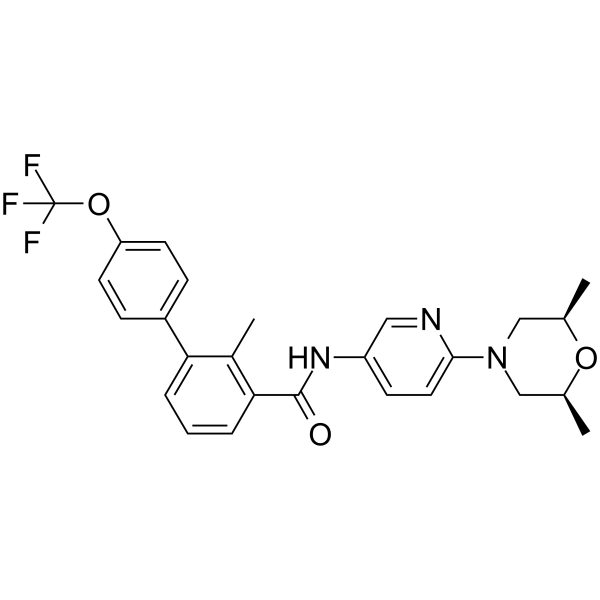
Sonidegib
Based on 13 publication(s) in Google Scholar
Sonidegib (Erismodegib) is a potent and selective Smo antagonist with IC50 of 1.3 nM and 2.5 nM for mouse and human Smo in binding assay, respectively.
For research use only. We do not sell to patients.
- Purity : 99.98%
- CAS No.: 956697-53-3
- Formula: C26H26F3N3O3
- Molecular Weight:485.50
-
Storage:Powder -20°C, 3 years , 4°C, 2 years ; In solvent -80°C, 2 years , -20°C, 1 year

To place orders, for customer services and technical support, please contact: MedChemExpress USA
Tel: 609-228-6898 E-mail: [email protected] [email protected]


-
 Biological Activity
-
Chemical Information
-
Solvent & Solubility
- Purity & Documentation
- References
-
 Help & FAQs


-
HY-10440
VismodegibHedgehog Inhibitor -
HY-12848
SAGSmoothened Agonist -
HY-17024
CyclopamineHedgehog Pathway Antagonist -
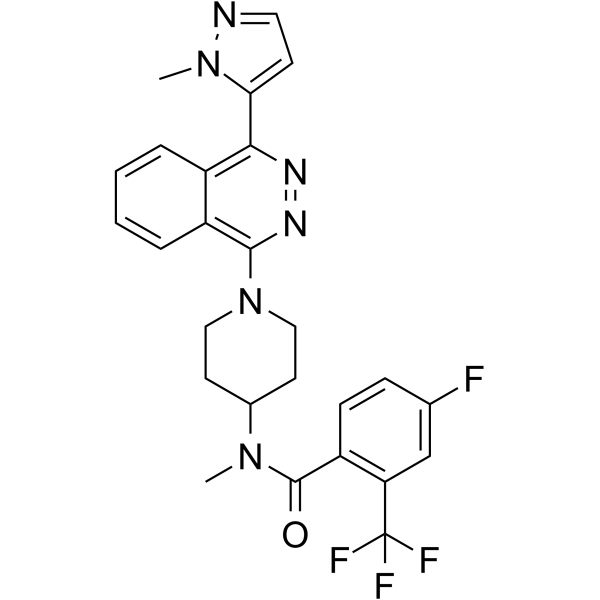
HY-13242
TaladegibSMO Antagonist -
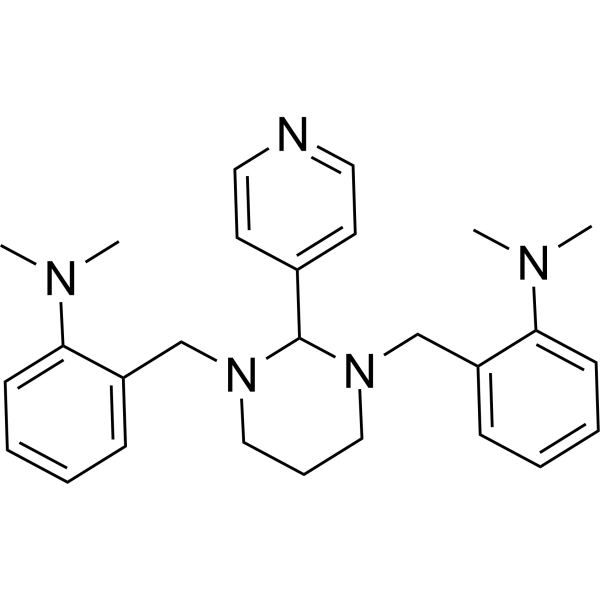
HY-13901
GANT 61Gli1/2 Inhibitor -
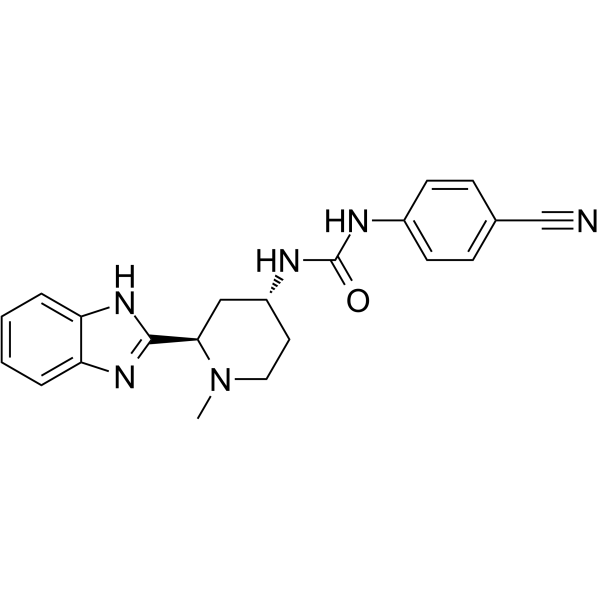
HY-16391
Glasdegib -
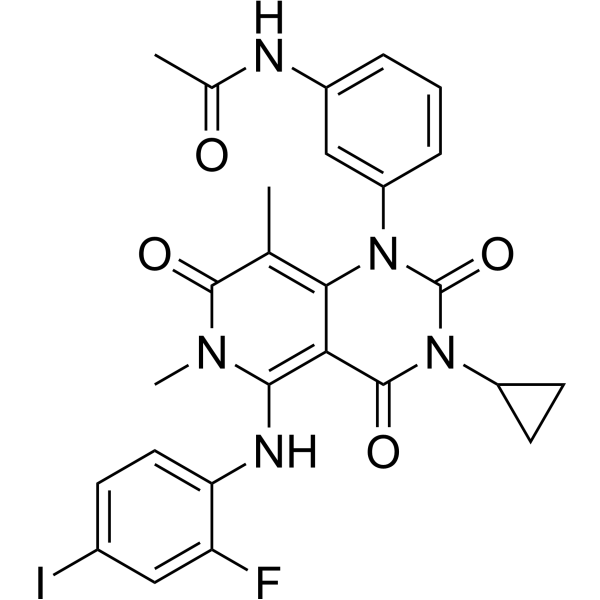
HY-10999
TrametinibMEK Inhibitor -
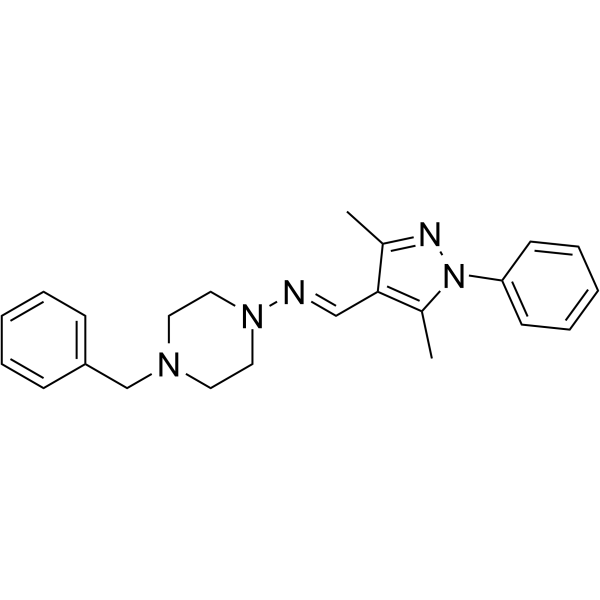
HY-100224
SANT-1Smo Antagonist -
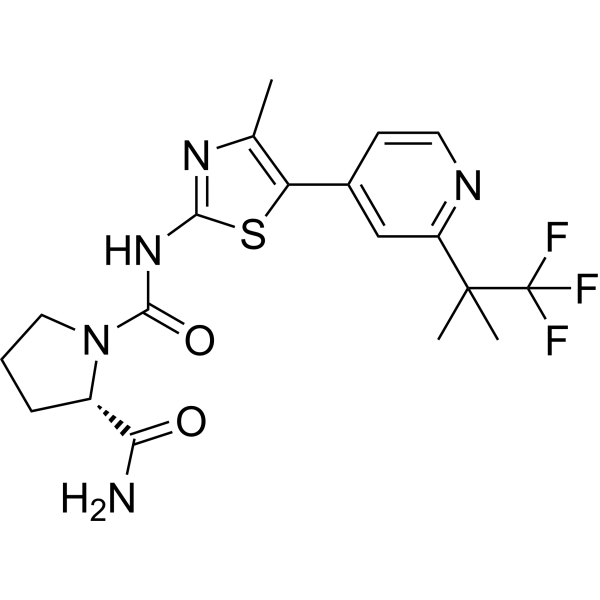
HY-15244
AlpelisibPI3Kα Inhibitor -
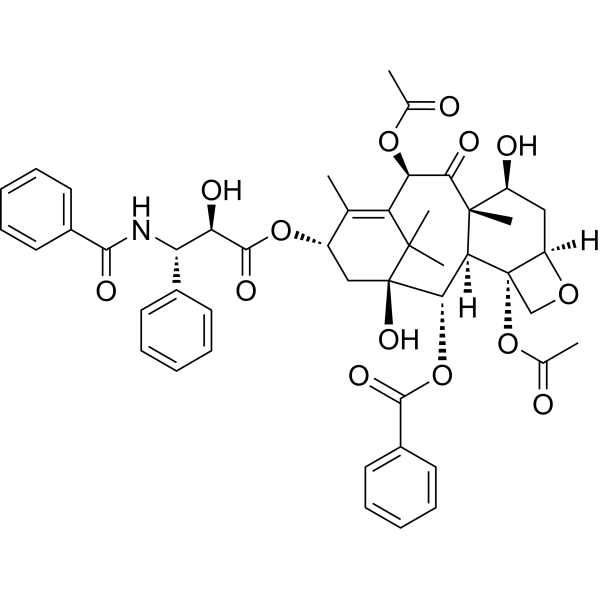
HY-B0015
PaclitaxelAntitumor Agent -
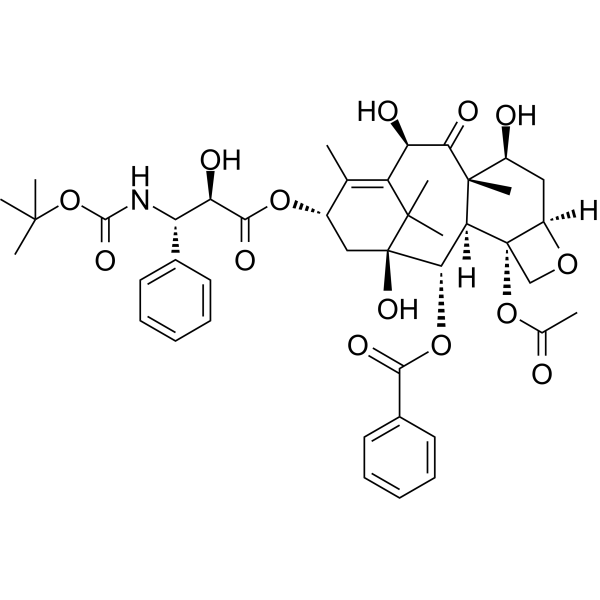
HY-B0011
DocetaxelTubulin Stabilizer -
HY-18739
Phorbol 12-myristate 13-acetatePKC Activator
Publications Citing Use of MedChemExpress (MCE) Sonidegib
More- Nat Med. 2018 Nov;24(11):1752-1761. [Abstract]
- Free Radic Biol Med. 2026 Aug 16:252:493-508. [Abstract]
- J Genet Genomics. 2018 May 20;45(5):237-246. [Abstract]
- J Pathol. 2025 Nov 6. [Abstract]
- Tissue Cell. 2026 Apr:99:103263. [Abstract]
- Tissue Cell. 2025 Feb:92:102643. [Abstract]
- Cell Physiol Biochem. 2018;47(4):1352-1364. [Abstract]
- bioRxiv. 2025 Oct 11.
- SSRN. 2025 Jul 25.
- bioRxiv. 2024 Jul 25.
- bioRxiv. 2024 Nov 4:2024.10.08.617155. [Abstract]
- bioRxiv. 2023 Nov 6:2023.11.03.565570. [Abstract]
- Patent. US20180263995A1.
 Customer Validation & Images

-
In Vivo Efficacy Study
-
WB
-
Histological Imaging/Staining
-
IF
-
IF


Biological Activity
Description
IC50 & Target
IC50: 1.3 nM (mSmo), 2.5 nM (hSmo)[1]
Cellular Effect
|
Cell Line

|
Type | Value | Description | References |
|---|---|---|---|---|
| Caco-2 | CC50 |
2.26 μM
Compound: LDE225
|
Toxicity against Caco-2 cells determined at 48 hours by intracellular ATP concentration using the CellTiter-Glo Luminescent Cell Viability Assay
Toxicity against Caco-2 cells determined at 48 hours by intracellular ATP concentration using the CellTiter-Glo Luminescent Cell Viability Assay
|
10.21203/rs.3.rs-23951/v1 |
| Caco-2 | IC50 |
10.67 μM
Compound: LDE225
|
Determination of IC50 values for inhibition of SARS-CoV-2 induced cytotoxicity of Caco-2 cells after 48 hours by high content imaging
Determination of IC50 values for inhibition of SARS-CoV-2 induced cytotoxicity of Caco-2 cells after 48 hours by high content imaging
|
10.21203/rs.3.rs-23951/v1 |
| NIH3T3 | IC50 |
5.5 nM
Compound: 2; LDE-225
|
Inhibition of Sonic-induced hedgehog signalling in mouse NIH3T3 cells after 48 hrs by Gli-luciferase reporter assay
Inhibition of Sonic-induced hedgehog signalling in mouse NIH3T3 cells after 48 hrs by Gli-luciferase reporter assay
|
[PMID: 26820554] |
| NIH3T3 | IC50 |
5.5 nM
Compound: LDE-225, NVP-LDE-225, sonidegib
|
Inhibition of SHH signaling pathway in mouse NIH3T3 cells measured after 48 hrs by Gli-luciferase reporter assay
Inhibition of SHH signaling pathway in mouse NIH3T3 cells measured after 48 hrs by Gli-luciferase reporter assay
|
[PMID: 24176396] |
In Vitro
The IC50 values for Sonidegib (NVP-LDE225) for the major human CYP450 drug metabolizing enzymes is greater than 10 μM[1]. Sonidegib (LDE225), a small molecule, clinically investigated SMO inhibitor, used alone and in combination with Nilotinib, inhibits the Hh pathway in CD34+ chronic phase (CP)-chronic myeloid leukaemia (CML) cells, reducing the number and self-renewal capacity of CML leukaemia stem cell (LSC). Sonidegib interacts directly with SMO, in a similar fashion to cyclopamine, to reduce expression of downstream Hh signaling targets. Primary CD34+ CP-CML cells are cultured in serum free media (SFM)±Sonidegib for 6, 24 and 72 hours (h). At 72 h, while there is variability between the biological samples, GLI1 is significantly downregulated following exposure to Sonidegib (10 nM; 0.78-fold and 100 nM; 0.73-fold, respectively (p<0.01)[2].
MedChemExpress (MCE) has not independently confirmed the accuracy of these methods. They are for reference only.
In Vivo
MedChemExpress (MCE) has not independently confirmed the accuracy of these methods. They are for reference only.


Chemical Information
-
CAS No. 956697-53-3
-
Appearance Solid
-
Molecular Weight 485.50
-
Formula C26H26F3N3O3
-
Color White to light yellow
-
SMILES
O=C(C1=C(C)C(C(C=C2)=CC=C2OC(F)(F)F)=CC=C1)NC3=CC=C(N=C3)N4C[C@@H](C)O[C@@H](C)C4
-
Synonyms
Erismodegib; LDE225; NVP-LDE225
-
Shipping
Room temperature in continental US; may vary elsewhere.
-
Storage
Powder -20°C 3 years 4°C 2 years In solvent -80°C 2 years -20°C 1 year


Publications (13)
-
Journal Impact Factor
-
Most Recent
-
Nat Med
2018 Nov;24(11):1752-1761. PMID: 30349086 -
Free Radic Biol Med
Targeted delivery of nebivolol via lactoferrin-modified liposomes inhibits NEK7-mediated pyroptosis to ameliorate inflammatory bowel disease. [Abstract]2026 Aug 16:252:493-508. PMID: 42061481 -
J Genet Genomics
Reduced Smoothened level rescues Aβ-induced memory deficits and neuronal inflammation in animal models of Alzheimer's disease. [Abstract]2018 May 20;45(5):237-246. PMID: 29807798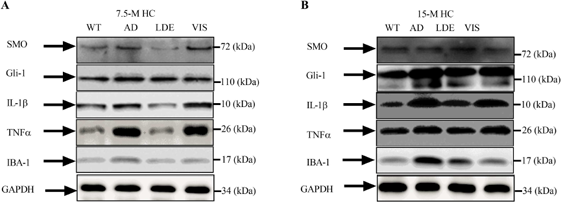
Sonidegib purchased from MedChemExpress. Usage Cited in: J Genet Genomics. 2018 May 20;45(5):237-246. [Abstract]
Drug-feeding scheme (upper panel). Memory rescuing effects through treatment with LDE225 (LDE) or Vismodegib (VIS) at 20 mg/kg for 7.5-m-old and 15-m-old mice (lower panel, n=7 for each group).
-
J Pathol
Transcriptomic profiling reveals the role of Hedgehog signaling as a biomarker and in the pathogenesis of Ménétrier's disease. [Abstract]2025 Nov 6. PMID: 41199529
Sonidegib purchased from MedChemExpress. Usage Cited in: J Pathol. 2025 Nov 6. [Abstract]
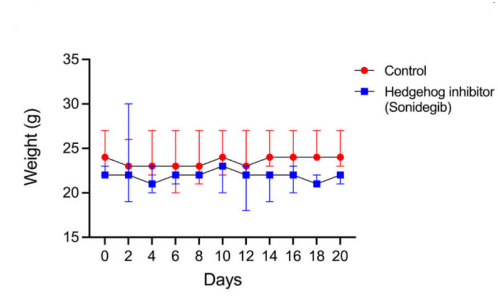
Sonidegib (5 mg/kg; IP; three weeks every other day) in Two-to-four-month-old MT-TGFα mice showed Sonidegib or DMSO treatment did not affect the weight of mice.
Sonidegib purchased from MedChemExpress. Usage Cited in: J Pathol. 2025 Nov 6. [Abstract]
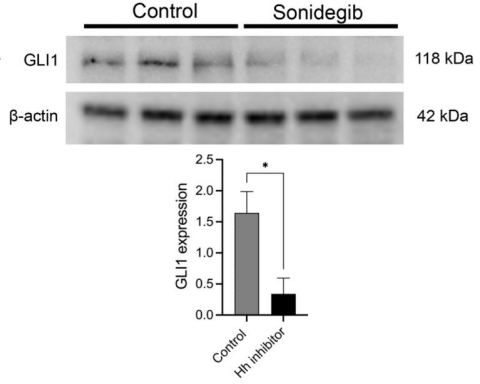
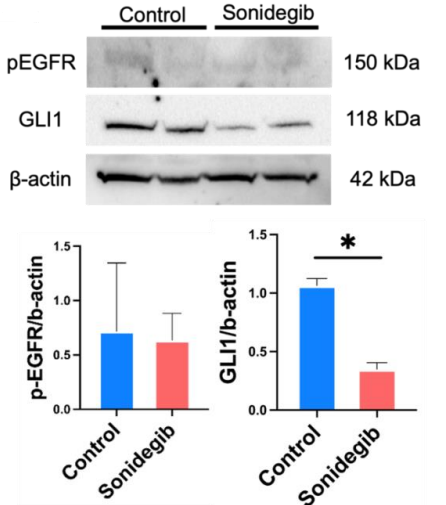
Sonidegib (5 mg/kg; IP; three weeks every other day) in Two-to-four-month-old MT-TGFα mice showed immunoblotting with anti-GLI1 and anti-beta-actin antibodies showed GLI1 expression is decreased by the sonidegib treatment, confirming the effective inhibition of Hh signaling. Bar graph represents quantification of the immunoblotting.
Sonidegib purchased from MedChemExpress. Usage Cited in: J Pathol. 2025 Nov 6. [Abstract]
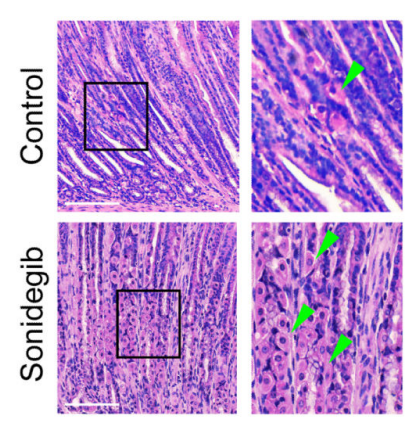
Sonidegib (5 mg/kg; IP; three weeks every other day) in Two-to-four-month-old MT-TGFα mice showed Hematoxylin and eosin (H&E) stains reveal that Hh inhibitor sonidegib treatment partially rescues the phenotypes in MT-TGFα mice.
Sonidegib purchased from MedChemExpress. Usage Cited in: J Pathol. 2025 Nov 6. [Abstract]
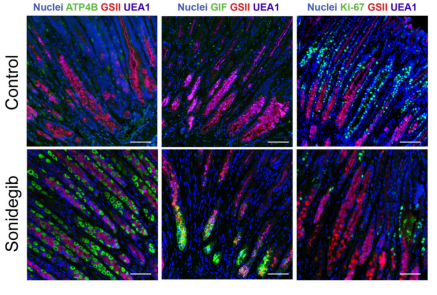
Sonidegib (5 mg/kg; IP; three weeks every other day) in Two-to-four-month-old MT-TGFα mice showed H+/K+ ATPase positive parietal cells and GIF positive chief cells are significantly increased following sonidegib treatment. UEA1 positive foveolar cells are significantly decreased while GSII positive neck cells show a decreasing trend although the result is not statistically significant. The Ki-67 positive proliferating cells are significantly decreased after sonidegib treatment in stomach tissues.
Sonidegib purchased from MedChemExpress. Usage Cited in: J Pathol. 2025 Nov 6. [Abstract]
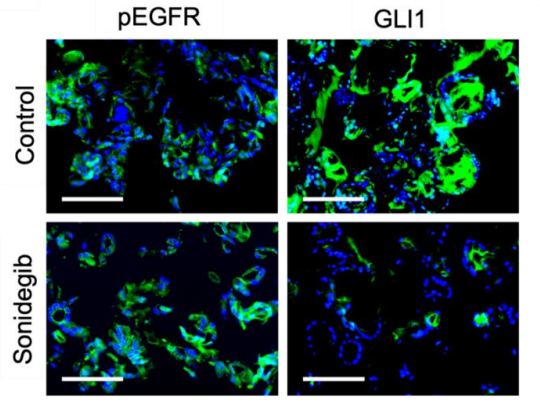
Immunofluorescentstaining shows GLI1 expression is decreased following Sonidegib (50 μM; 48 h) treatment whereas pEGFR expression is not changing in gastric organoids from MD patients.
Sonidegib purchased from MedChemExpress. Usage Cited in: J Pathol. 2025 Nov 6. [Abstract]
Immunoblotting with anti-pEGFR, anti-GLI1, and anti-b-actin antibodies show GLI1 expression is significantly decreased in the Sonidegib (50 μM; 48 h) treatment group whereas pEGFR expression is not changing in gastric organoids from MD patients. Bar graphs represent quantification of the immunoblotting.
-
Tissue Cell
2026 Apr:99:103263. PMID: 41365188 -
Tissue Cell
The Shh-p38-NFATc1 signaling pathway is essential for osteoclastogenesis during tooth eruption. [Abstract]2025 Feb:92:102643. PMID: 39612595 -
Cell Physiol Biochem
2018;47(4):1352-1364. PMID: 29929201 -
-
-
-
bioRxiv
2024 Nov 4:2024.10.08.617155. PMID: 39415993 -
bioRxiv
Transcriptomic Profiling Reveals Claudin 18.2 as a Diagnostic Biomarker of Ménétrier's Disease and the Role of Hedgehog Signaling in Pathogenesis. [Abstract]2023 Nov 6:2023.11.03.565570. PMID: 37986961 -


Solvent & Solubility
In Vitro:
DMSO : 100 mg/mL (205.97 mM; Need ultrasonic; Hygroscopic DMSO has a significant impact on the solubility of product, please use newly opened DMSO)
Please refer to the solubility information to select the appropriate solvent. Once prepared, please aliquot and store the solution to prevent product inactivation from repeated freeze-thaw cycles.
Storage method and period of stock solution: -80°C, 2 years; -20°C, 1 year. When stored at -80°C, please use it within 2 years. When stored at -20°C, please use it within 1 year.
Please refer to the solubility information to select the appropriate solvent. Once prepared, please aliquot and store the solution to prevent product inactivation from repeated freeze-thaw cycles.
Storage method and period of stock solution: -80°C, 2 years; -20°C, 1 year. When stored at -80°C, please use it within 2 years. When stored at -20°C, please use it within 1 year.
Concentration (start) × Volume (start) = Concentration (final) × Volume (final)
In Vivo:
Select the appropriate dissolution method based on your experimental animal and administration route.
- For the following dissolution methods, please ensure to first prepare a clear stock solution using an In Vitro approach and then sequentially add co-solvents:
- To ensure reliable experimental results, the clarified stock solution can be appropriately stored based on storage conditions. As for the working solution for In Vivo experiments, it is recommended to prepare freshly and use it on the same day.
- The percentages shown for the solvents indicate their volumetric ratio in the final prepared solution. If precipitation or phase separation occurs during preparation, heat and/or sonication can be used to aid dissolution.
Add each solvent one by one: 10% DMSO 40% PEG300 5% Tween-80 45% Saline
Solubility: ≥ 2.5 mg/mL (5.15 mM); Clear solution
This protocol yields a clear solution of ≥ 2.5 mg/mL (saturation unknown).
Taking 1 mL working solution as an example, add 100 μL DMSO stock solution (25.0 mg/mL) to 400 μL PEG300, and mix evenly; then add 50 μL Tween-80 and mix evenly; then add 450 μL Saline to adjust the volume to 1 mL.
Preparation of Saline: Dissolve 0.9 g sodium chloride in ddH₂O and dilute to 100 mL to obtain a clear Saline solution.
Add each solvent one by one: 10% DMSO 90% (20% SBE-β-CD in Saline)
Solubility: 2.5 mg/mL (5.15 mM); Suspended solution; Need ultrasonic
This protocol yields a suspended solution of 2.5 mg/mL. Suspended solution can be used for oral and intraperitoneal injection.
Taking 1 mL working solution as an example, add 100 μL DMSO stock solution (25.0 mg/mL) to 900 μL 20% SBE-β-CD in Saline, and mix evenly.
Preparation of 20% SBE-β-CD in Saline (4°C, storage for one week): 2 g SBE-β-CD powder is dissolved in 10 mL Saline, completely dissolve until clear.
For the following dissolution methods, please prepare the working solution directly:
It is recommended to prepare fresh solutions and use them promptly within a short period of time.
The percentages shown for the solvents indicate their volumetric ratio in the final prepared solution. If precipitation or phase separation occurs during preparation, heat and/or sonication can be used to aid dissolution.
Add each solvent one by one: 75% PEG300 25% (5% Dextrose in Water)
Solubility: 2 mg/mL (4.12 mM); Clear solution; Need ultrasonic
In Vivo Dissolution Calculator
Please enter the basic information of animal experiments:
-
-
-
-
Recommended: Prepare an additional quantity of animals to account for potential losses during experiments.
Please enter your animal formula composition:
-
%DMSO +
Recommended: Keep the proportion of DMSO in working solution below 2% if your animal is weak.
-
%+
-
+%Tween-80 + +
-
%Saline +
The co-solvents required include: DMSO, . All of co-solvents are available by MedChemExpress (MCE). , Tween 80. All of co-solvents are available by MedChemExpress (MCE).
Working solution concentration: 0.22 mg/mL
Method for preparing stock solution: mg drug dissolved in μL DMSO. Stock solution concentration: mg/mL.
1. Take μL DMSO stock solution;
2. Add μL .
μL , mix evenly;
3. Then add μL Tween 80, mix evenly;
4. Then add μL
Please ensure that the stock solution in the first step is dissolved to a clear state, and add co-solvents in sequence. You can use ultrasonic heating (ultrasonic cleaner, recommended frequency 20-40 kHz), vortexing, etc. to assist dissolution.


Purity & Documentation
-
Data Sheet (287 KB)
-
SDS (393 KB)
- English - EN (393 KB)
- Français - FR (393 KB)
- Deutsch - DE (393 KB)
- Norwegian - NO (393 KB)
- Español - ES (393 KB)
- Swedish - SV (393 KB)
- Italian - IT (393 KB)
- Korean - KR (393 KB)
- Portuguese - PT (393 KB)
-
Handling Instructions (2659 KB)
References
[1]. Pan S, et al. Discovery of NVP-LDE225, a Potent and Selective Smoothened Antagonist. ACS Med Chem Lett. 2010 Mar 16;1(3):130-4. [Content Brief]
[2]. Irvine DA, et al. Deregulated hedgehog pathway signaling is inhibited by the smoothened antagonist LDE225 (Sonidegib) in chronic phase chronic myeloid leukaemia. Sci Rep. 2016 May 9;6:25476. [Content Brief]


Complete Stock Solution Preparation Table
Please refer to the solubility information to select the appropriate solvent. Once prepared, please aliquot and store the solution to prevent product inactivation from repeated freeze-thaw cycles.
Storage method and period of stock solution: -80°C, 2 years; -20°C, 1 year. When stored at -80°C, please use it within 2 years. When stored at -20°C, please use it within 1 year.
| Optional Solvent | Concentration Solvent Mass | 1 mg | 5 mg | 10 mg | 25 mg |
|---|---|---|---|---|---|
| DMSO | 1 mM | 2.0597 mL | 10.2987 mL | 20.5973 mL | 51.4933 mL |
| 5 mM | 0.4119 mL | 2.0597 mL | 4.1195 mL | 10.2987 mL | |
| 10 mM | 0.2060 mL | 1.0299 mL | 2.0597 mL | 5.1493 mL | |
| 15 mM | 0.1373 mL | 0.6866 mL | 1.3732 mL | 3.4329 mL | |
| 20 mM | 0.1030 mL | 0.5149 mL | 1.0299 mL | 2.5747 mL | |
| 25 mM | 0.0824 mL | 0.4119 mL | 0.8239 mL | 2.0597 mL | |
| 30 mM | 0.0687 mL | 0.3433 mL | 0.6866 mL | 1.7164 mL | |
| 40 mM | 0.0515 mL | 0.2575 mL | 0.5149 mL | 1.2873 mL | |
| 50 mM | 0.0412 mL | 0.2060 mL | 0.4119 mL | 1.0299 mL | |
| 60 mM | 0.0343 mL | 0.1716 mL | 0.3433 mL | 0.8582 mL | |
| 80 mM | 0.0257 mL | 0.1287 mL | 0.2575 mL | 0.6437 mL | |
| 100 mM | 0.0206 mL | 0.1030 mL | 0.2060 mL | 0.5149 mL |


Sonidegib Related Classifications
HY-16582A Related Classifications
 Powered by Bioz