



Pezadeftide
Pezadeftide (HXP124) is a naturally derived plant defensin peptide molecule with antifungal activity. Pezadeftide binds to fungal cell wall chitin and β-glucan, enters fungal cells via endocytosis; induces mitochondrial membrane hyperpolarization, promotes ROS generation, further triggers vacuole fusion, alters plasma membrane permeability, and ultimately causes fungal cell death. Pezadeftide exhibits inhibitory effects against various skin and nail pathogenic fungi. Pezadeftide can be used in research related to fungal infections.
For research use only. We do not sell to patients.
- CAS No.: 1907724-92-8
- Formula: C234H372N70O66S8
- Molecular Weight:5478.41
-
Storage:
Please store the product under the recommended conditions in the Certificate of Analysis.

To place orders, for customer services and technical support, please contact: MedChemExpress USA
Tel: 609-228-6898 E-mail: [email protected] [email protected]


-
 Biological Activity
-
Chemical Information
- Protocols
- Purity & Documentation
- References
-
 Help & FAQs




Biological Activity
Description
In Vitro
Pezadeftide exhibits inhibitory activity against multiple skin and nail pathogenic fungi; for Trichophyton rubrum IC50 = 4.6 μg/mL, for Trichophyton mentagrophytes IC50 = 8.4 μg/mL, for Candida auris IC50 = 1.3 μg/mL, for Candida albicans IC50 = 3.4 μg/mL, for Candida tropicalis IC50 = 1.9 μg/mL[1].
Pezadeftide selects resistant S. cerevisiae deletion strains enriched in mitochondrial respiration and sphingolipid biosynthesis, among which F1-F0 ATP synthase mutants exhibit higher tolerance[2].
Pezadeftide permeabilizes the S. cerevisiae plasma membrane in a concentration-dependent manner, induces ROS, and hyperpolarizes the mitochondrial membrane potential in S. cerevisiae BY4741[2].
Pezadeftide induces ROS at 3-7 min and triggers vacuolar fusion at 14-16 min[2].
Pezadeftide (Ppdef1) binds chitin and yeast β-glucan in cell-free polysaccharide-binding assays and inhibits fungal pathogens with IC50 values of 1.3-42.7 µg/mL, showing no activity against the tested bacteria at concentrations up to 200 µg/mL[2].
Pezadeftide (15 μM) induces mitochondrial membrane hyperpolarization in C. albicans/S. cerevisiae and binds/internalizes in T. rubrum, accompanied by increased mitochondrial membrane potential[1].
Pezadeftide induces ROS in C. albicans cells and increases ROS production in T. rubrum[1].
MedChemExpress (MCE) has not independently confirmed the accuracy of these methods. They are for reference only.


Chemical Information
-
CAS No. 1907724-92-8
-
Molecular Weight 5478.41
-
Formula C234H372N70O66S8
-
Synonyms
HXP124
-
Sequence
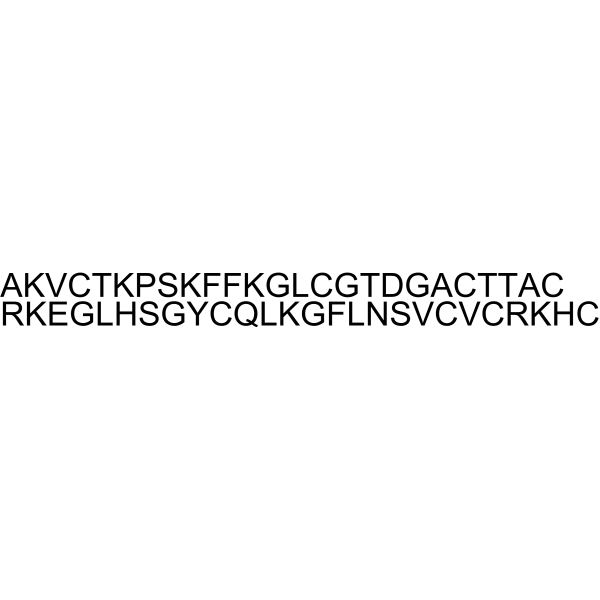
Ala-Lys-Val-Cys-Thr-Lys-Pro-Ser-Lys-Phe-Phe-Lys-Gly-Leu-Cys-Gly-Thr-Asp-Gly-Ala-Cys-Thr-Thr-Ala-Cys-Arg-Lys-Glu-Gly-Leu-His-Ser-Gly-Tyr-Cys-Gln-Leu-Lys-Gly-Phe-Leu-Asn-Ser-Val-Cys-Val-Cys-Arg-Lys-His-Cys (Disulfide bridge:Cys4-Cys51,Cys15-Cys35,Cys21-Cys45,Cys25-Cys47)
-
Sequence Shortening
AKVCTKPSKFFKGLCGTDGACTTACRKEGLHSGYCQLKGFLNSVCVCRKHC (Disulfide bridge:Cys4-Cys51,Cys15-Cys35,Cys21-Cys45,Cys25-Cys47)
-
Shipping
Room temperature in continental US; may vary elsewhere.
-
Storage
Please store the product under the recommended conditions in the Certificate of Analysis.


Purity & Documentation
References

Calculators
Concentration (start) × Volume (start) = Concentration (final) × Volume (final)


Pezadeftide Related Classifications
HY-P3384 Related Classifications
 Powered by Bioz