



HMBPP lithium

Based on 1 Customer Validation
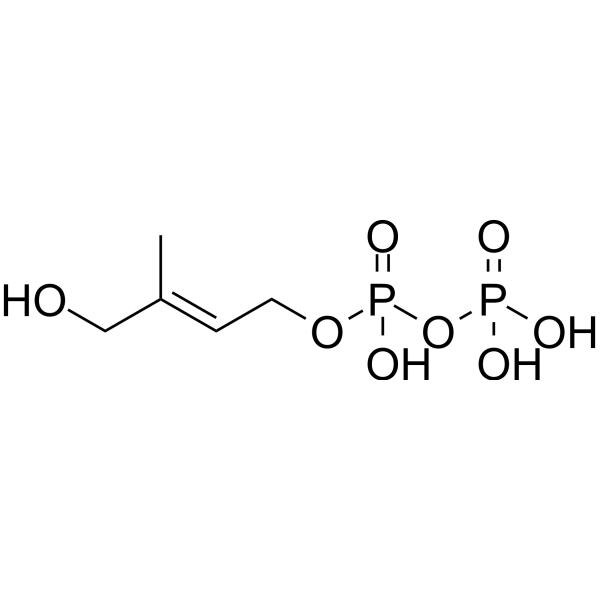
HMBPP lithium is an intermediate in isoprenoid biosynthesis that can be produced by bacteria and protozoa that use the non-mevalonate pathway for isoprenoid biosynthesis. HMBPP lithium is a ligand of the internal domain of BTN3A1 and is an activator for human Vγ9/Vδ2 T cells. HMBPP lithium exhibits phagostimulant property in mosquitos.
Nur für Forschungszwecke. Wir verkaufen nicht an Patienten.
- Reinheit : 98%
- CAS. Nr.: 396726-03-7
- Formel: C5H9Li3O8P2
- Molecular Weight:279.89
-
Speicherung:
-20°C, sealed storage, away from moisture and light
* In solvent : -80°C, 6 months; -20°C, 1 month (sealed storage, away from moisture and light)

To place orders, for customer services and technical support, please contact: MedChemExpress USA
Tel: 609-228-6898 E-mail: [email protected] [email protected]


-
 Biologische Aktivität
-
Chemical Information
-
Lösungsmittel & Löslichkeit
- Reinheit & Dokumentation
- Verweise
-
 Help & FAQs




Biologische Aktivität
Beschreibung
In Vitro
HMBPP (10 μM) lithium stimulates the mosquito feeding behaviour in main mosquito vectors (HMBPP-supplemented red blood cells)[2].
HMBPP (10 μM, 12 h) lithium activates human purified γδ T cell, and increases CD69, intracellular perforin, IFN-γ, and TNF-α production when γδ T cell are incubated with GBM cells (U251, U373 and primary GBM cultures)[3].
MedChemExpress (MCE) has not independently confirmed the accuracy of these methods. They are for reference only.
In Vivo
MedChemExpress (MCE) has not independently confirmed the accuracy of these methods. They are for reference only.
-
Animal Model:Macaques infected with Y.pestis, 5 hours after inhalational Y.pestis infection, the macaques received HMBPP plus IL-2[5]
-
Dosage:50 mg/kg
-
Administration:i.m., plus IL-2 (s.c., 1 million unit, once daily for 5 days)
-
Result:Induced Vγ2Vδ2 T cell accumulation localized in pulmonary interstitials surrounding bloodvessels and airway mucosa in the lung tissues with no or mildplague lesions.
Attenuated inhalation plague lesions in lungs.


Chemical Information
-
CAS. Nr. 396726-03-7
-
Appearance Solid
-
Molecular Weight 279.89
-
Formel C5H9Li3O8P2
-
Color White to off-white
-
SMILES
O=P(OP(O[Li])(O[Li])=O)(O[Li])OC/C=C(C)/CO
-
Synonyms
(E)-4-Hydroxy-3-methyl-but-2-enyl diphosphate lithium
-
Structure Classification
-
Initial Source
Escherichia coli
-
Versand
Room temperature in continental US; may vary elsewhere.
-
Speicherung
-20°C, sealed storage, away from moisture and light
* In solvent : -80°C, 6 months; -20°C, 1 month (sealed storage, away from moisture and light)


Lösungsmittel & Löslichkeit
In Vitro:
H2O : 2.5 mg/mL (8.93 mM; ultrasonic and warming and heat to 60°C)
Please refer to the solubility information to select the appropriate solvent. Once prepared, please aliquot and store the solution to prevent product inactivation from repeated freeze-thaw cycles.
Storage method and period of stock solution: -80°C, 6 months; -20°C, 1 month (sealed storage, away from moisture and light). When stored at -80°C, please use it within 6 months. When stored at -20°C, please use it within 1 month.
* Note: If you choose water as the stock solution, please dilute it to the working solution, then filter and sterilize it with a 0.22 μm filter before use.
Please refer to the solubility information to select the appropriate solvent. Once prepared, please aliquot and store the solution to prevent product inactivation from repeated freeze-thaw cycles.
Storage method and period of stock solution: -80°C, 6 months; -20°C, 1 month (sealed storage, away from moisture and light). When stored at -80°C, please use it within 6 months. When stored at -20°C, please use it within 1 month.
* Note: If you choose water as the stock solution, please dilute it to the working solution, then filter and sterilize it with a 0.22 μm filter before use.
Konzentration (Stammlösung) × Volumen (Stammlösung) = Konzentration (Ziellösung) × Volumen (Ziellösung)


Reinheit & Dokumentation
-
Data Sheet (273 KB)
-
SDS (393 KB)
- English - EN (393 KB)
- Français - FR (393 KB)
- Deutsch - DE (393 KB)
- Norwegian - NO (393 KB)
- Español - ES (393 KB)
- Swedish - SV (393 KB)
- Italian - IT (393 KB)
- Korean - KR (393 KB)
- Portuguese - PT (393 KB)
-
Handling Instructions (2659 KB)
Verweise
[1]. Hintz M, et al., Identification of (E)-4-hydroxy-3-methyl-but-2-enyl pyrophosphate as a major activator for human gammadelta T cells in Escherichia coli. FEBS Lett. 2001 Dec 7;509(2):317-22. [Content Brief]
[2]. Stromsky VE, et al., Plasmodium metabolite HMBPP stimulates feeding of main mosquito vectors on blood and artificial toxic sources. Commun Biol. 2021 Oct 7;4(1):1161. [Content Brief]
[3]. Rosso DA, et al. Glioblastoma cells potentiate the induction of the Th1-like profile in phosphoantigen-stimulated γδ T lymphocytes. J Neurooncol. 2021 Jul;153(3):403-415. [Content Brief]
[4]. Nguyen K,et al. The butyrophilin 3A1 intracellular domain undergoes a conformational change involving the juxtamembrane region. FASEB J. 2017 Nov;31(11):4697-4706. [Content Brief]
[5]. Huang D, et al. Antigen-specific Vgamma2Vdelta2 T effector cells confer homeostatic protection against pneumonic plaque lesions. Proc Natl Acad Sci U S A. 2009 May 5;106(18):7553-8. [Content Brief]


Complete Stock Solution Preparation Table
Please refer to the solubility information to select the appropriate solvent. Once prepared, please aliquot and store the solution to prevent product inactivation from repeated freeze-thaw cycles.
Storage method and period of stock solution: -80°C, 6 months; -20°C, 1 month (sealed storage, away from moisture and light). When stored at -80°C, please use it within 6 months. When stored at -20°C, please use it within 1 month.
| Optional Solvent | Concentration Solvent Mass | 1 mg | 5 mg | 10 mg | 25 mg |
|---|---|---|---|---|---|
| H2O | 1 mM | 3.5728 mL | 17.8642 mL | 35.7283 mL | 89.3208 mL |
| 5 mM | 0.7146 mL | 3.5728 mL | 7.1457 mL | 17.8642 mL |
* Note: If you choose water as the stock solution, please dilute it to the working solution, then filter and sterilize it with a 0.22 μm filter before use.


HMBPP lithium Related Classifications
HY-134891 Related Classifications
 Powered by Bioz