



IRAK4-IN-16
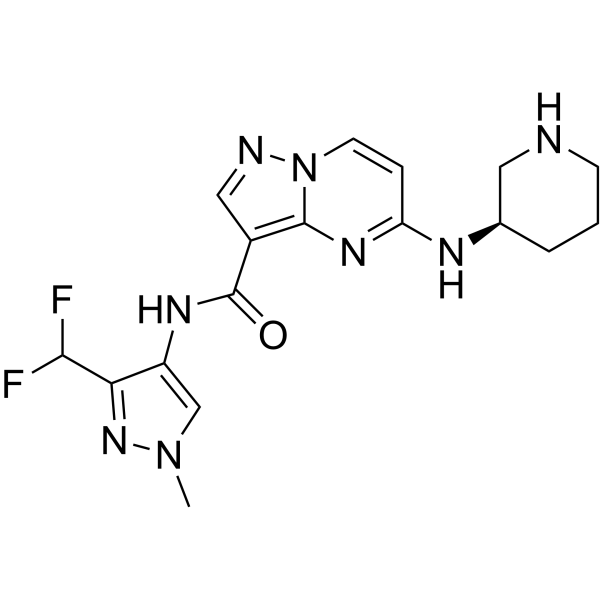
IRAK4-IN-16 (compound 4) is a potent IRAK4 (interleukin-1 receptor associated kinase 4) inhibitor, with an IC50 of 2.5 nM. IRAK4-IN-16 shows cytotoxicity activity against OCI-LY10, TMD8, Ramos and HT cells, with IC50 values of 0.2, 0.2, 0.6, and 2.7 μM, respectively.
Para uso exclusivo en investigación. No vendemos a pacientes.
- No. CAS: 1812188-83-2
- Fòrmula: C17H20F2N8O
- Peso molecular:390.39
-
Almacenamiento:
Please store the product under the recommended conditions in the Certificate of Analysis.

To place orders, for customer services and technical support, please contact: MedChemExpress USA
Tel: 609-228-6898 E-mail: [email protected] [email protected]


-
 Actividad biológica
-
Chemical Information
- Protocolo
- Pureza y Documentación
- Referencias
-
 Help & FAQs




Actividad biológica
Descripciòn
IC50 & Target
|
IRAK4 2.5 ± 0.8 nM (IC50) |
Cellular Effect
|
Cell Line

|
Type | Value | Description | References |
|---|---|---|---|---|
| HT | IC50 |
2.7 μM
Compound: 4
|
Cytotoxicity against human HT cells harboring MYD88 assessed as reduction in cell viability incubated for 72 hrs by CCK-8 assay
Cytotoxicity against human HT cells harboring MYD88 assessed as reduction in cell viability incubated for 72 hrs by CCK-8 assay
|
[PMID: 32014679] |
| OCI-Ly10 | IC50 |
0.2 μM
Compound: 4
|
Cytotoxicity against human OCILY10 cells harboring MYD88 L265P mutant assessed as reduction in cell viability incubated for 72 hrs by CCK-8 assay
Cytotoxicity against human OCILY10 cells harboring MYD88 L265P mutant assessed as reduction in cell viability incubated for 72 hrs by CCK-8 assay
|
[PMID: 32014679] |
| Ramos | IC50 |
0.6 μM
Compound: 4
|
Cytotoxicity against human Ramos cells harboring MYD88 assessed as reduction in cell viability incubated for 72 hrs by CCK-8 assay
Cytotoxicity against human Ramos cells harboring MYD88 assessed as reduction in cell viability incubated for 72 hrs by CCK-8 assay
|
[PMID: 32014679] |
| TMD8 | IC50 |
0.2 μM
Compound: 4
|
Cytotoxicity against human TMD8 cells harboring MYD88 L265P mutant assessed as reduction in cell viability incubated for 72 hrs by CCK-8 assay
Cytotoxicity against human TMD8 cells harboring MYD88 L265P mutant assessed as reduction in cell viability incubated for 72 hrs by CCK-8 assay
|
[PMID: 32014679] |


Chemical Information
-
No. CAS 1812188-83-2
-
Peso molecular 390.39
-
Fòrmula C17H20F2N8O
-
SMILES
FC(F)C1=NN(C=C1NC(C2=C3N(C=CC(N[C@@H]4CCCNC4)=N3)N=C2)=O)C
-
Envío
Room temperature in continental US; may vary elsewhere.
-
Almacenamiento
Please store the product under the recommended conditions in the Certificate of Analysis.

Protocolo
-
Cell Cytotoxicity Assay
Cytotoxicity assays are usually based on the assessment of cell membrane damage, which can also be indirectly detected by measuring cell viability. Detection methods include MTT assay, CKK-8 assay, LDH assay and ATP assay, etc.
-
Mammalian live/dead viability and cytotoxicity staining
Live/dead viability and cytotoxicity staining assays are based on the simultaneous detection of intracellular esterase activity in metabolically active (viable) cells and membrane integrity loss in non-viable cells. In commonly used dual-staining approaches, membrane-permeant fluorogenic substrates are converted by intracellular esterases into fluorescent products in live cells, while impermeant DNA-binding dyes selectively enter cells with compromised plasma membranes and label nucleic acids in dead or dying cells, enabling discrimination between viable and non-viable populations by fluorescence microscopy or flow cytometry.
-
Cell Viability Determination by MTT Colorimetric Assay
The following protocol uses the MTT colorimetric assay as a classic literature-established method for assessing cell viability/metabolic activity in cultured mammalian cells. MTT[3-(4,5-dimethylthiazol-2-yl)-2,5-diphenyltetrazolium bromide] is reduced by metabolically active cells to a colored formazan product; the amount of formazan is quantified spectrophotometrically and provides an indirect measure of metabolically active viable cells. Importantly, MTT reduction reflects cellular oxidoreductase/metabolic activity rather than an absolute direct count of living cells, so changes in cellular metabolism can alter the signal independently of cell number.


Pureza y Documentación
Referencias

Calculators
Concentration (start) × Volume (start) = Concentration (final) × Volume (final)


IRAK4-IN-16 Related Classifications
HY-150593 Related Classifications
 Powered by Bioz