



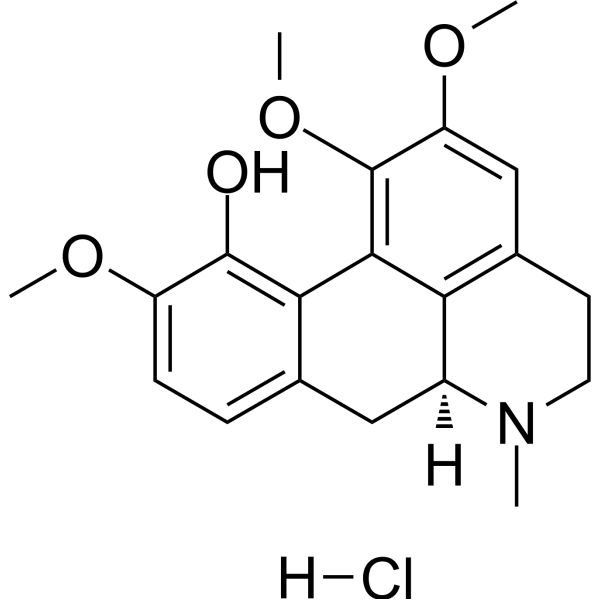
Isocorydine hydrochloride
Isocorydine hydrochloride is isolated from Dicranostigma leptopodum (Maxim.) Fedde (DLF). Isocorydine hydrochloride combines with Doxorubicin (DOX) has a promising potential to eradicate hepatocellular carcinoma (HCC).
For research use only. We do not sell to patients.
- CAS No.: 13552-72-2
- Formula: C20H24ClNO4
- Molecular Weight:377.86
-
Storage:
Please store the product under the recommended conditions in the Certificate of Analysis.

To place orders, for customer services and technical support, please contact: MedChemExpress USA
Tel: 609-228-6898 E-mail: [email protected] [email protected]


-
 Biological Activity
-
Chemical Information
- Protocols
- Purity & Documentation
- References
-
 Help & FAQs


All Endogenous Metabolite Isoforms
More

Biological Activity
Description
IC50 & Target
|
Human Endogenous Metabolite |


Chemical Information
-
CAS No. 13552-72-2
-
Molecular Weight 377.86
-
Formula C20H24ClNO4
-
SMILES
COC1=C2C3=C(C=C1OC)CCN(C)[C@@]3([H])CC4=CC=C(OC)C(O)=C24.[H]Cl
-
Structure Classification
-
Initial Source
-
Shipping
Room temperature in continental US; may vary elsewhere.
-
Storage
Please store the product under the recommended conditions in the Certificate of Analysis.

Protocols
-
Liver Cancer Modeling
Liver cancer can be classified into primary liver cancer and secondary liver cancer. Secondary liver cancer is the metastatic liver cancer. Primary liver cancer includes hepatocellular carcinoma (HCC), intrahepatic cholangiocarcinoma (ICC) and fibrolamellar HCC, of which HCC is the most common form, accounting for approximately 90% of primary liver cancers[1]. HCC mouse models include chemical agent-induced models, transplanted tumor models, and genetic engineered models.


Purity & Documentation
References

Calculators
Concentration (start) × Volume (start) = Concentration (final) × Volume (final)


Isocorydine hydrochloride Related Classifications
HY-N2591A Related Classifications
 Powered by Bioz