



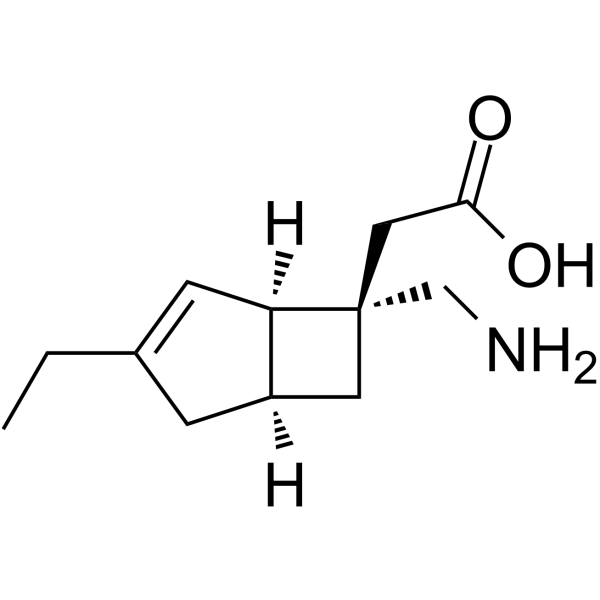
Mirogabalin
Based on 6 publication(s) in Google Scholar
Mirogabalin (DS-5565) is a novel, preferentially selective α2δ-1 ligand characterized by high potency and selectivity to the α2δ-1 subunit of voltage-sensitive calcium channel complexes in the CNS.
For research use only. We do not sell to patients.
- Purity : 99.22%
- CAS No.: 1138245-13-2
- Formula: C12H19NO2
- Molecular Weight:209.28
-
Storage:Powder -20°C, 3 years , 4°C, 2 years ; In solvent -80°C, 2 years , -20°C, 1 year

To place orders, for customer services and technical support, please contact: MedChemExpress USA
Tel: 609-228-6898 E-mail: [email protected] [email protected]


-
 Biological Activity
-
Chemical Information
-
Solvent & Solubility
- Purity & Documentation
- References
-
 Help & FAQs



Publications Citing Use of MedChemExpress (MCE) Mirogabalin
More- Cell Commun Signal. 2024 Feb 1;22(1):92. [Abstract]
- Brain Behav Immun. 2021 Jul:95:344-361. [Abstract]
- Pharmaceuticals (Basel). 2023 Jul 19;16(7):1023. [Abstract]
- Pharmaceuticals (Basel). 2022 Jan 13;15(1):88. [Abstract]
- Molecules. 2023 Nov 30;28(23):7862. [Abstract]
- Pharmacol Rep. 2026 May 28. [Abstract]
All Calcium Channel Isoforms
More

Biological Activity
Description
IC50 & Target
α2δ-1 Calcium Channel[1]
In Vitro
Mirogabalin (DS-5565) is a novel, preferentially selective α2δ-1 ligand characterized by high potency and selectivity to the α2δ-1 subunit of voltage-sensitive calcium-channel complexes in the central nervous system (CNS). In vitro experiments using membrane preparations from human and rat α2δ subunit-expressed cells show that Mirogabalin had a slower dissociation rate from α2δ-1 than α2δ-2, in particular, α2δ-1 compared with Pregabalin. Additionally, Mirogabalin shows potent, sustained analgesic effects in streptozotocin-induced diabetic rats with induces pain, and the superior analgesic effects and wider CNS safety margin relative to Pregabalin are attributed to its selectivity for and slow dissociation from α2δ-1 compared with Pregabalin[1]. Mirogabalin (DS-5565) is an α2δ-1 ligand being developed for pain associated with diabetic peripheral neuropathy, fibromyalgia, and postherpetic neuralgia. Mirogabalin targets α2δ-1, an auxiliary protein associated with voltage-sensitive calcium channel complexes in the central nervous system. This binding reduces calcium influx at nerve terminals, therefore reducing the release of several pain neurotransmitters. The ED50 (on the transformed scale) for Mirogabalin is estimated to be 20.5 mg with a 90% confidence interval (CI) of 10.1-41.7 mg[2].
MedChemExpress (MCE) has not independently confirmed the accuracy of these methods. They are for reference only. .
In Vivo
MedChemExpress (MCE) has not independently confirmed the accuracy of these methods. They are for reference only.


Chemical Information
-
CAS No. 1138245-13-2
-
Appearance Solid
-
Molecular Weight 209.28
-
Formula C12H19NO2
-
Color Light yellow to light brown
-
SMILES
O=C(O)C[C@]1(CN)[C@]2([H])C=C(CC)C[C@]2([H])C1
-
Synonyms
DS5565
-
Shipping
Room temperature in continental US; may vary elsewhere.
-
Storage
Powder -20°C 3 years 4°C 2 years In solvent -80°C 2 years -20°C 1 year


Publications (6)
-
Journal Impact Factor
-
Most Recent
-
Cell Commun Signal
T-type voltage-gated channels, Na+/Ca2+-exchanger, and calpain-2 promote photoreceptor cell death in inherited retinal degeneration. [Abstract]2024 Feb 1;22(1):92. PMID: 38303059 -
Brain Behav Immun
Microglial IL-10 and β-endorphin expression mediates gabapentinoids antineuropathic pain. [Abstract]2021 Jul:95:344-361. PMID: 33862171 -
Pharmaceuticals (Basel)
Mirogabalin Decreases Pain-like Behaviors by Inhibiting the Microglial/Macrophage Activation, p38MAPK Signaling, and Pronociceptive CCL2 and CCL5 Release in a Mouse Model of Neuropathic Pain. [Abstract]2023 Jul 19;16(7):1023. PMID: 37513935 -
Pharmaceuticals (Basel)
Mirogabalin Decreases Pain-like Behaviours and Improves Opioid and Ketamine Antinociception in a Mouse Model of Neuropathic Pain. [Abstract]2022 Jan 13;15(1):88. PMID: 35056145 -
Molecules
Naturally Inspired Molecules for Neuropathic Pain Inhibition-Effect of Mirogabalin and Cebranopadol on Mechanical and Thermal Nociceptive Threshold in Mice. [Abstract]2023 Nov 30;28(23):7862. PMID: 38067591 -
Pharmacol Rep
Therapeutic potential of combining mirogabalin with antidepressants in relieving hypersensitivity: evidence from a mouse model of neuropathic pain. [Abstract]2026 May 28. PMID: 42207469


Solvent & Solubility
In Vitro:
H2O : 7.71 mg/mL (36.84 mM; Need ultrasonic)
DMSO : < 1 mg/mL (insoluble or slightly soluble)
Please refer to the solubility information to select the appropriate solvent. Once prepared, please aliquot and store the solution to prevent product inactivation from repeated freeze-thaw cycles.
Storage method and period of stock solution: -80°C, 2 years; -20°C, 1 year. When stored at -80°C, please use it within 2 years. When stored at -20°C, please use it within 1 year.
* Note: If you choose water as the stock solution, please dilute it to the working solution, then filter and sterilize it with a 0.22 μm filter before use.
Please refer to the solubility information to select the appropriate solvent. Once prepared, please aliquot and store the solution to prevent product inactivation from repeated freeze-thaw cycles.
Storage method and period of stock solution: -80°C, 2 years; -20°C, 1 year. When stored at -80°C, please use it within 2 years. When stored at -20°C, please use it within 1 year.
* Note: If you choose water as the stock solution, please dilute it to the working solution, then filter and sterilize it with a 0.22 μm filter before use.
Concentration (start) × Volume (start) = Concentration (final) × Volume (final)
In Vivo:
Select the appropriate dissolution method based on your experimental animal and administration route.
- For the following dissolution methods, please ensure to first prepare a clear stock solution using an In Vitro approach and then sequentially add co-solvents:
- To ensure reliable experimental results, the clarified stock solution can be appropriately stored based on storage conditions. As for the working solution for In Vivo experiments, it is recommended to prepare freshly and use it on the same day.
- The percentages shown for the solvents indicate their volumetric ratio in the final prepared solution. If precipitation or phase separation occurs during preparation, heat and/or sonication can be used to aid dissolution.
Add each solvent one by one: 10% DMSO 40% PEG300 5% Tween-80 45% Saline
Solubility: ≥ 0.83 mg/mL (3.97 mM); Clear solution
This protocol yields a clear solution of ≥ 0.83 mg/mL (saturation unknown).
Taking 1 mL working solution as an example, add 100 μL DMSO stock solution (8.3 mg/mL) to 400 μL PEG300, and mix evenly; then add 50 μL Tween-80 and mix evenly; then add 450 μL Saline to adjust the volume to 1 mL.
Preparation of Saline: Dissolve 0.9 g sodium chloride in ddH₂O and dilute to 100 mL to obtain a clear Saline solution.
Add each solvent one by one: 10% DMSO 90% (20% SBE-β-CD in Saline)
Solubility: ≥ 0.83 mg/mL (3.97 mM); Clear solution
This protocol yields a clear solution of ≥ 0.83 mg/mL (saturation unknown).
Taking 1 mL working solution as an example, add 100 μL DMSO stock solution (8.3 mg/mL) to 900 μL 20% SBE-β-CD in Saline, and mix evenly.
Preparation of 20% SBE-β-CD in Saline (4°C, storage for one week): 2 g SBE-β-CD powder is dissolved in 10 mL Saline, completely dissolve until clear.
For the following dissolution methods, please prepare the working solution directly:
It is recommended to prepare fresh solutions and use them promptly within a short period of time.
The percentages shown for the solvents indicate their volumetric ratio in the final prepared solution. If precipitation or phase separation occurs during preparation, heat and/or sonication can be used to aid dissolution.
Add each solvent one by one: PBS
Solubility: 10 mg/mL (47.78 mM); Clear solution; Need ultrasonic
In Vivo Dissolution Calculator
Please enter the basic information of animal experiments:
-
-
-
-
Recommended: Prepare an additional quantity of animals to account for potential losses during experiments.
Please enter your animal formula composition:
-
%DMSO +
Recommended: Keep the proportion of DMSO in working solution below 2% if your animal is weak.
-
%+
-
+%Tween-80 + +
-
%Saline +
The co-solvents required include: DMSO, . All of co-solvents are available by MedChemExpress (MCE). , Tween 80. All of co-solvents are available by MedChemExpress (MCE).
Working solution concentration: 0.22 mg/mL
Method for preparing stock solution: mg drug dissolved in μL DMSO. Stock solution concentration: mg/mL.
1. Take μL DMSO stock solution;
2. Add μL .
μL , mix evenly;
3. Then add μL Tween 80, mix evenly;
4. Then add μL
Please ensure that the stock solution in the first step is dissolved to a clear state, and add co-solvents in sequence. You can use ultrasonic heating (ultrasonic cleaner, recommended frequency 20-40 kHz), vortexing, etc. to assist dissolution.


Purity & Documentation
-
Data Sheet (276 KB)
-
SDS (393 KB)
- English - EN (393 KB)
- Français - FR (393 KB)
- Deutsch - DE (393 KB)
- Norwegian - NO (393 KB)
- Español - ES (393 KB)
- Swedish - SV (393 KB)
- Italian - IT (393 KB)
- Korean - KR (393 KB)
- Portuguese - PT (393 KB)
-
Handling Instructions (2659 KB)
References
[1]. Vinik A, et al. Efficacy and safety of Mirogabalin (DS-5565) for the treatment of diabetic peripheral neuropathic pain: a randomized, double-blind, placebo- and active comparator-controlled, adaptive proof-of-concept phase 2 study. Diabetes Care. 2014 Dec [Content Brief]
[2]. Hutmacher MM, et al. Exposure-response modeling of average daily pain score, and dizziness and somnolence, forMirogabalin (DS-5565) in patients with diabetic peripheral neuropathic pain. J Clin Pharmacol. 2016 Jan;56(1):67-77. [Content Brief]


Complete Stock Solution Preparation Table
Please refer to the solubility information to select the appropriate solvent. Once prepared, please aliquot and store the solution to prevent product inactivation from repeated freeze-thaw cycles.
Storage method and period of stock solution: -80°C, 2 years; -20°C, 1 year. When stored at -80°C, please use it within 2 years. When stored at -20°C, please use it within 1 year.
| Optional Solvent | Concentration Solvent Mass | 1 mg | 5 mg | 10 mg | 25 mg |
|---|---|---|---|---|---|
| H2O | 1 mM | 4.7783 mL | 23.8914 mL | 47.7829 mL | 119.4572 mL |
| 5 mM | 0.9557 mL | 4.7783 mL | 9.5566 mL | 23.8914 mL | |
| 10 mM | 0.4778 mL | 2.3891 mL | 4.7783 mL | 11.9457 mL | |
| 15 mM | 0.3186 mL | 1.5928 mL | 3.1855 mL | 7.9638 mL | |
| 20 mM | 0.2389 mL | 1.1946 mL | 2.3891 mL | 5.9729 mL | |
| 25 mM | 0.1911 mL | 0.9557 mL | 1.9113 mL | 4.7783 mL | |
| 30 mM | 0.1593 mL | 0.7964 mL | 1.5928 mL | 3.9819 mL |
* Note: If you choose water as the stock solution, please dilute it to the working solution, then filter and sterilize it with a 0.22 μm filter before use.


Mirogabalin Related Classifications
HY-12650 Related Classifications
 Powered by Bioz