



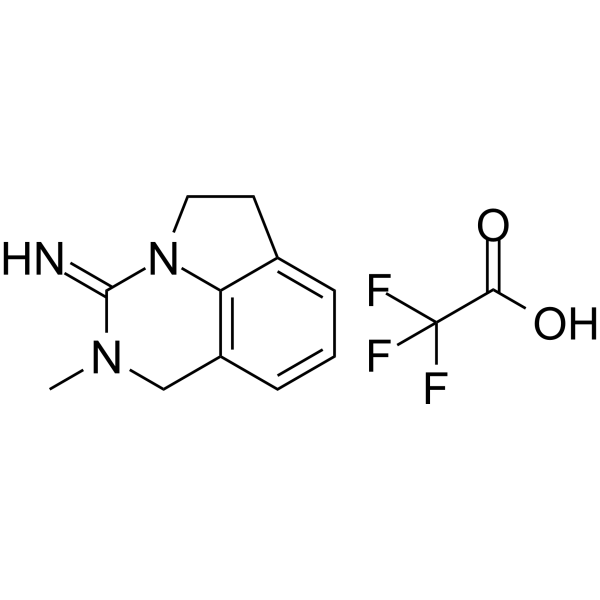
JBSNF-000028 TFA

Based on 1 Customer Validation
JBSNF-00002 TFA is an orally active small molecule inhibitor of the tricyclic nicotinamide N-methyltransferase (NNMT) with IC50 values for human, mouse and monkey sources of NNMT of 33, 210 and 190 nM respectively. JBSNF-00002 TFA can reduce endogenous MNA levels in U2OS osteosarcoma cells, with its EC50 being 2.5 μM. JBSNF-00002 TFA exhibits significant anti-obesity and anti-diabetic activities in the diet-induced obesity (DIO) model. JBSNF-00002 TFA can be used for the study of metabolic diseases such as obesity, type 2 diabetes and non-alcoholic fatty liver disease.
For research use only. We do not sell to patients.
- Purity : 99.47%
- Formula: C13H14F3N3O2
- Molecular Weight:301.26
-
Storage:
4°C, sealed storage, away from moisture and light
* In solvent : -80°C, 6 months; -20°C, 1 month (sealed storage, away from moisture and light)

To place orders, for customer services and technical support, please contact: MedChemExpress USA
Tel: 609-228-6898 E-mail: [email protected] [email protected]


-
 Biological Activity
-
Chemical Information
-
Solvent & Solubility
- Protocols
- Purity & Documentation
- References
-
 Help & FAQs




Biological Activity
Description
IC50 & Target
IC50: 0.033 μM (hNNMT), 0.19 μM (mkNNMT), 0.21 μM (mNNMT)[1]
In Vitro
JBSNF-000028 TFA (24 h) inhibits NNMT activity with an EC50 of 2.5 μM in U2OS cells[1].
JBSNF-000028 TFA (10-100 μM; 72 h) has no cytotoxicity against HepG2 cells[1].
JBSNF-000028 TFA binds below a hairpin structural motif at the nicotinamide pocket and stacks between Tyr-204 (from Hairpin) and Leu-164 (from central domain)[1].
JBSNF-000028 TFA is inactive against a broad panel of targets related to metabolism and safety[1].
MedChemExpress (MCE) has not independently confirmed the accuracy of these methods. They are for reference only. Further protocols information, click here.
In Vivo
JBSNF-000028 TFA (50 mg/kg; p.o.; twice daily for 4 weeks) improves glucose tolerance in NNMT knockout mice with diet-induced obesity[1].
MedChemExpress (MCE) has not independently confirmed the accuracy of these methods. They are for reference only.


Chemical Information
-
Appearance Solid
-
Molecular Weight 301.26
-
Formula C13H14F3N3O2
-
Color White to off-white
-
SMILES
CN1CC2=C3C(CCN3C1=N)=CC=C2.FC(F)(C(O)=O)F
-
Shipping
Room temperature in continental US; may vary elsewhere.
-
Storage
4°C, sealed storage, away from moisture and light
* In solvent : -80°C, 6 months; -20°C, 1 month (sealed storage, away from moisture and light)


Solvent & Solubility
In Vitro:
DMSO : ≥ 100 mg/mL (331.94 mM; Hygroscopic DMSO has a significant impact on the solubility of product, please use newly opened DMSO)
* "≥" means soluble, but saturation unknown.
Please refer to the solubility information to select the appropriate solvent. Once prepared, please aliquot and store the solution to prevent product inactivation from repeated freeze-thaw cycles.
Storage method and period of stock solution: -80°C, 6 months; -20°C, 1 month (sealed storage, away from moisture and light). When stored at -80°C, please use it within 6 months. When stored at -20°C, please use it within 1 month.
Please refer to the solubility information to select the appropriate solvent. Once prepared, please aliquot and store the solution to prevent product inactivation from repeated freeze-thaw cycles.
Storage method and period of stock solution: -80°C, 6 months; -20°C, 1 month (sealed storage, away from moisture and light). When stored at -80°C, please use it within 6 months. When stored at -20°C, please use it within 1 month.
Concentration (start) × Volume (start) = Concentration (final) × Volume (final)

Protocols
-
Research Protocol for Metabolic Diseases
AMP-activated protein kinase, AMPK, is a conserved cellular energy sensor that responds to reduced cellular energy status and coordinates metabolism by increasing ATP-generating catabolic pathways while suppressing ATP-consuming anabolic processes. In metabolic disease research, the AMPK pathway is experimentally relevant because it regulates hepatic lipid synthesis, fatty acid oxidation, glucose production, skeletal-muscle glucose disposal, mTORC1-linked biosynthesis, autophagy, mitochondrial homeostasis, and whole-body energy balance. The central pathway logic is that energy stress, metformin, exercise-like stimulation, or direct AMPK activators increase AMPKα Thr172 phosphorylation and downstream substrate phosphorylation, including ACC and RAPTOR. Phosphorylation of ACC suppresses lipogenesis and supports fatty acid oxidation, whereas phosphorylation of RAPTOR suppresses mTORC1 signaling and links cellular energy status to growth and protein synthesis control. The pathway is linked


Purity & Documentation
-
Data Sheet (271 KB)
-
SDS (252 KB)
- English - EN (252 KB)
- Français - FR (252 KB)
- Deutsch - DE (252 KB)
- Norwegian - NO (252 KB)
- Español - ES (252 KB)
- Swedish - SV (252 KB)
- Italian - IT (252 KB)
- Korean - KR (252 KB)
- Portuguese - PT (252 KB)
-
Handling Instructions (2659 KB)
References


Complete Stock Solution Preparation Table
Please refer to the solubility information to select the appropriate solvent. Once prepared, please aliquot and store the solution to prevent product inactivation from repeated freeze-thaw cycles.
Storage method and period of stock solution: -80°C, 6 months; -20°C, 1 month (sealed storage, away from moisture and light). When stored at -80°C, please use it within 6 months. When stored at -20°C, please use it within 1 month.
| Optional Solvent | Concentration Solvent Mass | 1 mg | 5 mg | 10 mg | 25 mg |
|---|---|---|---|---|---|
| DMSO | 1 mM | 3.3194 mL | 16.5970 mL | 33.1939 mL | 82.9848 mL |
| 5 mM | 0.6639 mL | 3.3194 mL | 6.6388 mL | 16.5970 mL | |
| 10 mM | 0.3319 mL | 1.6597 mL | 3.3194 mL | 8.2985 mL | |
| 15 mM | 0.2213 mL | 1.1065 mL | 2.2129 mL | 5.5323 mL | |
| 20 mM | 0.1660 mL | 0.8298 mL | 1.6597 mL | 4.1492 mL | |
| 25 mM | 0.1328 mL | 0.6639 mL | 1.3278 mL | 3.3194 mL | |
| 30 mM | 0.1106 mL | 0.5532 mL | 1.1065 mL | 2.7662 mL | |
| 40 mM | 0.0830 mL | 0.4149 mL | 0.8298 mL | 2.0746 mL | |
| 50 mM | 0.0664 mL | 0.3319 mL | 0.6639 mL | 1.6597 mL | |
| 60 mM | 0.0553 mL | 0.2766 mL | 0.5532 mL | 1.3831 mL | |
| 80 mM | 0.0415 mL | 0.2075 mL | 0.4149 mL | 1.0373 mL | |
| 100 mM | 0.0332 mL | 0.1660 mL | 0.3319 mL | 0.8298 mL |


JBSNF-000028 TFA Related Classifications
HY-151500A Related Classifications
 Powered by Bioz