



GluR23Y
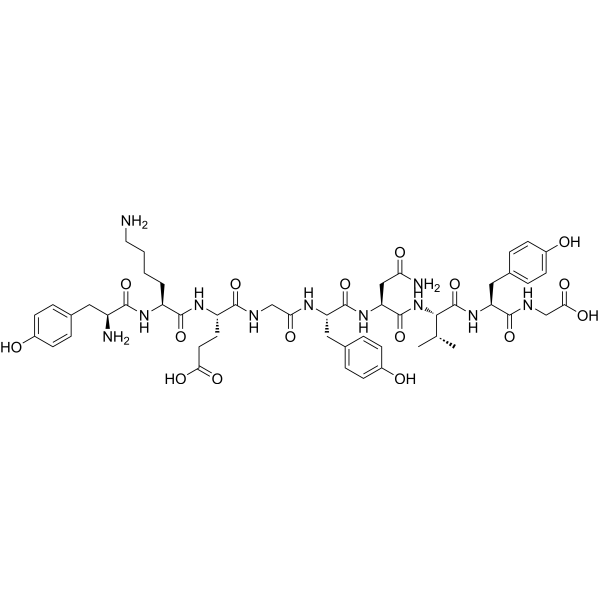
GluR23Y is a biological active peptide. (This GluR23Y peptide was used in ELISA cell-surface assay for the insulin-stimulated endocytosis of native AMPA receptors in cultured hippocampal neurons. GluR23Y prevented any insulin-induced reduction. The blockade of insulin action was observed when the GluR23Y peptide was delivered into neurons by fusing it to the membrane transduction domain of HIV-1.)
商品は「研究用試薬」です。人や動物の医療用・臨床診断用・食品用の製品ではありません。
研究用途以外に使用した場合、当社は一切の責任を負いかねます。
- CAS 番号: 696659-27-5
- 分子式: C51H69N11O16
- 分子量:1092.16
-
保管条件:
Please store the product under the recommended conditions in the Certificate of Analysis.

To place orders, for customer services and technical support, please contact: MedChemExpress USA
Tel: 609-228-6898 E-mail: [email protected] [email protected]


-
 生物活性
生物活性
-
化学情報
- プロトコル
- 純度とドキュメンテーション
-
 Help & FAQs


iGluR アイソフォーム固有の製品をすべて表示
More

生物活性
製品説明


化学情報
-
CAS 番号 696659-27-5
-
分子量 1092.16
-
分子式 C51H69N11O16
-
配列
Tyr-Lys-Glu-Gly-Tyr-Asn-Val-Tyr-Gly
-
シーケンスの短縮
YKEGYNVYG
-
輸送条件
Room temperature in continental US; may vary elsewhere.
-
保管条件
Please store the product under the recommended conditions in the Certificate of Analysis.

プロトコル
-
Enzyme-Linked Immunosorbent Assay (ELISA)
Enzyme-linked immunosorbent assay (ELISA) is a biochemical technology widely used to detect and quantify proteins, antibodies, hormones and other biomolecules. This method uses enzyme-labeled antibodies or antigens to specifically bind to the test substance, and generates a measurable signal through an enzyme-catalyzed reaction. ELISA has the characteristics of high sensitivity, specificity and high-throughput, and is suitable for medical diagnosis, biomedical research and drug development and other fields.
-
Research Protocol for Endocrine Diseases
Endocrine diseases often arise from disrupted hormone production, hormone signaling, or target-tissue responsiveness; for diabetes-focused endocrine disease models, insulin signaling regulates glucose uptake, hepatic glucose output, lipid metabolism, and β-cell compensation. Type 2 diabetes develops through interacting defects in insulin resistance, β-cell dysfunction, adipose inflammation, hepatic glucose overproduction, altered incretin signaling, and ectopic lipid metabolism. A major unresolved question is whether endocrine dysfunction is driven primarily by target-tissue insulin resistance, intrinsic β-cell failure, immune/inflammatory stress, or combined multi-organ failure that differs by disease stage.
-
Primary Embryonic Hippocampal Neuron Culture
Primary embryonic hippocampal neuron culture is an in vitro method in which hippocampi from embryonic rodents are dissected, enzymatically or mechanically dissociated, plated on adhesive substrates, and maintained in defined neuronal medium or in low-density sandwich/co-culture formats to support neuronal attachment, neurite extension, polarity formation, dendritic arborization, and synapse formation. The main readouts are cell survival, neuronal purity, neurite outgrowth, axon-dendrite polarization, synaptic marker development, and functional neuronal activity, assessed by phase-contrast microscopy, immunocytochemistry for neuronal/glial markers, live imaging, or electrophysiology depending on the downstream experiment.


純度とドキュメンテーション

Calculators
濃度 (開始) × 体積 (開始) = 濃度 (終了) × 体積 (終了)


GluR23Y 関連分類
HY-P5487 関連分類
 Powered by Bioz