



Secologanic acid
Based on 1 publication(s) in Google Scholar
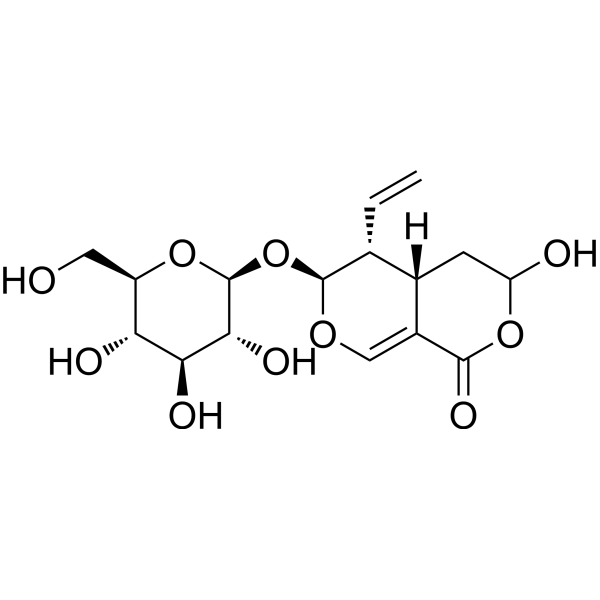
Secologanic acid is a secoiridoid glycoside. Secologanic acid inhibits NO production, the relative expression of AKT and p-AKT. Secologanic acid shows anti-inflammatory activity.
商品は「研究用試薬」です。人や動物の医療用・臨床診断用・食品用の製品ではありません。
研究用途以外に使用した場合、当社は一切の責任を負いかねます。
- 純度 : 98.02%
- CAS 番号: 60077-46-5
- 分子式: C16H22O10
- 分子量:374.34
-
保管条件:Powder -20°C, 3 years ; In solvent -80°C, 6 months , -20°C, 1 month

To place orders, for customer services and technical support, please contact: MedChemExpress USA
Tel: 609-228-6898 E-mail: [email protected] [email protected]


-
 生物活性
生物活性
-
化学情報
-
溶剤 & 溶解度
- プロトコル
- 純度とドキュメンテーション
- 参考文献
-
 Help & FAQs


MedChemExpress(MCE)の使用を引用している文献 Secologanic acid
More

生物活性
製品説明
体外実験
Secologanic acid (2 h) inhibits nitric oxide (NO) production in LPS-activated rat peritoneal macrophages with an inhibition rate of 31.5%[1].
Secologanic acid (5-80 μM; 1-24 h) shows anti-inflammatory activity (reduction of TNF-α mRNA expression) in LPS-activated RAW264.7 mouse macrophages without cytotoxicity[2].
MedChemExpress (MCE) has not independently confirmed the accuracy of these methods. They are for reference only.
-
Cell Line:LPS-activated RAW264.7
-
Concentration:20 μM
-
Incubation Time:24 h
-
Result:Inhibited the relative expression of AKT and p-AKT.


化学情報
-
CAS 番号 60077-46-5
-
性状 Solid
-
分子量 374.34
-
分子式 C16H22O10
-
Color White to off-white
-
SMILES
O=C1C2=CO[C@@H](O[C@H]3[C@@H]([C@H]([C@@H]([C@@H](CO)O3)O)O)O)[C@H](C=C)[C@]2([H])CC(O)O1
-
Structure Classification
-
Initial Source
-
輸送条件
Room temperature in continental US; may vary elsewhere.
-
保管条件
Powder -20°C 3 years In solvent -80°C 6 months -20°C 1 month


Publications (1)
-
Journal Impact Factor
-
Most Recent


溶剤 & 溶解度
体外:
H2O : 25 mg/mL (66.78 mM; Need ultrasonic)
Please refer to the solubility information to select the appropriate solvent. Once prepared, please aliquot and store the solution to prevent product inactivation from repeated freeze-thaw cycles.
Storage method and period of stock solution: -80°C, 6 months; -20°C, 1 month. When stored at -80°C, please use it within 6 months. When stored at -20°C, please use it within 1 month.
* Note: If you choose water as the stock solution, please dilute it to the working solution, then filter and sterilize it with a 0.22 μm filter before use.
Please refer to the solubility information to select the appropriate solvent. Once prepared, please aliquot and store the solution to prevent product inactivation from repeated freeze-thaw cycles.
Storage method and period of stock solution: -80°C, 6 months; -20°C, 1 month. When stored at -80°C, please use it within 6 months. When stored at -20°C, please use it within 1 month.
* Note: If you choose water as the stock solution, please dilute it to the working solution, then filter and sterilize it with a 0.22 μm filter before use.
濃度 (開始) × 体積 (開始) = 濃度 (終了) × 体積 (終了)


純度とドキュメンテーション
-
データシート (274 KB)
-
SDS (393 KB)
- English - EN (393 KB)
- Français - FR (393 KB)
- Deutsch - DE (393 KB)
- Norwegian - NO (393 KB)
- Español - ES (393 KB)
- Swedish - SV (393 KB)
- Italian - IT (393 KB)
- Korean - KR (393 KB)
- Portuguese - PT (393 KB)
-
取扱説明書 (2659 KB)
参考文献
[1]. Tamara L Meragelman, et al. Modified secoiridoid from Acicarpha tribuloides and inhibition of nitric oxide production in LPS-activated macrophages. Phytochemistry. 2006 Jul;67(14):1534-8. [Content Brief]
[2]. Guo X, et al. Network Pharmacology-Based Identification of Potential Targets of Lonicerae japonicae Flos Acting on Anti-Inflammatory Effects. Biomed Res Int. 2021 Sep 20;2021:5507003. [Content Brief]


Complete Stock Solution Preparation Table
Please refer to the solubility information to select the appropriate solvent. Once prepared, please aliquot and store the solution to prevent product inactivation from repeated freeze-thaw cycles.
Storage method and period of stock solution: -80°C, 6 months; -20°C, 1 month. When stored at -80°C, please use it within 6 months. When stored at -20°C, please use it within 1 month.
| Optional Solvent | Concentration Solvent Mass | 1 mg | 5 mg | 10 mg | 25 mg |
|---|---|---|---|---|---|
| H2O | 1 mM | 2.6714 mL | 13.3568 mL | 26.7137 mL | 66.7842 mL |
| 5 mM | 0.5343 mL | 2.6714 mL | 5.3427 mL | 13.3568 mL | |
| 10 mM | 0.2671 mL | 1.3357 mL | 2.6714 mL | 6.6784 mL | |
| 15 mM | 0.1781 mL | 0.8905 mL | 1.7809 mL | 4.4523 mL | |
| 20 mM | 0.1336 mL | 0.6678 mL | 1.3357 mL | 3.3392 mL | |
| 25 mM | 0.1069 mL | 0.5343 mL | 1.0685 mL | 2.6714 mL | |
| 30 mM | 0.0890 mL | 0.4452 mL | 0.8905 mL | 2.2261 mL | |
| 40 mM | 0.0668 mL | 0.3339 mL | 0.6678 mL | 1.6696 mL | |
| 50 mM | 0.0534 mL | 0.2671 mL | 0.5343 mL | 1.3357 mL | |
| 60 mM | 0.0445 mL | 0.2226 mL | 0.4452 mL | 1.1131 mL |
* Note: If you choose water as the stock solution, please dilute it to the working solution, then filter and sterilize it with a 0.22 μm filter before use.


Secologanic acid 関連分類
HY-N7895 関連分類
 Powered by Bioz