



ZIM

Based on 1 Customer Validation
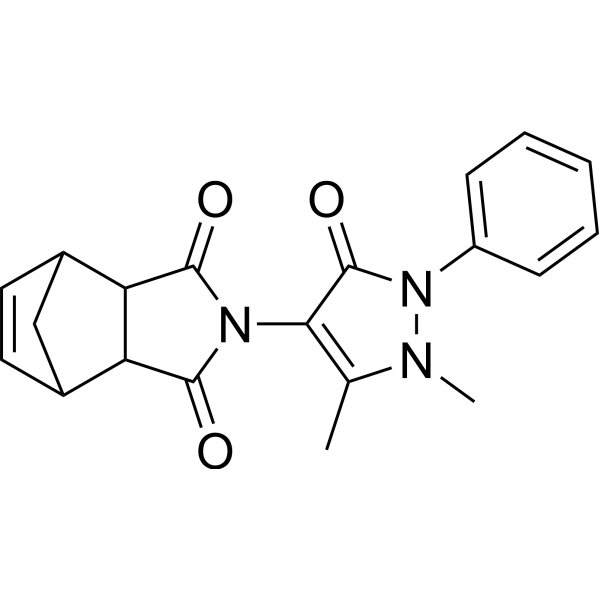
ZIM, a norbornene derived from 4-Aminoantipyrine, is a potent inducer of DNA damage, causing genomic and chromosomal damage as well as inducing cell death and activating phagocytosis. ZIM has chemotherapeutic potential for use in cancer research.
商品は「研究用試薬」です。人や動物の医療用・臨床診断用・食品用の製品ではありません。
研究用途以外に使用した場合、当社は一切の責任を負いかねます。
- 純度 : 99.00%
- CAS 番号: 301298-87-3
- 分子式: C20H19N3O3
- 分子量:349.38
-
保管条件:Powder -20°C, 3 years ; In solvent -80°C, 6 months , -20°C, 1 month

To place orders, for customer services and technical support, please contact: MedChemExpress USA
Tel: 609-228-6898 E-mail: [email protected] [email protected]


-
 生物活性
生物活性
-
化学情報
-
溶剤 & 溶解度
- プロトコル
- 純度とドキュメンテーション
- 参考文献
-
 Help & FAQs


DNA/RNA Synthesis アイソフォーム固有の製品をすべて表示
More

生物活性
製品説明
体内実験
ZIM (i.p., 12, 24 and 48 mg/kg) reduces the frequency of cisplatin-CIS and doxorubicin-DOX-induced liver and kidney cell death. At 12, 24 and 48 mg/kg dosages, the percentage of liver damage reduction in CIS group are 79.27, 75.20 and 52.84%, and that in DOX group are 62.06, 59.44 and 77.80%, respectively. The reduction percentages of kidney injury in CIS group are 45.29, 36.09 and 41.61%, and those in DOX group are 28.00, 21.41 and 30.82%, respectively[1].
MedChemExpress (MCE) has not independently confirmed the accuracy of these methods. They are for reference only.
臨床実験
| NCT Number | Sponsor | Condition | Start Date |
Phase

|
|---|---|---|---|---|
| NCT01329991 | Plexxikon| | 2011-05 | PHASE1 |


化学情報
-
CAS 番号 301298-87-3
-
性状 Solid
-
分子量 349.38
-
分子式 C20H19N3O3
-
Color White to off-white
-
SMILES
CC1=C(C(N(N1C)C2=CC=CC=C2)=O)N3C(C4C5C=CC(C4C3=O)C5)=O
-
輸送条件
Room temperature in continental US; may vary elsewhere.
-
保管条件
Powder -20°C 3 years In solvent -80°C 6 months -20°C 1 month


溶剤 & 溶解度
体外:
DMSO : 50 mg/mL (143.11 mM; ultrasonic and warming and heat to 60°C; Hygroscopic DMSO has a significant impact on the solubility of product, please use newly opened DMSO)
Please refer to the solubility information to select the appropriate solvent. Once prepared, please aliquot and store the solution to prevent product inactivation from repeated freeze-thaw cycles.
Storage method and period of stock solution: -80°C, 6 months; -20°C, 1 month. When stored at -80°C, please use it within 6 months. When stored at -20°C, please use it within 1 month.
Please refer to the solubility information to select the appropriate solvent. Once prepared, please aliquot and store the solution to prevent product inactivation from repeated freeze-thaw cycles.
Storage method and period of stock solution: -80°C, 6 months; -20°C, 1 month. When stored at -80°C, please use it within 6 months. When stored at -20°C, please use it within 1 month.
濃度 (開始) × 体積 (開始) = 濃度 (終了) × 体積 (終了)

プロトコル
-
Phagocytosis Functional Assay
A phagocytosis functional assay measures the ability of phagocytic cells, such as neutrophils, macrophages, monocytes, or microglia/macrophages, to bind and internalize particulate targets including bacteria, yeast particles, beads, or myelin particles. Fluorescent flow-cytometry assays detect target uptake as fluorescence associated with gated phagocytes, while pH-sensitive dyes such as pHrodo increase signal in acidic phagosomal compartments and therefore preferentially report internalized particles rather than particles remaining outside the cell. Microscopy or high-content imaging can be used to confirm intracellular localization and, in some protocols, to follow uptake kinetics.
-
Cell Cytotoxicity Assay
Cytotoxicity assays are usually based on the assessment of cell membrane damage, which can also be indirectly detected by measuring cell viability. Detection methods include MTT assay, CKK-8 assay, LDH assay and ATP assay, etc.
-
Mammalian live/dead viability and cytotoxicity staining
Live/dead viability and cytotoxicity staining assays are based on the simultaneous detection of intracellular esterase activity in metabolically active (viable) cells and membrane integrity loss in non-viable cells. In commonly used dual-staining approaches, membrane-permeant fluorogenic substrates are converted by intracellular esterases into fluorescent products in live cells, while impermeant DNA-binding dyes selectively enter cells with compromised plasma membranes and label nucleic acids in dead or dying cells, enabling discrimination between viable and non-viable populations by fluorescence microscopy or flow cytometry.
-
Apoptosis Solutions
Apoptosis is a regulated, generally non-lytic cell-death pathway that removes unwanted, damaged, infected, or abnormal cells through coordinated morphological changes, caspase activation, DNA fragmentation, and membrane remodeling. The intrinsic apoptosis pathway is controlled mainly by mitochondrial outer membrane permeabilization, BCL-2 family proteins, cytochrome c release, apoptosome formation, caspase-9 activation, and downstream executioner caspase-3/7 activation. The extrinsic apoptosis pathway is initiated by death receptors such as Fas, TNFR, and TRAIL receptors, which recruit adaptor proteins and activate caspase-8 before engaging executioner caspases or mitochondrial amplification through BID cleavage. Apoptosis is linked to many phenotypes, including cancer cell killing, tissue homeostasis, immune regulation, neurodegeneration, infection response, and treatment-induced cytotoxicity; unresolved questions include how apoptosis interacts with necroptosis, pyroptosis, ferroptos
-
Genotoxicity/Mutagenicity Study
The bacterial reverse mutation assay detects point mutations that restore amino-acid prototrophy in auxotrophic Salmonella typhimurium or Escherichia coli tester strains; after exposure to a test article, mutagenic activity is read out as an increased number of revertant colonies on minimal agar compared with the vehicle control. The assay uses tester strains with different mutation targets so that base-substitution and frameshift mutagens can be detected, and testing is performed with and without exogenous mammalian metabolic activation because some chemicals require biotransformation to become mutagenic.


純度とドキュメンテーション
-
データシート (276 KB)
-
SDS (393 KB)
- English - EN (393 KB)
- Français - FR (393 KB)
- Deutsch - DE (393 KB)
- Norwegian - NO (393 KB)
- Español - ES (393 KB)
- Swedish - SV (393 KB)
- Italian - IT (393 KB)
- Korean - KR (393 KB)
- Portuguese - PT (393 KB)
-
取扱説明書 (2659 KB)
参考文献


Complete Stock Solution Preparation Table
Please refer to the solubility information to select the appropriate solvent. Once prepared, please aliquot and store the solution to prevent product inactivation from repeated freeze-thaw cycles.
Storage method and period of stock solution: -80°C, 6 months; -20°C, 1 month. When stored at -80°C, please use it within 6 months. When stored at -20°C, please use it within 1 month.
| Optional Solvent | Concentration Solvent Mass | 1 mg | 5 mg | 10 mg | 25 mg |
|---|---|---|---|---|---|
| DMSO | 1 mM | 2.8622 mL | 14.3111 mL | 28.6221 mL | 71.5553 mL |
| 5 mM | 0.5724 mL | 2.8622 mL | 5.7244 mL | 14.3111 mL | |
| 10 mM | 0.2862 mL | 1.4311 mL | 2.8622 mL | 7.1555 mL | |
| 15 mM | 0.1908 mL | 0.9541 mL | 1.9081 mL | 4.7704 mL | |
| 20 mM | 0.1431 mL | 0.7156 mL | 1.4311 mL | 3.5778 mL | |
| 25 mM | 0.1145 mL | 0.5724 mL | 1.1449 mL | 2.8622 mL | |
| 30 mM | 0.0954 mL | 0.4770 mL | 0.9541 mL | 2.3852 mL | |
| 40 mM | 0.0716 mL | 0.3578 mL | 0.7156 mL | 1.7889 mL | |
| 50 mM | 0.0572 mL | 0.2862 mL | 0.5724 mL | 1.4311 mL | |
| 60 mM | 0.0477 mL | 0.2385 mL | 0.4770 mL | 1.1926 mL | |
| 80 mM | 0.0358 mL | 0.1789 mL | 0.3578 mL | 0.8944 mL | |
| 100 mM | 0.0286 mL | 0.1431 mL | 0.2862 mL | 0.7156 mL |


ZIM 関連分類
HY-152246 関連分類
 Powered by Bioz