



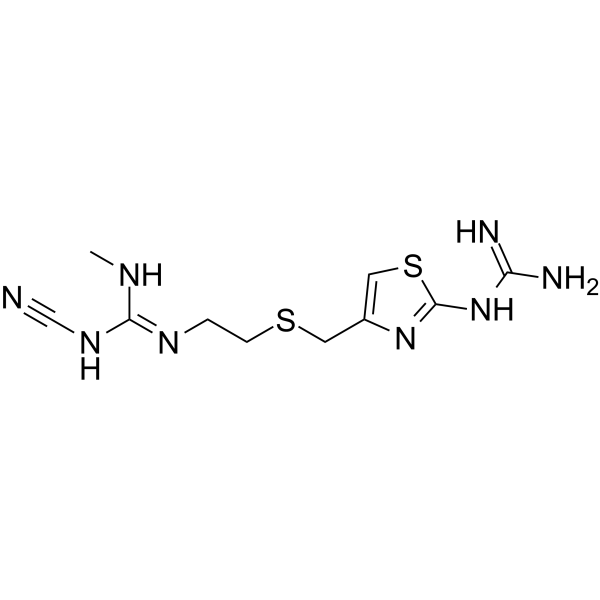
Tiotidine
Based on 2 publication(s) in Google Scholar
Tiotidine (ICI 125211) is a potent and selective antagonist of histamine H2-receptor (pA2=7.3-7.8 for guinea-pig right atrium). Tiotidine has low affinity for both the H1 and the H3 receptors.
For research use only. We do not sell to patients.
- Purity : 98.09%
- CAS No.: 69014-14-8
- Formula: C10H16N8S2
- Molecular Weight:312.42
-
Storage:Powder -20°C, 3 years , 4°C, 2 years ; In solvent -80°C, 2 years , -20°C, 1 year

To place orders, for customer services and technical support, please contact: MedChemExpress USA
Tel: 609-228-6898 E-mail: [email protected] [email protected]


-
 Biological Activity
-
Chemical Information
-
Solvent & Solubility
- Purity & Documentation
- References
-
 Help & FAQs


Publications Citing Use of MedChemExpress (MCE) Tiotidine
MoreAll Histamine Receptor Isoforms
More

Biological Activity
Description
IC50 & Target
[1]|
H2 Receptor 7.3-7.8 (pA2) |
H3 Receptor 4.8 (pA2) |
Cellular Effect
|
Cell Line

|
Type | Value | Description | References |
|---|---|---|---|---|
| CHO-K1 | IC50 |
0.022 μM
Compound: tiotidine
|
Displacement of [125I]Aminopotentidine from human recombinant histamine H2 receptor expressed in CHOK1 cells after 2 hrs
Displacement of [125I]Aminopotentidine from human recombinant histamine H2 receptor expressed in CHOK1 cells after 2 hrs
|
[PMID: 23403082] |
In Vitro
Tiotidine competitively antagonizes the positive chronotropic action of histamine with an apparent dissociation constant of 30 μM (23-38 μM). Tiotidine abolishes H2-mediated increases in contractile force leaving H2-mediated negative inotropic responses unopposed. The actions of histamine at the A-V node, manifested by lengthening of the P-R interval and A-V block, are attenuated by 2.5 x 10(-7) M Tiotidine[2].
Tiotidine actually behaves as an inverse agonist in U-937 cells, diminishing basal cAMP levels[3].
MedChemExpress (MCE) has not independently confirmed the accuracy of these methods. They are for reference only.


Chemical Information
-
CAS No. 69014-14-8
-
Appearance Solid
-
Molecular Weight 312.42
-
Formula C10H16N8S2
-
Color White to yellow
-
SMILES
CN/C(NC#N)=N\CCSCC1=CSC(NC(N)=N)=N1
-
Synonyms
ICI 125211
-
Shipping
Room temperature in continental US; may vary elsewhere.
-
Storage
Powder -20°C 3 years 4°C 2 years In solvent -80°C 2 years -20°C 1 year


Publications (2)
-
Journal Impact Factor
-
Most Recent
-
ACS Environ Au
Machine Learning-Assisted Recognition of Environmental Sulfur-Containing Chemicals in Nontargeted Mass Spectrometry Analysis of Inadequate Mass Resolution. [Abstract]2025 Aug 5;5(6):573-582. PMID: 41277996 -
Anal Chem
Exposome-Scale Investigation of Cl-/Br-Containing Chemicals Using High-Resolution Mass Spectrometry, Multistage Machine Learning, and Cloud Computing. [Abstract]2025 Jun 3;97(21):11099-11109. PMID: 40401576


Solvent & Solubility
In Vitro:
DMSO : 125 mg/mL (400.10 mM; Need ultrasonic; Hygroscopic DMSO has a significant impact on the solubility of product, please use newly opened DMSO)
Please refer to the solubility information to select the appropriate solvent. Once prepared, please aliquot and store the solution to prevent product inactivation from repeated freeze-thaw cycles.
Storage method and period of stock solution: -80°C, 2 years; -20°C, 1 year. When stored at -80°C, please use it within 2 years. When stored at -20°C, please use it within 1 year.
Please refer to the solubility information to select the appropriate solvent. Once prepared, please aliquot and store the solution to prevent product inactivation from repeated freeze-thaw cycles.
Storage method and period of stock solution: -80°C, 2 years; -20°C, 1 year. When stored at -80°C, please use it within 2 years. When stored at -20°C, please use it within 1 year.
Concentration (start) × Volume (start) = Concentration (final) × Volume (final)
In Vivo:
Select the appropriate dissolution method based on your experimental animal and administration route.
- For the following dissolution methods, please ensure to first prepare a clear stock solution using an In Vitro approach and then sequentially add co-solvents:
- To ensure reliable experimental results, the clarified stock solution can be appropriately stored based on storage conditions. As for the working solution for In Vivo experiments, it is recommended to prepare freshly and use it on the same day.
- The percentages shown for the solvents indicate their volumetric ratio in the final prepared solution. If precipitation or phase separation occurs during preparation, heat and/or sonication can be used to aid dissolution.
Add each solvent one by one: 10% DMSO 40% PEG300 5% Tween-80 45% Saline
Solubility: ≥ 2.08 mg/mL (6.66 mM); Clear solution
This protocol yields a clear solution of ≥ 2.08 mg/mL (saturation unknown).
Taking 1 mL working solution as an example, add 100 μL DMSO stock solution (20.8 mg/mL) to 400 μL PEG300, and mix evenly; then add 50 μL Tween-80 and mix evenly; then add 450 μL Saline to adjust the volume to 1 mL.
Preparation of Saline: Dissolve 0.9 g sodium chloride in ddH₂O and dilute to 100 mL to obtain a clear Saline solution.
Add each solvent one by one: 10% DMSO 90% (20% SBE-β-CD in Saline)
Solubility: ≥ 2.08 mg/mL (6.66 mM); Clear solution
This protocol yields a clear solution of ≥ 2.08 mg/mL (saturation unknown).
Taking 1 mL working solution as an example, add 100 μL DMSO stock solution (20.8 mg/mL) to 900 μL 20% SBE-β-CD in Saline, and mix evenly.
Preparation of 20% SBE-β-CD in Saline (4°C, storage for one week): 2 g SBE-β-CD powder is dissolved in 10 mL Saline, completely dissolve until clear.
In Vivo Dissolution Calculator
Please enter the basic information of animal experiments:
-
-
-
-
Recommended: Prepare an additional quantity of animals to account for potential losses during experiments.
Please enter your animal formula composition:
-
%DMSO +
Recommended: Keep the proportion of DMSO in working solution below 2% if your animal is weak.
-
%+
-
+%Tween-80 + +
-
%Saline +
The co-solvents required include: DMSO, . All of co-solvents are available by MedChemExpress (MCE). , Tween 80. All of co-solvents are available by MedChemExpress (MCE).
Working solution concentration: 0.22 mg/mL
Method for preparing stock solution: mg drug dissolved in μL DMSO. Stock solution concentration: mg/mL.
1. Take μL DMSO stock solution;
2. Add μL .
μL , mix evenly;
3. Then add μL Tween 80, mix evenly;
4. Then add μL
Please ensure that the stock solution in the first step is dissolved to a clear state, and add co-solvents in sequence. You can use ultrasonic heating (ultrasonic cleaner, recommended frequency 20-40 kHz), vortexing, etc. to assist dissolution.


Purity & Documentation
-
Data Sheet (271 KB)
-
SDS (251 KB)
- English - EN (251 KB)
- Français - FR (251 KB)
- Deutsch - DE (251 KB)
- Norwegian - NO (251 KB)
- Español - ES (251 KB)
- Swedish - SV (251 KB)
- Italian - IT (251 KB)
- Korean - KR (251 KB)
- Portuguese - PT (251 KB)
-
Handling Instructions (2659 KB)
References
[1]. Barth H, et al. Structural requirements of imidazole compounds to be inhibitors or activators of histaminemethyltransferase: investigation of histamine analogues and H2-receptor antagonists. [Content Brief]
[2]. Trzeciakowski JP, et al. The cardiac pharmacology of tiotidine (LCL 125, 211): a new histamine H2-receptor antagonist. J Pharmacol Exp Ther. 1980 Sep;214(3):629-34. [Content Brief]
[3]. Monczor F, et al. Tiotidine, a histamine H2 receptor inverse agonist that binds with high affinity to an inactive G-protein-coupled form of the receptor. Experimental support for the cubic ternary complex model. Mol Pharmacol. 2003 Aug;64(2):512-20. [Content Brief]


Complete Stock Solution Preparation Table
Please refer to the solubility information to select the appropriate solvent. Once prepared, please aliquot and store the solution to prevent product inactivation from repeated freeze-thaw cycles.
Storage method and period of stock solution: -80°C, 2 years; -20°C, 1 year. When stored at -80°C, please use it within 2 years. When stored at -20°C, please use it within 1 year.
| Optional Solvent | Concentration Solvent Mass | 1 mg | 5 mg | 10 mg | 25 mg |
|---|---|---|---|---|---|
| DMSO | 1 mM | 3.2008 mL | 16.0041 mL | 32.0082 mL | 80.0205 mL |
| 5 mM | 0.6402 mL | 3.2008 mL | 6.4016 mL | 16.0041 mL | |
| 10 mM | 0.3201 mL | 1.6004 mL | 3.2008 mL | 8.0020 mL | |
| 15 mM | 0.2134 mL | 1.0669 mL | 2.1339 mL | 5.3347 mL | |
| 20 mM | 0.1600 mL | 0.8002 mL | 1.6004 mL | 4.0010 mL | |
| 25 mM | 0.1280 mL | 0.6402 mL | 1.2803 mL | 3.2008 mL | |
| 30 mM | 0.1067 mL | 0.5335 mL | 1.0669 mL | 2.6673 mL | |
| 40 mM | 0.0800 mL | 0.4001 mL | 0.8002 mL | 2.0005 mL | |
| 50 mM | 0.0640 mL | 0.3201 mL | 0.6402 mL | 1.6004 mL | |
| 60 mM | 0.0533 mL | 0.2667 mL | 0.5335 mL | 1.3337 mL | |
| 80 mM | 0.0400 mL | 0.2001 mL | 0.4001 mL | 1.0003 mL | |
| 100 mM | 0.0320 mL | 0.1600 mL | 0.3201 mL | 0.8002 mL |


Tiotidine Related Classifications
HY-101232 Related Classifications
 Powered by Bioz