



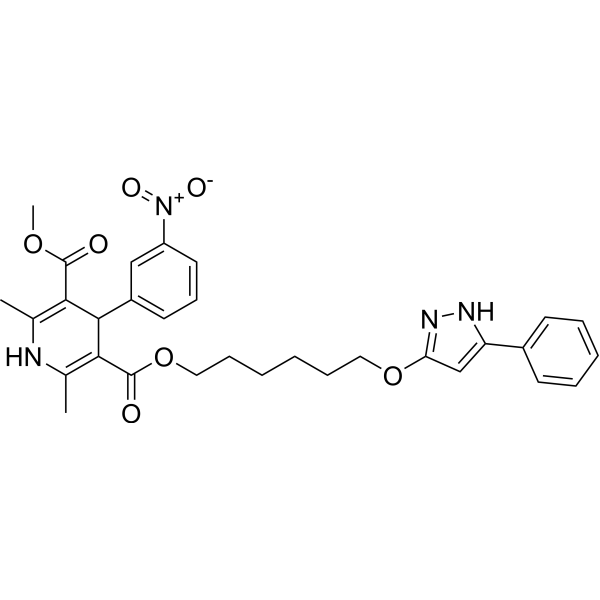
CV-159
CV-159 is a unique dihydropyridine Ca2+ antagonist with an anti-calmodulin (CaM) action, and has antiinflammatory activities.
연구목적의 판매만을 진행합니다. 환자를 대상으로 한 판매는 하지 않습니다.
- CAS No.: 86384-98-7
- 화학식: C31H34N4O7
- 분자량:574.62
-
보관:
Please store the product under the recommended conditions in the Certificate of Analysis.

To place orders, for customer services and technical support, please contact: MedChemExpress USA
Tel: 609-228-6898 E-mail: [email protected] [email protected]


-
 Biological Activity
-
Chemical Information
- Protocol
- 순도&문서
- References
-
 Help & FAQs




Biological Activity
제품 설명
In Vitro
CV-159 (0.1-10 μM) significantly inhibits TNF-α (10 ng/ml, 24 h)-induced VCAM-1 in SMCs in a concentrationdependent manner. CV-159 (10 μM, 30 min) significantly inhibits the TNF-induced ROS production[1]. CV-159 (10 μM) inhibits TNF (24 h)-induced expression of e-selectin but not vascular cell adhesion molecule-1 and intercellular adhesion molecule-1. CV-159 inhibits TNF (20 min)-induced phosphorylation of JNK, p38, and NF-κB p65 (Ser536)[2].
MedChemExpress (MCE) has not independently confirmed the accuracy of these methods. They are for reference only.
In Vivo
MedChemExpress (MCE) has not independently confirmed the accuracy of these methods. They are for reference only.


Chemical Information
-
CAS No. 86384-98-7
-
분자량 574.62
-
화학식 C31H34N4O7
-
SMILES
O=C(C1=C(C)NC(C)=C(C(OCCCCCCOC2=NNC(C3=CC=CC=C3)=C2)=O)C1C4=CC=CC([N+]([O-])=O)=C4)OC
-
선적
Room temperature in continental US; may vary elsewhere.
-
보관
Please store the product under the recommended conditions in the Certificate of Analysis.


순도&문서
References
[1]. Usui T, et al. Mechanisms underlying the anti-inflammatory effects of the Ca2+/calmodulin antagonist CV-159 in cultured vascular smooth muscle cells. J Pharmacol Sci. 2010;113(3):214-23. Epub 2010 Jun 16. [Content Brief]
[2]. Usui T, et al. CV-159, a unique dihydropyridine derivative, prevents TNF-induced inflammatory responses in human umbilical vein endothelial cells. J Pharmacol Sci. 2010;113(2):182-91. Epub 2010 May 19. [Content Brief]
[3]. Miyazaki H, et al. Neuroprotective effects of a dihydropyridine derivative, 1,4-dihydro-2,6-dimethyl-4-(3-nitrophenyl)-3,5-pyridinedicarbox ylic acid methyl 6-(5-phenyl-3-pyrazolyloxy)hexyl ester (CV-159), on rat ischemic brain injury. Life Sci. 1999;64(10):869-78. [Content Brief]

Calculators
Concentration (start) × Volume (start) = Concentration (final) × Volume (final)


CV-159 Related Classifications
HY-19025 Related Classifications
 Powered by Bioz