



Amprenavir-d4-1
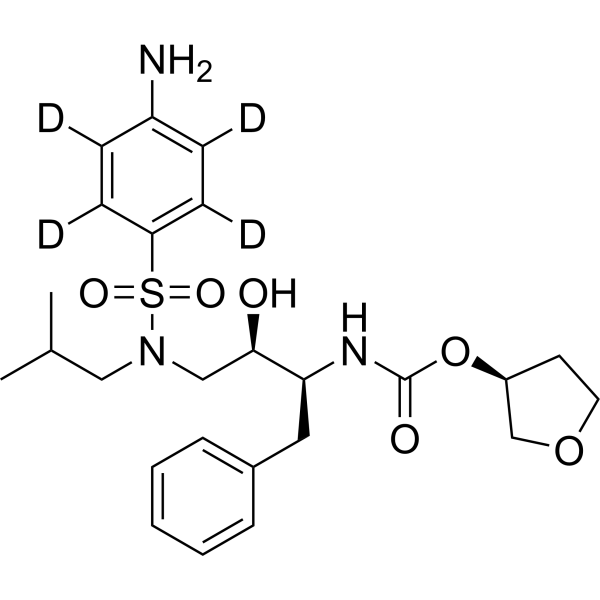
Amprenavir-d4-1 is deuterium labeled Amprenavir. Amprenavir (VX-478) is a HIV protease inhibitor (Ki=0.6 nM) used to treat HIV infection. Amprenavir is also a SARS-CoV 3CLpro inhibitor with an IC50 of 1.09 μM.
연구목적의 판매만을 진행합니다. 환자를 대상으로 한 판매는 하지 않습니다.
- CAS No.: 2738376-78-6
- 화학식: C25H31D4N3O6S
- 분자량:509.65
-
보관:
Please store the product under the recommended conditions in the Certificate of Analysis.

To place orders, for customer services and technical support, please contact: MedChemExpress USA
Tel: 609-228-6898 E-mail: [email protected] [email protected]


-
 Biological Activity
-
Chemical Information
- Protocol
- 순도&문서
- References
-
 Help & FAQs




Biological Activity
제품 설명
In Vitro
Stable heavy isotopes of hydrogen, carbon, and other elements have been incorporated into drug molecules, largely as tracers for quantitation during the drug development process. Deuteration has gained attention because of its potential to affect the pharmacokinetic and metabolic profiles of drugs[1].
MedChemExpress (MCE) has not independently confirmed the accuracy of these methods. They are for reference only.
신청
1. This compound can be used as a tracer
2. This compound can be used as an internal standard for quantitative analysis by NMR, GC-MS, or LC-MS.


Chemical Information
-
CAS No. 2738376-78-6
-
Unlabeled CAS 161814-49-9
-
분자량 509.65
-
화학식 C25H31D4N3O6S
-
SMILES
O=C(O[C@@H]1COCC1)N[C@@H](CC2=CC=CC=C2)[C@H](O)CN(S(=O)(C3=C([2H])C([2H])=C(N)C([2H])=C3[2H])=O)CC(C)C
-
Synonyms
VX-478-d4-1
-
선적
Room temperature in continental US; may vary elsewhere.
-
보관
Please store the product under the recommended conditions in the Certificate of Analysis.


순도&문서
References
[1]. Russak EM, et al. Impact of Deuterium Substitution on the Pharmacokinetics of Pharmaceuticals. Ann Pharmacother. 2019;53(2):211-216. [Content Brief]
[2]. Sadler BM, Stein DS. Clinical pharmacology and pharmacokinetics of amprenavir. Ann Pharmacother. 2002 Jan;36(1):102-18. [Content Brief]
[3]. Esposito V, Verdina A, Manente L, Amprenavir inhibits the migration in human hepatocarcinoma cell and the growth of xenografts. J Cell Physiol. 2013 Mar;228(3):640-5. [Content Brief]
[4]. Helsley RN, Sui Y, Ai N, Pregnane X Receptor Mediates Dyslipidemia Induced by the HIV Protease Inhibitor Amprenavir in Mice. Mol Pharmacol. 2013 Jun;83(6):1190-9. [Content Brief]
[5]. Qi Sun, et al. Bardoxolone and bardoxolone methyl, two Nrf2 activators in clinical trials, inhibit SARS-CoV-2 replication and its 3C-like protease. Signal Transduct Target Ther. 2021 May 29;6(1):212. [Content Brief]

Calculators
Concentration (start) × Volume (start) = Concentration (final) × Volume (final)


Amprenavir-d4-1 Related Classifications
HY-17430S1 Related Classifications
 Powered by Bioz