



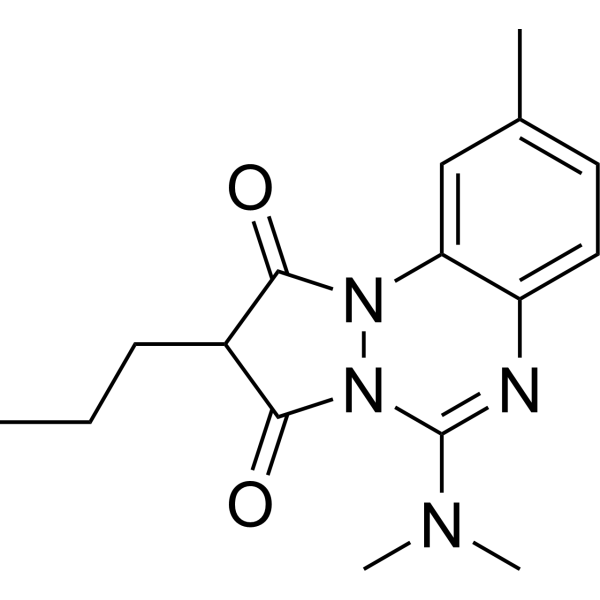
Azapropazone

Based on 1 Customer Validation
Azapropazone is an orally active nonsteroidal anti-inflammatory agent. Azapropazone inhibits Xanthine oxidase activity with an IC50 of 70-140 μg/mL. Azapropazone exerts significant cardiomyocyte protective effects on dogs with ischemia-reperfusion injury. Azapropazone reduces arthritis. Azapropazone inhibits Adrenaline-induced platelet aggregation. Azapropazone can be used for the research of myocardial ischemia and reperfusion injury, adjuvant arthritis, and gouty arthritis.
연구목적의 판매만을 진행합니다. 환자를 대상으로 한 판매는 하지 않습니다.
- Purity : 99.67%
- CAS No.: 13539-59-8
- 화학식: C16H20N4O2
- 분자량:300.36
-
보관:Powder -20°C, 3 years , 4°C, 2 years ; In solvent -80°C, 6 months , -20°C, 1 month

To place orders, for customer services and technical support, please contact: MedChemExpress USA
Tel: 609-228-6898 E-mail: [email protected] [email protected]


-
 Biological Activity
-
Chemical Information
-
용액&용해도
- Protocol
- 순도&문서
- References
-
 Help & FAQs




Biological Activity
제품 설명
In Vitro
Azapropazone (70-140 μg/mL) inhibits xanthine oxidase activity in vitro with an IC50 of 70-140 μg/mL[1].
Azapropazone (40-400 μg/mL) inhibits multiple neutrophil functions (migration, aggregation)[1].
Azapropazone (10-200 μM; 10 min) potently inhibits superoxide anion generation by human PMNs stimulated with polyhistidine or TPA (half-maximal inhibition at ~15 μM) but not by histone-coated streptococci with cytochalasin B[2].
Azapropazone (5 μM; 1-5 min before or concurrent with stimulus addition) inhibits adrenaline-induced human platelet aggregation but has no effect on ADP- or thrombin-induced aggregation[2].
MedChemExpress (MCE) has not independently confirmed the accuracy of these methods. They are for reference only. Further protocols information, click here.
In Vivo
Azapropazone (150-200 mg/kg; p.o.; 10-14 days) significantly reduces joint swelling, cartilage damage and clinical disease activity in rats with established adjuvant-induced arthritis[2].
MedChemExpress (MCE) has not independently confirmed the accuracy of these methods. They are for reference only.
-
Animal Model:Sprague-Dawley (female, 14-18 days post-disease induction)[2]
-
Dosage:150 mg/kg/day (10-13 day treatment; ED50); 100 mg/kg/day (14 day treatment); 200 mg/kg/day (14 day treatment)
-
Administration:p.o.; 10-13 days; 14 days
-
Result:Produced a significant reduction in rear-paw and ankle swelling, comparable to standard NSAIDs.
Reduced cartilage destruction from a control score of 3.2 to 1.2.
Reduced periostitis/new bone growth from a control score of 4.0 to 2.8.
Reduced pannus formation from a control score of 4.0 to 2.8.
Resulted in an overall clinical disease activity score of 2.3 ± 0.5 (mean ± s.d.) compared to 0.0 for controls.
Showed no significant improvement in body weight.
Established an ED50 of 150 mg/kg/day after 14 days of treatment.
Showed no differences in efficacy between once-daily and divided-daily administration of 100 or 200 mg/kg/day.


Chemical Information
-
CAS No. 13539-59-8
-
Appearance Solid
-
분자량 300.36
-
화학식 C16H20N4O2
-
Color White to light yellow
-
SMILES
O=C1C(C(N2N1C(N(C)C)=NC3=CC=C(C=C32)C)=O)CCC
-
선적
Room temperature in continental US; may vary elsewhere.
-
보관
Powder -20°C 3 years 4°C 2 years In solvent -80°C 6 months -20°C 1 month


용액&용해도
In Vitro:
DMSO : 125 mg/mL (416.17 mM; Need ultrasonic; Hygroscopic DMSO has a significant impact on the solubility of product, please use newly opened DMSO)
Please refer to the solubility information to select the appropriate solvent. Once prepared, please aliquot and store the solution to prevent product inactivation from repeated freeze-thaw cycles.
Storage method and period of stock solution: -80°C, 6 months; -20°C, 1 month. When stored at -80°C, please use it within 6 months. When stored at -20°C, please use it within 1 month.
Please refer to the solubility information to select the appropriate solvent. Once prepared, please aliquot and store the solution to prevent product inactivation from repeated freeze-thaw cycles.
Storage method and period of stock solution: -80°C, 6 months; -20°C, 1 month. When stored at -80°C, please use it within 6 months. When stored at -20°C, please use it within 1 month.
Concentration (start) × Volume (start) = Concentration (final) × Volume (final)

Protocol
-
Collagen-Induced Arthritis
Collagen-induced arthritis (CIA) is an autoimmune murine model of rheumatoid arthritis in which immunization with type II collagen (CII) emulsified in an adjuvant induces a T cell- and autoantibody-driven inflammatory arthritis characterized by synovial hyperplasia, immune cell infiltration, and joint destruction. The model typically relies on genetically susceptible mouse strains (e. g. , DBA/1) and reproduces key features of human rheumatoid arthritis, including anti-collagen immune responses and progressive joint inflammation. Disease onset generally occurs within ~3-4 weeks after immunization, depending on antigen/adjuvant combinations and protocol variation. The immunopathology is driven by adaptive immune activation against CII, leading to systemic and local joint inflammation mediated by pro-inflammatory cytokines and effector immune cells, making CIA a standard preclinical platform for evaluating immunomodulatory and anti-arthritic interventions.
-
Research Protocol for Inflammation-related Diseases
The NLRP3 inflammasome is a cytosolic innate immune signaling platform that integrates priming signals and danger-signal activation to promote caspase-1 activation, maturation of IL-1β and IL-18, and gasdermin D-mediated pyroptotic cell death. The core experimental logic is to determine whether inflammatory disease phenotypes are driven by increased NLRP3 expression, ASC-containing inflammasome assembly, caspase-1 cleavage, GSDMD cleavage, and extracellular release of IL-1β/IL-18 rather than by nonspecific cell injury alone. The pathway is strongly linked to inflammation-related disease phenotypes because monosodium urate crystals activate NALP3/NLRP3 inflammasome signaling in gout-like crystal inflammation, cholesterol crystals activate NLRP3 inflammasomes in atherogenesis models, and DSS-induced intestinal inflammation has been reported to involve NLRP3 inflammasome activity. However, experimental colitis studies also show context-dependent protective effects of NLRP3 inflammasome co


순도&문서
-
Data Sheet (278 KB)
-
SDS (251 KB)
- English - EN (251 KB)
- Français - FR (251 KB)
- Deutsch - DE (251 KB)
- Norwegian - NO (251 KB)
- Español - ES (251 KB)
- Swedish - SV (251 KB)
- Italian - IT (251 KB)
- Korean - KR (251 KB)
- Portuguese - PT (251 KB)
-
Handling Instructions (2659 KB)
References
[1]. Mousa SA, et al. Myocardial cytoprotective efficacy of azapropazone in a canine heart model of regional ischemia and reperfusion. J Cardiovasc Pharmacol. 1989;14(4):542-548. [Content Brief]
[2]. Rainsford KD, et al. Comparative effects of azapropazone on cellular events at inflamed sites. Influence on joint pathology in arthritic rats, leucocyte superoxide and eicosanoid production, platelet aggregation, synthesis of cartilage proteoglycans, synovial production and actions of interleukin-1 in cartilage resorption correlated with drug uptake into cartilage in-vitro. J Pharm Pharmacol. 1989;41(5):322-330. [Content Brief]
[3]. Mackin WM, et al. Inhibition of rat neutrophil functional responses by azapropazone, an anti-gout drug. Biochem Pharmacol. 1986;35(6):917-922. [Content Brief]


Complete Stock Solution Preparation Table
Please refer to the solubility information to select the appropriate solvent. Once prepared, please aliquot and store the solution to prevent product inactivation from repeated freeze-thaw cycles.
Storage method and period of stock solution: -80°C, 6 months; -20°C, 1 month. When stored at -80°C, please use it within 6 months. When stored at -20°C, please use it within 1 month.
| Optional Solvent | Concentration Solvent Mass | 1 mg | 5 mg | 10 mg | 25 mg |
|---|---|---|---|---|---|
| DMSO | 1 mM | 3.3293 mL | 16.6467 mL | 33.2934 mL | 83.2335 mL |
| 5 mM | 0.6659 mL | 3.3293 mL | 6.6587 mL | 16.6467 mL | |
| 10 mM | 0.3329 mL | 1.6647 mL | 3.3293 mL | 8.3233 mL | |
| 15 mM | 0.2220 mL | 1.1098 mL | 2.2196 mL | 5.5489 mL | |
| 20 mM | 0.1665 mL | 0.8323 mL | 1.6647 mL | 4.1617 mL | |
| 25 mM | 0.1332 mL | 0.6659 mL | 1.3317 mL | 3.3293 mL | |
| 30 mM | 0.1110 mL | 0.5549 mL | 1.1098 mL | 2.7744 mL | |
| 40 mM | 0.0832 mL | 0.4162 mL | 0.8323 mL | 2.0808 mL | |
| 50 mM | 0.0666 mL | 0.3329 mL | 0.6659 mL | 1.6647 mL | |
| 60 mM | 0.0555 mL | 0.2774 mL | 0.5549 mL | 1.3872 mL | |
| 80 mM | 0.0416 mL | 0.2081 mL | 0.4162 mL | 1.0404 mL | |
| 100 mM | 0.0333 mL | 0.1665 mL | 0.3329 mL | 0.8323 mL |


Azapropazone Related Classifications
HY-116442 Related Classifications
 Powered by Bioz