



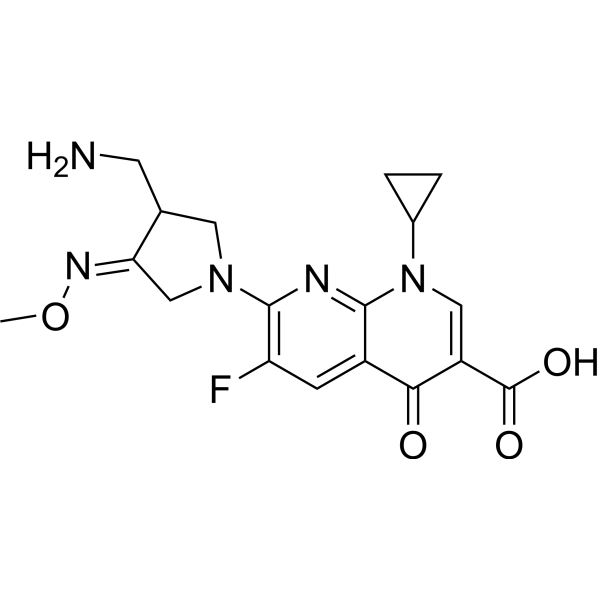
Gemifloxacin
Gemifloxacin, a fluoroquinolone, is a potent and orally active antipneumococcal agent. Gemifloxacin shows bactericidal activity against highly quinolone-resistant pneumococci.Gemifloxacin can be used for the research of respiratory infections, such as community-acquired pneumonia (CAP) and acute exacerbation of chronic bronchitis (AECB).
연구목적의 판매만을 진행합니다. 환자를 대상으로 한 판매는 하지 않습니다.
- CAS No.: 175463-14-6
- 화학식: C18H20FN5O4
- 분자량:389.38
-
보관:
Please store the product under the recommended conditions in the Certificate of Analysis.

To place orders, for customer services and technical support, please contact: MedChemExpress USA
Tel: 609-228-6898 E-mail: [email protected] [email protected]


-
 Biological Activity
-
Chemical Information
- Protocol
- 순도&문서
- References
-
 Help & FAQs


All Antibiotic Isoforms
More

Biological Activity
제품 설명
IC50 & Target
|
Quinolone |
Cellular Effect
|
Cell Line

|
Type | Value | Description | References |
|---|---|---|---|---|
| HEp-2 | CC50 |
46 μM
Compound: GEM
|
Cytotoxicity against human Hep2 cell line after 72 hrs
Cytotoxicity against human Hep2 cell line after 72 hrs
|
[PMID: 17228862] |
| HEp-2 | CC50 |
46 μM
Compound: GEM
|
Cytotoxicity against human Hep2 cell line after 72 hrs
Cytotoxicity against human Hep2 cell line after 72 hrs
|
[PMID: 21443219] |
| HEp-2 | CC50 |
46 μM
Compound: gemifloxacin
|
Cytotoxicity against human Hep2 laryngeal carcinoma cell line
Cytotoxicity against human Hep2 laryngeal carcinoma cell line
|
[PMID: 16337791] |
| Hepatocyte | CC50 |
>100 μM
Compound: GEM
|
Cytotoxicity against rat hepatocytes after 48 hrs
Cytotoxicity against rat hepatocytes after 48 hrs
|
[PMID: 17228862] |
| HepG2 | CC50 |
35 μM
Compound: GEM
|
Cytotoxicity against human HepG2 cells after 72 hrs
Cytotoxicity against human HepG2 cells after 72 hrs
|
[PMID: 17228862] |
| HepG2 | IC50 |
13.49 μg/mL
Compound: Gemifloxacin (GMFX)
|
Cytotoxicity was determined for the compound in HepG2 cell line
Cytotoxicity was determined for the compound in HepG2 cell line
|
[PMID: 14980680] |
| MDCK | CC50 |
321 μM
Compound: GMFX
|
Cytotoxicity against MDCK cells after 48 hrs by CPE assay
Cytotoxicity against MDCK cells after 48 hrs by CPE assay
|
[PMID: 21481984] |
| V79-4 | IC50 |
10.08 μg/mL
Compound: Gemifloxacin (GMFX)
|
Cytotoxicity was determined for the compound in V79-4 cell line
Cytotoxicity was determined for the compound in V79-4 cell line
|
[PMID: 14980680] |
Clinical Trial
| NCT Number | Sponsor | Condition | Start Date |
Phase
|
|---|---|---|---|---|
| NCT01329991 | Plexxikon| | 2011-05 | PHASE1 |


Chemical Information
-
CAS No. 175463-14-6
-
분자량 389.38
-
화학식 C18H20FN5O4
-
SMILES
NCC(C1)/C(CN1C(N=C2C(C(C(C(O)=O)=CN2C3CC3)=O)=C4)=C4F)=N/OC
-
Synonyms
SB-265805; LB20304
-
선적
Room temperature in continental US; may vary elsewhere.
-
보관
Please store the product under the recommended conditions in the Certificate of Analysis.

Protocol
-
Bacterial live/dead nucleic-acid viability staining
The LIVE/DEAD bacterial viability staining method is based on differential permeability of nucleic-acid-binding fluorescent dyes, most commonly SYTO 9 and propidium iodide (PI), which enables discrimination of bacterial populations with intact versus compromised cytoplasmic membranes. SYTO 9 penetrates both intact and damaged bacterial membranes and binds nucleic acids to produce green fluorescence, whereas propidium iodide penetrates only cells with compromised membranes and fluoresces red while also reducing SYTO 9 signal through competitive binding and fluorescence interactions. The resulting fluorescence pattern is interpreted as a proxy for membrane integrity, which is widely used as an indicator of bacterial viability in microscopy, flow cytometry, and spectroscopic platforms. However, mechanistic studies show that SYTO 9 and PI interactions involve displacement and fluorescence resonance energy transfer effects, which can influence signal interpretation depending on dye ratios a


순도&문서
References
[1]. Yoo BK, et al. Gemifloxacin: a new fluoroquinolone approved for treatment of respiratory infections. Ann Pharmacother. 2004 Jul-Aug;38(7-8):1226-35. [Content Brief]
[2]. Davies TA, et al. Antipneumococcal activities of gemifloxacin compared to those of nine other agents. Antimicrob Agents Chemother. 2000 Feb;44(2):304-10. [Content Brief]

Calculators
Concentration (start) × Volume (start) = Concentration (final) × Volume (final)


Gemifloxacin Related Classifications
HY-116229 Related Classifications
 Powered by Bioz