



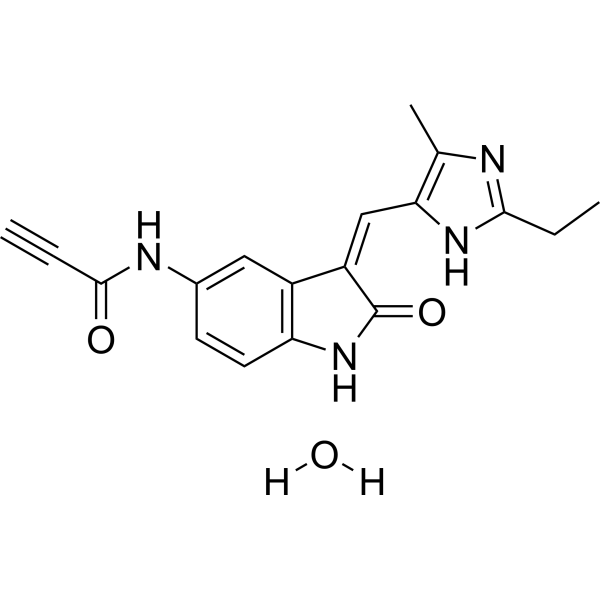
JH295 hydrate
JH295 hydrate is a potent, irreversible and selective NIMA-related kinase 2 (Nek2) inhibitor with an IC50 of 770 nM. JH295 hydrate inhibits cellular Nek2 via alkylation of Cys22. JH295 hydrate is inactive against the mitotic kinases, Cdk1, Aurora B or Plk1, and does not perturb bipolar spindle assembly or the spindle assembly checkpoint. JH295 (hydrate) is a click chemistry reagent, it contains an Alkyne group and can undergo copper-catalyzed azide-alkyne cycloaddition (CuAAc) with molecules containing Azide groups.
연구목적의 판매만을 진행합니다. 환자를 대상으로 한 판매는 하지 않습니다.
- Purity : 99.0%
- CAS No.: 2714087-26-8
- 화학식: C18H18N4O3
- 분자량:338.36
-
보관:Powder -20°C, 3 years ; In solvent -80°C, 6 months , -20°C, 1 month

To place orders, for customer services and technical support, please contact: MedChemExpress USA
Tel: 609-228-6898 E-mail: [email protected] [email protected]


-
 Biological Activity
-
Chemical Information
- Protocol
- 순도&문서
- References
-
 Help & FAQs




Biological Activity
제품 설명
IC50 & Target
|
NEK2 770 nM (IC50) |
In Vitro
JH295 (Compound 16; 0.08-20 μM; 45 minutes; RPMI7951 cells) treatment inhibits WT Nek2 in cells with an IC50 of ~1.3 μM, whereas it has little effect on the C22V mutant[1].
MedChemExpress (MCE) has not independently confirmed the accuracy of these methods. They are for reference only. Further protocols information, click here.
-
Cell Line:RPMI7951 cells
-
Concentration:0.08 μM, 0.25 μM, 0.74 μM, 2.2 μM, 6.6 μM, 20 μM
-
Incubation Time:45 minutes
-
Result:Inhibited WT Nek2 in cells with an IC50 of ~1.3 μM, whereas had little effect on the C22V mutant.


Chemical Information
-
CAS No. 2714087-26-8
-
Appearance Solid
-
분자량 338.36
-
화학식 C18H18N4O3
-
Color Yellow to brown
-
SMILES
C#CC(NC1=CC2=C(NC(/C2=C\C3=C(C)N=C(CC)N3)=O)C=C1)=O.[H]O[H]
-
선적
Room temperature in continental US; may vary elsewhere.
-
보관
Powder -20°C 3 years In solvent -80°C 6 months -20°C 1 month

Protocol
-
EdU Incorporation Assay (Click Chemistry-Based DNA Synthesis Measurement)
The EdU incorporation assay measures DNA synthesis by adding the thymidine analog 5-ethynyl-2′-deoxyuridine to cells or tissues, where it is incorporated into newly synthesized DNA during S phase. Incorporated EdU is detected by copper-catalyzed azide-alkyne cycloaddition, in which a fluorescent azide covalently reacts with the ethynyl group on EdU, allowing S-phase cells to be detected by fluorescence microscopy, flow cytometry, or high-content imaging. EdU detection does not require DNA denaturation or anti-BrdU antibody access, which preserves sample structure and improves compatibility with immunostaining and multiparameter cytometry compared with BrdU-based detection. EdU can be cytotoxic in a cell-type- and exposure-dependent manner, so pulse duration, concentration, and continuous-labeling designs should be validated for each cell type.


순도&문서
-
Data Sheet (271 KB)
-
SDS (251 KB)
- English - EN (251 KB)
- Français - FR (251 KB)
- Deutsch - DE (251 KB)
- Norwegian - NO (251 KB)
- Español - ES (251 KB)
- Swedish - SV (251 KB)
- Italian - IT (251 KB)
- Korean - KR (251 KB)
- Portuguese - PT (251 KB)
-
Handling Instructions (2659 KB)
References

Calculators
Concentration (start) × Volume (start) = Concentration (final) × Volume (final)


JH295 hydrate Related Classifications
HY-116423A Related Classifications
 Powered by Bioz