



KU14R

Based on 1 Customer Validation
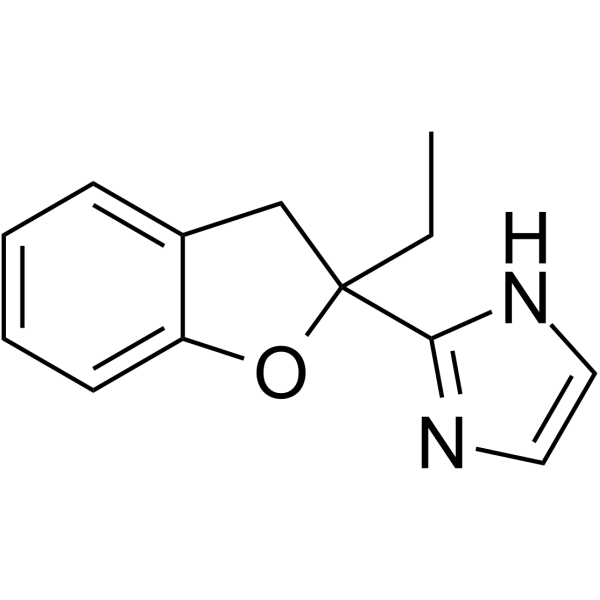
KU14R, an imidazole analog of efaroxan, is a putative imidazoline I3 receptor antagonist and reversible KATP channel inhibitor. KU14R inhibits KATP channel activity in mouse pancreatic β cells with an IC50 of 31.9 μmol/L, and also suppresses Kir6.2 ΔC26 channel activity. KU14R exerts model-dependent antagonistic effects on imidazoline-sensitive insulin secretion. KU14R can be used in the research of diabetes-related diseases.
For research use only. We do not sell to patients.
- Purity : 98.91%
- CAS No.: 189224-48-4
- Formula: C13H14N2O
- Molecular Weight:214.26
-
Storage:Powder -20°C, 3 years ; In solvent -80°C, 6 months , -20°C, 1 month

To place orders, for customer services and technical support, please contact: MedChemExpress USA
Tel: 609-228-6898 E-mail: [email protected] [email protected]


-
 Biological Activity
-
Chemical Information
-
Solvent & Solubility
- Protocols
- Purity & Documentation
- References
-
 Help & FAQs


-
HY-P0035
Insulin (human)Recombinant Human Insulin -

HY-P0035A
Insulin solution (human)Polypeptide Hormone -
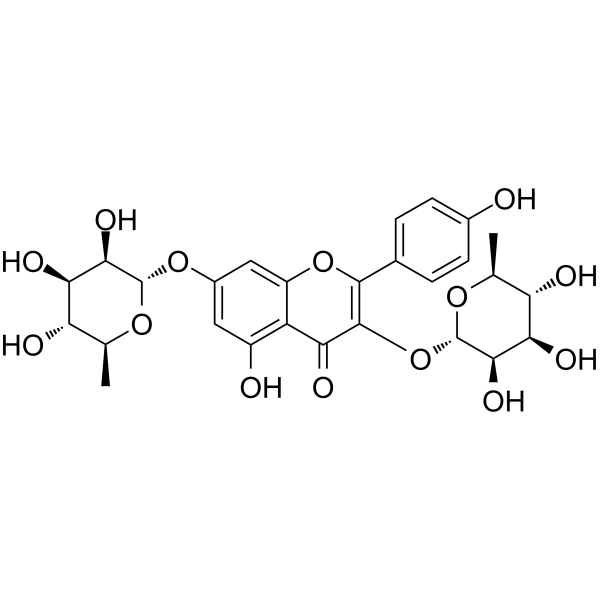
HY-N0628
KaempferitrinInsulin Receptor Activator -
HY-P1156
Insulin(cattle)Recombinant Cattle Insulin -
HY-10191
LinsitinibIGF-1R/Insulin Receptor Inhibitor -

HY-P2093
S961Insulin Receptor Antagonist -
HY-107586
Demethylasterriquinone B1Insulin Receptor Agonist/Akt Activator -
HY-100550
MSDC 0160Insulin Sensitizer -
HY-112720
AGL-2263Insulin Receptor Inhibitor -
HY-115461
MID-1MG53-IRS-1 Interaction Disruptor -

HY-108743
Insulin degludecInsulin Analogue -
HY-100037
NT157
All Adrenergic Receptor Isoforms
More

Biological Activity
Description
IC50 & Target
[1]|
KATP channel 31.9 μM (IC50) |
In Vitro
KU14R (300 μM; doses to determine IC50) potently blocks KATP channels in primary mouse pancreatic β cells, with an IC50 of 31.9 μM, and achieves nearly complete inhibition at 300 μM[1].
KU14R (100 μM) inhibits the Kir6.2 ΔC26 channel expressed in HEK cells, reducing channel activity to 45.2% of that in the control group at 100 μM[1].
KU14R (100 μM) depolarizes the membrane potential of mouse pancreatic β cells to -33.4 mV, and fails to repolarize cells that have been depolarized by efaroxan[1].
KU14R (100 μM; 30 min) does not alter cAMP levels in rat islets, nor does it reduce the forskolin (5 μM)- or IBMX (50 μM)-induced elevation of cAMP, suggesting that the antagonistic effect of KU14R on cAMP-dependent enhancement of insulin secretion occurs downstream of cAMP generation[4].
KU14R (10-5 M and 10-4 M; pre-incubated for 10 min) antagonizes the response of the α2-adrenoceptor agonist UK14304 in isolated mouse vas deferens functional assays, with Ki values of 4.44 × 10⁻⁶ M and 4.14 × 10⁻⁶ M, respectively; KU14R (10-6-10-5 M) does not alter the concentration-response curve of the imidazoline ligand S22068[2].
KU14R (30-300 μM) barely potentiates glucose-induced insulin secretion in freshly isolated islets from NMRI mice; when glucose increases from 5 mmol/L to 10 mmol/L, the integrated insulin secretion in the presence of KU14R reaches 226% of the pre-stimulation level, and 100 μM KU14R does not antagonize efaroxan (100 μM)-induced insulin secretion[1].
KU14R (0.1-1 μM; 7 mM glucose) dose-dependently reduces morin- or efaroxan-induced insulin secretion in MIN6 cells without altering basal insulin secretion; treatment with KU14R alone up to 50 μM also does not significantly change basal insulin secretion[3].
KU14R (1 μM; 20 mM glucose) inhibits the further enhancing effect of morin (1 μM) on high glucose-induced insulin secretion, while KU14R alone does not reduce insulin secretion induced by 20 mM glucose[3].
KU14R (100 μM; 1 h) does not alter basal insulin secretion induced by 6 or 20 mmol/L glucose in freshly isolated Wistar rat islets, but significantly inhibits the potentiating effects of efaroxan (100 μM), IBMX (50 μM) or forskolin (5 μM) on insulin secretion[4].
KU14R itself does not alter insulin secretion from isolated islets of Wistar rats under 4-20 mM glucose conditions, but dose-dependently reverses the insulinotropic effect of efaroxan, exhibiting functional antagonism[5].
KU14R (1-100 μM; 10 min) exhibits weak α2-adrenoceptor antagonist activity in isolated mouse vas deferens. It significantly and competitively inhibits UK14304-induced twitch suppression at concentrations of 10 μM and 100 μM, and directly suppresses twitches at 100 μM[2].
MedChemExpress (MCE) has not independently confirmed the accuracy of these methods. They are for reference only. Further protocols information, click here.
-
Cell Line:MIN6 cells (mouse-derived pancreatic β-cell line)
-
Concentration:0.1 μM; 1 μM
-
Incubation Time:30 min
-
Result:Dose-dependently reduced morin- and efaroxan-induced insulin secretion without affecting basal insulin secretion.
-
Cell Line:MIN6 cells (mouse-derived pancreatic β-cell line)
-
Concentration:1 μM
-
Incubation Time:2 h
-
Result:Blocked morin-enhanced insulin secretion under high-glucose conditions without affecting insulin secretion induced by high glucose alone.
-
Cell Line:MIN6 cells (mouse-derived pancreatic β-cell line)
-
Concentration:50 μM
-
Incubation Time:30 min pretreatment followed by 1 h incubation
-
Result:Did not significantly alter basal insulin secretion.
In Vivo
KU14R (16 mg/kg; i.p.; single dose) does not act as an antagonist of the hypoglycemic effect of S22068 (24 mg/kg) in healthy male CBA/Ca mice[2].
MedChemExpress (MCE) has not independently confirmed the accuracy of these methods. They are for reference only.
-
Animal Model:CBA/Ca (male, 16 weeks or older, 30-34 g)[2]
-
Dosage:4-25 mg/kg
-
Administration:i.p.; single dose
-
Result:Had no effect at 4 mg/kg.
Produced dose-dependent hypoglycemic responses at higher doses, with maximal decreases in blood glucose observed at 20-25 mg/kg between 120 and 180 min.
The median effective dose was 16 mg/kg.
-
Animal Model:CBA/Ca (male, 16 weeks or older, 30-34 g)[2]
-
Dosage:20 mg/kg
-
Administration:i.p.; single dose
-
Result:Decreased blood glucose and significantly increased plasma insulin at 120 min.
Blood glucose had already decreased at 60 min, preceding the measurable increase in plasma insulin.
-
Animal Model:CBA/Ca (male, 16 weeks or older, 30-34 g)[2]
-
Dosage:16 mg/kg
-
Administration:i.p.; administered 60 min before Efaroxan
-
Result:Produced a significantly greater and more prolonged decrease in blood glucose than efaroxan alone; blood glucose remained significantly reduced at 360 min.
-
Animal Model:CBA/Ca (male, 16 weeks or older, 30-34 g)[2]
-
Dosage:16 mg/kg
-
Administration:i.p.; administered 60 min before Efaroxan
-
Result:Produced a significantly greater decrease in blood glucose than either compound alone.
No antagonism was observed; the combined effect was synergistic or at least additive.


Chemical Information
-
CAS No. 189224-48-4
-
Appearance Solid
-
Molecular Weight 214.26
-
Formula C13H14N2O
-
Color White to off-white
-
SMILES
CCC1(C2=NC=CN2)OC3=CC=CC=C3C1
-
Shipping
Room temperature in continental US; may vary elsewhere.
-
Storage
Powder -20°C 3 years In solvent -80°C 6 months -20°C 1 month


Solvent & Solubility
In Vitro:
DMSO : 100 mg/mL (466.72 mM; Need ultrasonic; Hygroscopic DMSO has a significant impact on the solubility of product, please use newly opened DMSO)
Please refer to the solubility information to select the appropriate solvent. Once prepared, please aliquot and store the solution to prevent product inactivation from repeated freeze-thaw cycles.
Storage method and period of stock solution: -80°C, 6 months; -20°C, 1 month. When stored at -80°C, please use it within 6 months. When stored at -20°C, please use it within 1 month.
Please refer to the solubility information to select the appropriate solvent. Once prepared, please aliquot and store the solution to prevent product inactivation from repeated freeze-thaw cycles.
Storage method and period of stock solution: -80°C, 6 months; -20°C, 1 month. When stored at -80°C, please use it within 6 months. When stored at -20°C, please use it within 1 month.
Concentration (start) × Volume (start) = Concentration (final) × Volume (final)
In Vivo:
Select the appropriate dissolution method based on your experimental animal and administration route.
- For the following dissolution methods, please ensure to first prepare a clear stock solution using an In Vitro approach and then sequentially add co-solvents:
- To ensure reliable experimental results, the clarified stock solution can be appropriately stored based on storage conditions. As for the working solution for In Vivo experiments, it is recommended to prepare freshly and use it on the same day.
- The percentages shown for the solvents indicate their volumetric ratio in the final prepared solution. If precipitation or phase separation occurs during preparation, heat and/or sonication can be used to aid dissolution.
Add each solvent one by one: 10% DMSO 40% PEG300 5% Tween-80 45% Saline
Solubility: ≥ 2.5 mg/mL (11.67 mM); Clear solution
This protocol yields a clear solution of ≥ 2.5 mg/mL (saturation unknown).
Taking 1 mL working solution as an example, add 100 μL DMSO stock solution (25.0 mg/mL) to 400 μL PEG300, and mix evenly; then add 50 μL Tween-80 and mix evenly; then add 450 μL Saline to adjust the volume to 1 mL.
Preparation of Saline: Dissolve 0.9 g sodium chloride in ddH₂O and dilute to 100 mL to obtain a clear Saline solution.
Add each solvent one by one: 10% DMSO 90% (20% SBE-β-CD in Saline)
Solubility: ≥ 2.5 mg/mL (11.67 mM); Clear solution
This protocol yields a clear solution of ≥ 2.5 mg/mL (saturation unknown).
Taking 1 mL working solution as an example, add 100 μL DMSO stock solution (25.0 mg/mL) to 900 μL 20% SBE-β-CD in Saline, and mix evenly.
Preparation of 20% SBE-β-CD in Saline (4°C, storage for one week): 2 g SBE-β-CD powder is dissolved in 10 mL Saline, completely dissolve until clear.
In Vivo Dissolution Calculator
Please enter the basic information of animal experiments:
-
-
-
-
Recommended: Prepare an additional quantity of animals to account for potential losses during experiments.
Please enter your animal formula composition:
-
%DMSO +
Recommended: Keep the proportion of DMSO in working solution below 2% if your animal is weak.
-
%+
-
+%Tween-80 + +
-
%Saline +
The co-solvents required include: DMSO, . All of co-solvents are available by MedChemExpress (MCE). , Tween 80. All of co-solvents are available by MedChemExpress (MCE).
Working solution concentration: 0.22 mg/mL
Method for preparing stock solution: mg drug dissolved in μL DMSO. Stock solution concentration: mg/mL.
1. Take μL DMSO stock solution;
2. Add μL .
μL , mix evenly;
3. Then add μL Tween 80, mix evenly;
4. Then add μL
Please ensure that the stock solution in the first step is dissolved to a clear state, and add co-solvents in sequence. You can use ultrasonic heating (ultrasonic cleaner, recommended frequency 20-40 kHz), vortexing, etc. to assist dissolution.

Protocols
-
Cell Cytotoxicity Assay
Cytotoxicity assays are usually based on the assessment of cell membrane damage, which can also be indirectly detected by measuring cell viability. Detection methods include MTT assay, CKK-8 assay, LDH assay and ATP assay, etc.
-
Research Protocol for Endocrine Diseases
Endocrine diseases often arise from disrupted hormone production, hormone signaling, or target-tissue responsiveness; for diabetes-focused endocrine disease models, insulin signaling regulates glucose uptake, hepatic glucose output, lipid metabolism, and β-cell compensation. Type 2 diabetes develops through interacting defects in insulin resistance, β-cell dysfunction, adipose inflammation, hepatic glucose overproduction, altered incretin signaling, and ectopic lipid metabolism. A major unresolved question is whether endocrine dysfunction is driven primarily by target-tissue insulin resistance, intrinsic β-cell failure, immune/inflammatory stress, or combined multi-organ failure that differs by disease stage.
-
Human Islet Cell Culture
The method of preserving islets in vitro, with purified reduced immunogenicity. The steps are islet isolation, islet cell purification, in vitro determination of islet function and islet cell culture.
-
Research Protocol for Metabolic Diseases
AMP-activated protein kinase, AMPK, is a conserved cellular energy sensor that responds to reduced cellular energy status and coordinates metabolism by increasing ATP-generating catabolic pathways while suppressing ATP-consuming anabolic processes. In metabolic disease research, the AMPK pathway is experimentally relevant because it regulates hepatic lipid synthesis, fatty acid oxidation, glucose production, skeletal-muscle glucose disposal, mTORC1-linked biosynthesis, autophagy, mitochondrial homeostasis, and whole-body energy balance. The central pathway logic is that energy stress, metformin, exercise-like stimulation, or direct AMPK activators increase AMPKα Thr172 phosphorylation and downstream substrate phosphorylation, including ACC and RAPTOR. Phosphorylation of ACC suppresses lipogenesis and supports fatty acid oxidation, whereas phosphorylation of RAPTOR suppresses mTORC1 signaling and links cellular energy status to growth and protein synthesis control. The pathway is linked


Purity & Documentation
-
Data Sheet (299 KB)
-
SDS (251 KB)
- English - EN (251 KB)
- Français - FR (251 KB)
- Deutsch - DE (251 KB)
- Norwegian - NO (251 KB)
- Español - ES (251 KB)
- Swedish - SV (251 KB)
- Italian - IT (251 KB)
- Korean - KR (251 KB)
- Portuguese - PT (251 KB)
-
Handling Instructions (2659 KB)
References


Complete Stock Solution Preparation Table
Please refer to the solubility information to select the appropriate solvent. Once prepared, please aliquot and store the solution to prevent product inactivation from repeated freeze-thaw cycles.
Storage method and period of stock solution: -80°C, 6 months; -20°C, 1 month. When stored at -80°C, please use it within 6 months. When stored at -20°C, please use it within 1 month.
| Optional Solvent | Concentration Solvent Mass | 1 mg | 5 mg | 10 mg | 25 mg |
|---|---|---|---|---|---|
| DMSO | 1 mM | 4.6672 mL | 23.3361 mL | 46.6723 mL | 116.6807 mL |
| 5 mM | 0.9334 mL | 4.6672 mL | 9.3345 mL | 23.3361 mL | |
| 10 mM | 0.4667 mL | 2.3336 mL | 4.6672 mL | 11.6681 mL | |
| 15 mM | 0.3111 mL | 1.5557 mL | 3.1115 mL | 7.7787 mL | |
| 20 mM | 0.2334 mL | 1.1668 mL | 2.3336 mL | 5.8340 mL | |
| 25 mM | 0.1867 mL | 0.9334 mL | 1.8669 mL | 4.6672 mL | |
| 30 mM | 0.1556 mL | 0.7779 mL | 1.5557 mL | 3.8894 mL | |
| 40 mM | 0.1167 mL | 0.5834 mL | 1.1668 mL | 2.9170 mL | |
| 50 mM | 0.0933 mL | 0.4667 mL | 0.9334 mL | 2.3336 mL | |
| 60 mM | 0.0778 mL | 0.3889 mL | 0.7779 mL | 1.9447 mL | |
| 80 mM | 0.0583 mL | 0.2917 mL | 0.5834 mL | 1.4585 mL | |
| 100 mM | 0.0467 mL | 0.2334 mL | 0.4667 mL | 1.1668 mL |


KU14R Related Classifications
HY-15481 Related Classifications
 Powered by Bioz