



L-Phenylalanine (Standard)

Based on 1 Customer Validation
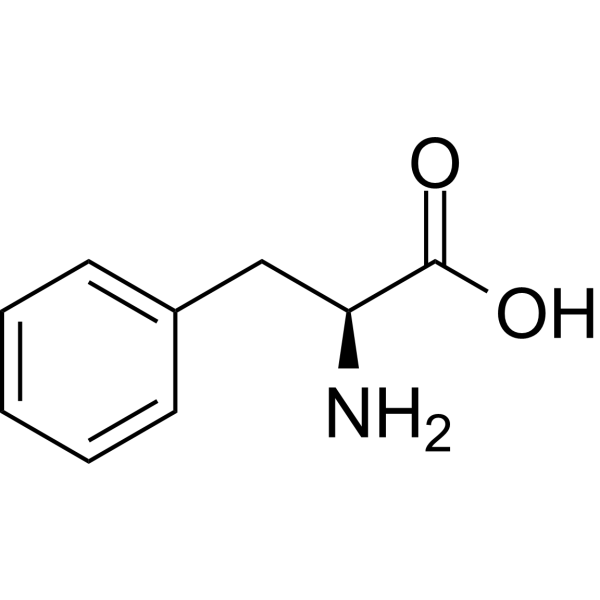
L-Phenylalanine (Standard) is the analytical standard of L-Phenylalanine. This product is intended for research and analytical applications. L-Phenylalanine ((S)-2-Amino-3-phenylpropionic acid) is an essential amino acid isolated from Escherichia coli. L-Phenylalanine is a α2δ subunit of voltage-dependent Ca+ channels antagonist with a Ki of 980 nM. L-phenylalanine is a competitive antagonist for the glycine- and glutamate-binding sites of N-methyl-D-aspartate receptors (NMDARs) (KB of 573 μM ) and non-NMDARs, respectively. L-Phenylalanine is widely used in the production of food flavors and pharmaceuticals.
For research use only. We do not sell to patients.
- Purity : 99.99%
- CAS No.: 63-91-2
- Formula: C9H11NO2
- Molecular Weight:165.19
-
Storage:
Please store the product under the recommended conditions in the Certificate of Analysis.


To place orders, for customer services and technical support, please contact: MedChemExpress USA
Tel: 609-228-6898 E-mail: [email protected] [email protected]


-
 Product Information
-
Chemical Information
- Purity & Documentation
-
 Help & FAQs


-

HY-N0473R
L-Tyrosine (Standard)Citrate Synthase Inhibitor -

HY-N0623R
L-Tryptophan (standard)Essential Amino Acid -
HY-N0215
L-PhenylalanineCalcium Channels Antagonist -

HY-N0717R
L-Valine (Standard)Analytical Standard -

HY-N0486R
L-Leucine (Standard)mTOR activator -

HY-Y0252R
L-Proline (Standard) -

HY-N0771R
L-Isoleucine (Standard)Endogenous Metabolite, L-enantiomer of Isoleucine -

HY-14608R
L-Glutamic acid (Standard)Glutamate Receptors Agonist -
HY-N0473
L-TyrosineCitrate Synthase Inhibitor -

HY-N0229R
L-Alanine (Standard)Endogenous Metabolite -

HY-N0666R
L-Aspartic acid (Standard)Reference Standard -

HY-N0658R
L-Threonine (Standard)Endogenous Metabolite


Product Information
Information
Application
The compound is the grade of analytical standard, which is the reference standard supplied assay. It is commonly used in qualitative, quantitative and methodological research experiments in HPLC, GC and MS.


Chemical Information
-
CAS No. 63-91-2
-
Appearance Solid
-
Molecular Weight 165.19
-
Formula C9H11NO2
-
Color White to off-white
-
SMILES
N[C@@H](CC1=CC=CC=C1)C(O)=O
-
Synonyms
(S)-2-Amino-3-phenylpropionic acid (Standard)
-
Structure Classification
-
Initial Source
-
Shipping
Room temperature in continental US; may vary elsewhere.
-
Storage
Please store the product under the recommended conditions in the Certificate of Analysis.


Purity & Documentation
-
SDS (252 KB)
- English - EN (252 KB)
- Français - FR (252 KB)
- Deutsch - DE (252 KB)
- Norwegian - NO (252 KB)
- Español - ES (252 KB)
- Swedish - SV (252 KB)
- Italian - IT (252 KB)
- Korean - KR (252 KB)
- Portuguese - PT (252 KB)
-
Handling Instructions (2659 KB)
References
[1]. Glushakov AV, et al. Long-term changes in glutamatergic synaptic transmission in phenylketonuria. Brain. 2005 Feb;128(Pt 2):300-7. [Content Brief]
[2]. Glushakov AV, et al. L-phenylalanine selectively depresses currents at glutamatergic excitatory synapses. J Neurosci Res. 2003 Apr 1;72(1):116-24. [Content Brief]
[3]. Glushakov AV, et al. Specific inhibition of N-methyl-D-aspartate receptor function in rat hippocampal neurons by L-phenylalanine at concentrations observed during phenylketonuria. Mol Psychiatry. 2002;7(4):359-67. [Content Brief]
[4]. Mortell KH, et al. Structure-activity relationships of alpha-amino acid ligands for the alpha2delta subunit of voltage-gated calcium channels. Bioorg Med Chem Lett. 2006 Mar 1;16(5):1138-41. [Content Brief]
[5]. Wu WB, et al. Enhancement of l-phenylalanine production in Escherichia coli by heterologous expression of Vitreoscilla hemoglobin. Biotechnol Appl Biochem. 2018 May;65(3):476-483. [Content Brief]

Calculators
Concentration (start) × Volume (start) = Concentration (final) × Volume (final)


L-Phenylalanine (Standard) Related Classifications
HY-N0215R Related Classifications
 Powered by Bioz