



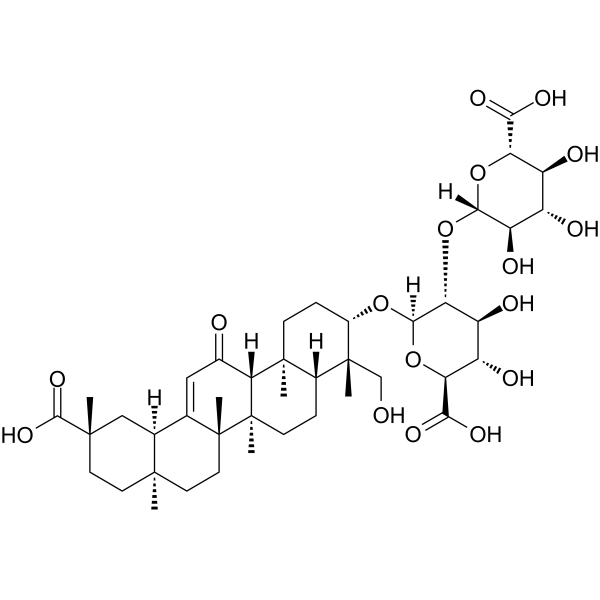
Licoricesaponin G2
Based on 1 publication(s) in Google Scholar
Licoricesaponin G2 is an orally active component found in Licorice. Licoricesaponin G2 significantly ameliorates Bleomycin (HY-108345)-induced pulmonary fibrosis by inhibiting the TNF-α signaling pathway, reducing epithelial-mesenchymal transition, and decreasing extracellular matrix deposition. Licoricesaponin G2 inhibits cancer cells proliferation, migration, inhibits PI3K/AKT/mTOR signaling pathway and increases ROS production. Licoricesaponin G2 can be used for the research of lung cancer and pulmonary fibrosis.
For research use only. We do not sell to patients.
- Purity : 99.87%
- CAS No.: 118441-84-2
- Formula: C42H62O17
- Molecular Weight:838.93
-
Storage:
4°C, protect from light
* In solvent : -80°C, 6 months; -20°C, 1 month (protect from light)

To place orders, for customer services and technical support, please contact: MedChemExpress USA
Tel: 609-228-6898 E-mail: [email protected] [email protected]


-
 Biological Activity
-
Chemical Information
-
Solvent & Solubility
- Purity & Documentation
- References
-
 Help & FAQs


Publications Citing Use of MedChemExpress (MCE) Licoricesaponin G2
More

Biological Activity
Description
Cellular Effect
|
Cell Line

|
Type | Value | Description | References |
|---|---|---|---|---|
| Hepatocyte | IC50 |
6.9 μM
Compound: 194
|
Hepatotoxicity in D-GaIN induced in Wistar rat model hepatocyte assessed as reduction in PLA2 level
Hepatotoxicity in D-GaIN induced in Wistar rat model hepatocyte assessed as reduction in PLA2 level
|
[PMID: 29353722] |
In Vitro
Licoricesaponin G2 (0.5-10 μM; 72 h) reduces the viability of NCI-A549, NCI-H460, and NCI-H446 lung cancer cells in a dose-dependent manner[1].
Licoricesaponin G2 (1-5 μM; 14 days) dose-dependently inhibits colony formation in NCI-A549, NCI-H460, and NCI-H446 lung cancer cells[1].
Licoricesaponin G2 (1-5 μM; 3 days) dose-dependently inhibits sphere formation in NCI-A549, NCI-H460, and NCI-H446 lung cancer cells[1].
Licoricesaponin G2 (1-5 μM) dose-dependently downregulates cancer stem cell markers (CD44, CD133), PI3K/AKT pathway phosphorylated proteins (p-PI3K, p-AKT, p-mTOR), EGFR/STAT3 pathway phosphorylated proteins (p-EGFR, p-STAT3), and ferroptosis markers (SLC7A11, GPX4) in NCI-A549 and NCI-H446 lung cancer cells[1].
Licoricesaponin G2 (1-5 μM; 48 h) increases the thermal stability of the PIK3R1 protein in NCI-A549 lung cancer cells[1].
Licoricesaponin G2 (1-5 μM; 24 h) dose-dependently increases intracellular reactive oxygen species levels in NCI-H446 lung cancer cells[1].
Licoricesaponin G2 (1-5 μM) dose-dependently increases MDA and GSH levels in NCI-H446 lung cancer cells[1].
Licoricesaponin G2 (1-5 μM) inhibits 3D spheroid formation in NCI-H460 lung cancer cells and dose-dependently downregulates phosphorylated PI3K/AKT pathway proteins (p-PI3K, p-AKT, p-mTOR) in spheroids[1].
Licoricesaponin G2 shows strong binding affinity to both TNF-α and MMP9 proteins, with docking scores of -4.849 kcal/mol and -6.392 kcal/mol, respectively[2].
Licoricesaponin G2 (0.2-50 μM; 48 h) reduces viability of A549 human lung carcinoma cells, and also reduces viability of TGF-β1-stimulated A549 and MRC5 cells at these respective concentrations[2].
Licoricesaponin G2 (0.8-3.1 μM; 48 h) reverses TGF-β1-induced EMT and ECM accumulation in A549 human lung carcinoma cells by upregulating E-cadherin and downregulating N-cadherin, α-SMA, and Collagen I at both mRNA and protein levels[2].
Licoricesaponin G2 (6.3-25 μM; 48 h) reverses TGF-β1-induced FMT and ECM accumulation in MRC5 human fetal lung fibroblasts by downregulating α-SMA and Collagen I at both mRNA and protein levels[2].
Licoricesaponin G2 (0.8-1.6 μM; 24 h) inhibits TGF-β1-induced migration of A549 human lung carcinoma cells[2].
Licoricesaponin G2 (0.8-12.5 μM; 48 h) inhibits the TNF-α signaling pathway in TGF-β1-stimulated A549 and MRC5 cells, reducing protein levels of TNF-α, p-IKK, p-NFκB, MMP3, and MMP9[2].
Licoricesaponin G2 (0.05-1.0 mg/plate) does not exhibit antimutagenic activity against MNU in Salmonella typhimurium TA1535[3].
MedChemExpress (MCE) has not independently confirmed the accuracy of these methods. They are for reference only.
-
Cell Line:NCI-A549, NCI-H460, NCI-H446
-
Concentration:0.5, 1, 2.5, 5, 10 μM
-
Incubation Time:72 h
-
Result:Significantly reduced the viability of A549, H460, and H446 cells at 5 and 10 μM.
Decreased viability in a dose-dependent manner.
-
Cell Line:TGF-β1-stimulated A549 human lung carcinoma cells
-
Concentration:0.8, 1.6 μM
-
Incubation Time:48 h
-
Result:Increased E-cadherin levles.
Reduced TGF-β1-increased N-cadherin, α-SMA and Collagen I levels.
In Vivo
Licoricesaponin G2 (50 mg/kg; i.g.,; daily; 14 days) significantly ameliorates Bleomycin (HY-108345)-induced pulmonary fibrosis in male C57/BL6 mice by inhibiting the TNF-α signaling pathway, reducing epithelial-mesenchymal transition, and decreasing extracellular matrix deposition[2].
MedChemExpress (MCE) has not independently confirmed the accuracy of these methods. They are for reference only.
-
Animal Model:BALB/c nude mice (female, 4-5 weeks old, 18-22 g, SPF, subcutaneous NCI-A549 cells xenograft model)[1]
-
Dosage:10 mg/kg; 50 mg/kg
-
Administration:daily; 21 days
-
Result:Reduced final tumor volume and tumor weight in a dose-dependent manner.
Reduced CD44 and CD133 protein levels in tumor tissue.
Reduced p-PI3K, p-AKT, and p-mTOR levels.
-
Animal Model:C57/BL6 (8-week-old male, bleomycin-induced pulmonary fibrosis)[2]
-
Dosage:50 mg/kg
-
Administration:p.o.; daily; 14 days
-
Result:Reduced bleomycin-induced lung pathological changes including connective tissue proliferation, alveolar structure damage, and inflammatory cell infiltration.
Decreased collagen fiber deposition.
Upregulated E-cadherin protein expression and downregulated N-cadherin, α-SMA, and Collagen I protein expression.
Decreased α-SMA and Collagen I levels in lung tissue.
Reduced Bleomycin-induced increases in TNF-α, p-IKK, p-NFκB, MMP3, and MMP9 protein levels in lung tissue.


Chemical Information
-
CAS No. 118441-84-2
-
Appearance Solid
-
Molecular Weight 838.93
-
Formula C42H62O17
-
Color White to off-white
-
SMILES
C[C@@]1([C@@]2([H])[C@@]3([C@@]([C@](C)([C@@H](O[C@@]4([H])[C@@H]([C@H]([C@H](O)[C@@H](C(O)=O)O4)O)O[C@]5([H])O[C@@H]([C@@H](O)[C@H](O)[C@H]5O)C(O)=O)CC3)CO)([H])CC1)C)[C@]6(C([C@@]7([H])[C@](C)(CC[C@@](C(O)=O)(C)C7)CC6)=CC2=O)C
-
Structure Classification
-
Initial Source
-
Shipping
Room temperature in continental US; may vary elsewhere.
-
Storage
4°C, protect from light
* In solvent : -80°C, 6 months; -20°C, 1 month (protect from light)


Publications (1)
-
Journal Impact Factor
-
Most Recent


Solvent & Solubility
In Vitro:
DMSO : 100 mg/mL (119.20 mM; Need ultrasonic; Hygroscopic DMSO has a significant impact on the solubility of product, please use newly opened DMSO)
Please refer to the solubility information to select the appropriate solvent. Once prepared, please aliquot and store the solution to prevent product inactivation from repeated freeze-thaw cycles.
Storage method and period of stock solution: -80°C, 6 months; -20°C, 1 month (protect from light). When stored at -80°C, please use it within 6 months. When stored at -20°C, please use it within 1 month.
Please refer to the solubility information to select the appropriate solvent. Once prepared, please aliquot and store the solution to prevent product inactivation from repeated freeze-thaw cycles.
Storage method and period of stock solution: -80°C, 6 months; -20°C, 1 month (protect from light). When stored at -80°C, please use it within 6 months. When stored at -20°C, please use it within 1 month.
Concentration (start) × Volume (start) = Concentration (final) × Volume (final)
In Vivo:
Select the appropriate dissolution method based on your experimental animal and administration route.
- For the following dissolution methods, please ensure to first prepare a clear stock solution using an In Vitro approach and then sequentially add co-solvents:
- To ensure reliable experimental results, the clarified stock solution can be appropriately stored based on storage conditions. As for the working solution for In Vivo experiments, it is recommended to prepare freshly and use it on the same day.
- The percentages shown for the solvents indicate their volumetric ratio in the final prepared solution. If precipitation or phase separation occurs during preparation, heat and/or sonication can be used to aid dissolution.
Add each solvent one by one: 10% DMSO 40% PEG300 5% Tween-80 45% Saline
Solubility: ≥ 2.5 mg/mL (2.98 mM); Clear solution
This protocol yields a clear solution of ≥ 2.5 mg/mL (saturation unknown).
Taking 1 mL working solution as an example, add 100 μL DMSO stock solution (25.0 mg/mL) to 400 μL PEG300, and mix evenly; then add 50 μL Tween-80 and mix evenly; then add 450 μL Saline to adjust the volume to 1 mL.
Preparation of Saline: Dissolve 0.9 g sodium chloride in ddH₂O and dilute to 100 mL to obtain a clear Saline solution.
Add each solvent one by one: 10% DMSO 90% (20% SBE-β-CD in Saline)
Solubility: ≥ 2.5 mg/mL (2.98 mM); Clear solution
This protocol yields a clear solution of ≥ 2.5 mg/mL (saturation unknown).
Taking 1 mL working solution as an example, add 100 μL DMSO stock solution (25.0 mg/mL) to 900 μL 20% SBE-β-CD in Saline, and mix evenly.
Preparation of 20% SBE-β-CD in Saline (4°C, storage for one week): 2 g SBE-β-CD powder is dissolved in 10 mL Saline, completely dissolve until clear.
In Vivo Dissolution Calculator
Please enter the basic information of animal experiments:
-
-
-
-
Recommended: Prepare an additional quantity of animals to account for potential losses during experiments.
Please enter your animal formula composition:
-
%DMSO +
Recommended: Keep the proportion of DMSO in working solution below 2% if your animal is weak.
-
%+
-
+%Tween-80 + +
-
%Saline +
The co-solvents required include: DMSO, . All of co-solvents are available by MedChemExpress (MCE). , Tween 80. All of co-solvents are available by MedChemExpress (MCE).
Working solution concentration: 0.22 mg/mL
Method for preparing stock solution: mg drug dissolved in μL DMSO. Stock solution concentration: mg/mL. * In solvent : -80°C, 6 months; -20°C, 1 month (protect from light)
1. Take μL DMSO stock solution;
2. Add μL .
μL , mix evenly;
3. Then add μL Tween 80, mix evenly;
4. Then add μL
Please ensure that the stock solution in the first step is dissolved to a clear state, and add co-solvents in sequence. You can use ultrasonic heating (ultrasonic cleaner, recommended frequency 20-40 kHz), vortexing, etc. to assist dissolution.


Purity & Documentation
-
Data Sheet (285 KB)
-
SDS (394 KB)
- English - EN (394 KB)
- Français - FR (394 KB)
- Deutsch - DE (394 KB)
- Norwegian - NO (394 KB)
- Español - ES (394 KB)
- Swedish - SV (394 KB)
- Italian - IT (394 KB)
- Korean - KR (394 KB)
- Portuguese - PT (394 KB)
-
Handling Instructions (2659 KB)
References
[1]. Yang X, et al. Based on network pharmacology and experiments to investigate the inhibitory effect of Licoricesaponin G2 on lung cancer tumor growth. J Ethnopharmacol. 2026;357:120950. [Content Brief]
[2]. Ma J, et al. Licoricesaponin G2 ameliorates bleomycin-induced pulmonary fibrosis via targeting TNF-α signaling pathway and inhibiting the epithelial-mesenchymal transition. Front Pharmacol. 2024;15:1437231. Published 2024 Sep 5. [Content Brief]
[3]. Inami K, et al. Antimutagenic components in Glycyrrhiza against N-methyl-N-nitrosourea in the Ames assay. Nat Prod Res. 2017;31(6):691-695. [Content Brief]


Complete Stock Solution Preparation Table
Please refer to the solubility information to select the appropriate solvent. Once prepared, please aliquot and store the solution to prevent product inactivation from repeated freeze-thaw cycles.
Storage method and period of stock solution: -80°C, 6 months; -20°C, 1 month (protect from light). When stored at -80°C, please use it within 6 months. When stored at -20°C, please use it within 1 month.
| Optional Solvent | Concentration Solvent Mass | 1 mg | 5 mg | 10 mg | 25 mg |
|---|---|---|---|---|---|
| DMSO | 1 mM | 1.1920 mL | 5.9600 mL | 11.9199 mL | 29.7999 mL |
| 5 mM | 0.2384 mL | 1.1920 mL | 2.3840 mL | 5.9600 mL | |
| 10 mM | 0.1192 mL | 0.5960 mL | 1.1920 mL | 2.9800 mL | |
| 15 mM | 0.0795 mL | 0.3973 mL | 0.7947 mL | 1.9867 mL | |
| 20 mM | 0.0596 mL | 0.2980 mL | 0.5960 mL | 1.4900 mL | |
| 25 mM | 0.0477 mL | 0.2384 mL | 0.4768 mL | 1.1920 mL | |
| 30 mM | 0.0397 mL | 0.1987 mL | 0.3973 mL | 0.9933 mL | |
| 40 mM | 0.0298 mL | 0.1490 mL | 0.2980 mL | 0.7450 mL | |
| 50 mM | 0.0238 mL | 0.1192 mL | 0.2384 mL | 0.5960 mL | |
| 60 mM | 0.0199 mL | 0.0993 mL | 0.1987 mL | 0.4967 mL | |
| 80 mM | 0.0149 mL | 0.0745 mL | 0.1490 mL | 0.3725 mL | |
| 100 mM | 0.0119 mL | 0.0596 mL | 0.1192 mL | 0.2980 mL |


Licoricesaponin G2 Related Classifications
HY-N6983 Related Classifications
 Powered by Bioz