



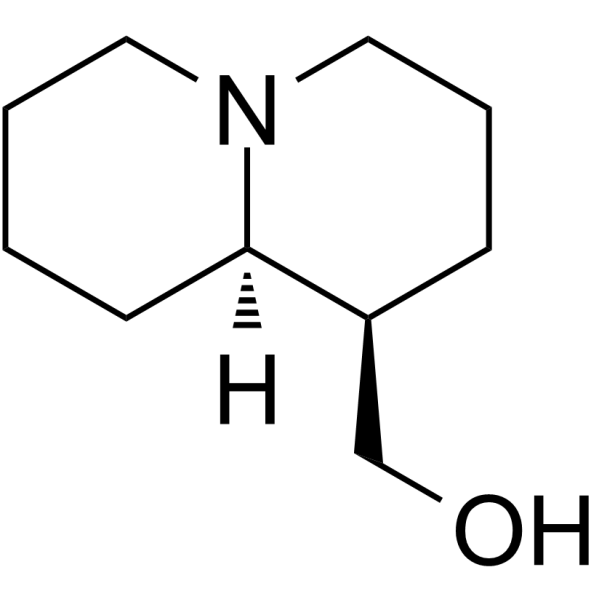
(-)-Lupinine

Based on 1 Customer Validation
(-)-Lupinine is an alkaloid and membrane fusion inhibitor. (-)-Lupinine does not affect the synthesis of proinflammatory cytokines during the host response to Serratia proteamaculans infection. (-)-Lupinine can enhance the expression of the bacterial surface protein OmpX. (-)-Lupinine can be used for research on bacterial infections.
For research use only. We do not sell to patients.
- Purity : 99.45%
- CAS No.: 486-70-4
- Formula: C10H19NO
- Molecular Weight:169.26
-
Storage:Powder -20°C, 3 years , 4°C, 2 years ; In solvent -80°C, 6 months , -20°C, 1 month

To place orders, for customer services and technical support, please contact: MedChemExpress USA
Tel: 609-228-6898 E-mail: [email protected] [email protected]


-
 Biological Activity
-
Chemical Information
-
Solvent & Solubility
- Protocols
- Purity & Documentation
- References
-
 Help & FAQs




Biological Activity
Description
In Vitro
(-)-Lupinine (400 μM; 24 h) has no significant effect on the growth of Serratia proteamaculans[1].
(-)-Lupinine (400 μM; 24 h) does not alter biofilm formation by Serratia proteamaculans[1].
(-)-Lupinine (400 μM; 24 h pre-incubation) increases Serratia proteamaculans sensitivity to Amikacin (HY-B0509A) by at least 20% and reduces sensitivity to Azlocillin (HY-B0529) and Ertapenem (HY-A0294)[1].
(-)-Lupinine (2-24 h) causes no cytotoxicity to M-HeLa cells and DF-2 skin dermal fibroblasts, reducing M-HeLa cell viability by no more than 30%[1].
(-)-Lupinine (400 μM; 2 h) has no effect on IL-6 or IL-8 secretion by M-HeLa cells in response to Serratia proteamaculans infection[1].
(-)-Lupinine (400 μM; 2 h) does not induce stress fiber formation in M-HeLa cells and has no effect on the intensity of Serratia proteamaculans invasion into M-HeLa cells[1].
(-)-Lupinine (400 μM; 24 h) increases ompX gene expression and increases OmpX surface protein levels by 1.6-5.5 times in Serratia proteamaculans[1].
MedChemExpress (MCE) has not independently confirmed the accuracy of these methods. They are for reference only. Further protocols information, click here.
-
Cell Line:M-HeLa cells, DF-2 skin dermal fibroblasts
-
Concentration:400 μM (M-HeLa, 2 h); 400 μM (M-HeLa, 24 h); 80-400 μM (DF-2, 24 h)
-
Incubation Time:2 h (M-HeLa); 24 h (M-HeLa, DF-2)
-
Result:Reduced M-HeLa cell viability by no more than 30% after 24 h of incubation.
Was nontoxic to DF-2 cells at both 400 μM and 80 μM after 24 h of incubation.


Chemical Information
-
CAS No. 486-70-4
-
Appearance Solid
-
Molecular Weight 169.26
-
Formula C10H19NO
-
Color Light yellow to yellow
-
SMILES
OC[C@@H]1CCCN2CCCC[C@@]21[H]
-
Shipping
Room temperature in continental US; may vary elsewhere.
-
Storage
Powder -20°C 3 years 4°C 2 years In solvent -80°C 6 months -20°C 1 month


Solvent & Solubility
In Vitro:
DMSO : 100 mg/mL (590.81 mM; Need ultrasonic; Hygroscopic DMSO has a significant impact on the solubility of product, please use newly opened DMSO)
Please refer to the solubility information to select the appropriate solvent. Once prepared, please aliquot and store the solution to prevent product inactivation from repeated freeze-thaw cycles.
Storage method and period of stock solution: -80°C, 6 months; -20°C, 1 month. When stored at -80°C, please use it within 6 months. When stored at -20°C, please use it within 1 month.
Please refer to the solubility information to select the appropriate solvent. Once prepared, please aliquot and store the solution to prevent product inactivation from repeated freeze-thaw cycles.
Storage method and period of stock solution: -80°C, 6 months; -20°C, 1 month. When stored at -80°C, please use it within 6 months. When stored at -20°C, please use it within 1 month.
Concentration (start) × Volume (start) = Concentration (final) × Volume (final)
In Vivo:
Select the appropriate dissolution method based on your experimental animal and administration route.
- For the following dissolution methods, please ensure to first prepare a clear stock solution using an In Vitro approach and then sequentially add co-solvents:
- To ensure reliable experimental results, the clarified stock solution can be appropriately stored based on storage conditions. As for the working solution for In Vivo experiments, it is recommended to prepare freshly and use it on the same day.
- The percentages shown for the solvents indicate their volumetric ratio in the final prepared solution. If precipitation or phase separation occurs during preparation, heat and/or sonication can be used to aid dissolution.
Add each solvent one by one: 10% DMSO 40% PEG300 5% Tween-80 45% Saline
Solubility: ≥ 2.5 mg/mL (14.77 mM); Clear solution
This protocol yields a clear solution of ≥ 2.5 mg/mL (saturation unknown).
Taking 1 mL working solution as an example, add 100 μL DMSO stock solution (25.0 mg/mL) to 400 μL PEG300, and mix evenly; then add 50 μL Tween-80 and mix evenly; then add 450 μL Saline to adjust the volume to 1 mL.
Preparation of Saline: Dissolve 0.9 g sodium chloride in ddH₂O and dilute to 100 mL to obtain a clear Saline solution.
Add each solvent one by one: 10% DMSO 90% (20% SBE-β-CD in Saline)
Solubility: ≥ 2.5 mg/mL (14.77 mM); Clear solution
This protocol yields a clear solution of ≥ 2.5 mg/mL (saturation unknown).
Taking 1 mL working solution as an example, add 100 μL DMSO stock solution (25.0 mg/mL) to 900 μL 20% SBE-β-CD in Saline, and mix evenly.
Preparation of 20% SBE-β-CD in Saline (4°C, storage for one week): 2 g SBE-β-CD powder is dissolved in 10 mL Saline, completely dissolve until clear.
In Vivo Dissolution Calculator
Please enter the basic information of animal experiments:
-
-
-
-
Recommended: Prepare an additional quantity of animals to account for potential losses during experiments.
Please enter your animal formula composition:
-
%DMSO +
Recommended: Keep the proportion of DMSO in working solution below 2% if your animal is weak.
-
%+
-
+%Tween-80 + +
-
%Saline +
The co-solvents required include: DMSO, . All of co-solvents are available by MedChemExpress (MCE). , Tween 80. All of co-solvents are available by MedChemExpress (MCE).
Working solution concentration: 0.22 mg/mL
Method for preparing stock solution: mg drug dissolved in μL DMSO. Stock solution concentration: mg/mL.
1. Take μL DMSO stock solution;
2. Add μL .
μL , mix evenly;
3. Then add μL Tween 80, mix evenly;
4. Then add μL
Please ensure that the stock solution in the first step is dissolved to a clear state, and add co-solvents in sequence. You can use ultrasonic heating (ultrasonic cleaner, recommended frequency 20-40 kHz), vortexing, etc. to assist dissolution.

Protocols
-
Research Protocol for Infectious Diseases
Infectious-disease experiments test how pathogens interact with host barriers, innate immune receptors, inflammatory signaling, pathogen replication, and tissue injury; pattern-recognition receptors such as TLRs, RIG-I-like receptors, NOD-like receptors, and inflammasomes detect microbial molecules and activate NF-κB, interferon, and cytokine responses. The central hypothesis is that infection severity reflects the balance between pathogen burden and host response: protective inflammation restricts pathogen growth, whereas excessive or mislocalized inflammation contributes to tissue damage and disease phenotype. Unresolved questions include which host pathways are protective versus pathogenic, why some infection models fail to translate to human disease, and which combined readouts best predict clinically relevant infection outcomes.
-
RNA extraction experimental
By lysing cells, releasing RNA, and removing impurities such as proteins and DNA, high-purity RNA products are finally obtained. The commonly used traditional method is the guanidine isothiocyanate/phenol/chloroform method (Trizol), which is suitable for a variety of animal materials including animal tissues, microorganisms, cultured cells, etc., and most plant materials.


Purity & Documentation
-
Data Sheet (288 KB)
-
SDS (476 KB)
- English - EN (476 KB)
- Français - FR (476 KB)
- Deutsch - DE (476 KB)
- Norwegian - NO (476 KB)
- Español - ES (476 KB)
- Swedish - SV (476 KB)
- Italian - IT (476 KB)
- Korean - KR (476 KB)
- Portuguese - PT (476 KB)
-
Handling Instructions (2659 KB)
References


Complete Stock Solution Preparation Table
Please refer to the solubility information to select the appropriate solvent. Once prepared, please aliquot and store the solution to prevent product inactivation from repeated freeze-thaw cycles.
Storage method and period of stock solution: -80°C, 6 months; -20°C, 1 month. When stored at -80°C, please use it within 6 months. When stored at -20°C, please use it within 1 month.
| Optional Solvent | Concentration Solvent Mass | 1 mg | 5 mg | 10 mg | 25 mg |
|---|---|---|---|---|---|
| DMSO | 1 mM | 5.9081 mL | 29.5404 mL | 59.0807 mL | 147.7018 mL |
| 5 mM | 1.1816 mL | 5.9081 mL | 11.8161 mL | 29.5404 mL | |
| 10 mM | 0.5908 mL | 2.9540 mL | 5.9081 mL | 14.7702 mL | |
| 15 mM | 0.3939 mL | 1.9694 mL | 3.9387 mL | 9.8468 mL | |
| 20 mM | 0.2954 mL | 1.4770 mL | 2.9540 mL | 7.3851 mL | |
| 25 mM | 0.2363 mL | 1.1816 mL | 2.3632 mL | 5.9081 mL | |
| 30 mM | 0.1969 mL | 0.9847 mL | 1.9694 mL | 4.9234 mL | |
| 40 mM | 0.1477 mL | 0.7385 mL | 1.4770 mL | 3.6925 mL | |
| 50 mM | 0.1182 mL | 0.5908 mL | 1.1816 mL | 2.9540 mL | |
| 60 mM | 0.0985 mL | 0.4923 mL | 0.9847 mL | 2.4617 mL | |
| 80 mM | 0.0739 mL | 0.3693 mL | 0.7385 mL | 1.8463 mL | |
| 100 mM | 0.0591 mL | 0.2954 mL | 0.5908 mL | 1.4770 mL |


(-)-Lupinine Related Classifications
HY-121219 Related Classifications
 Powered by Bioz