



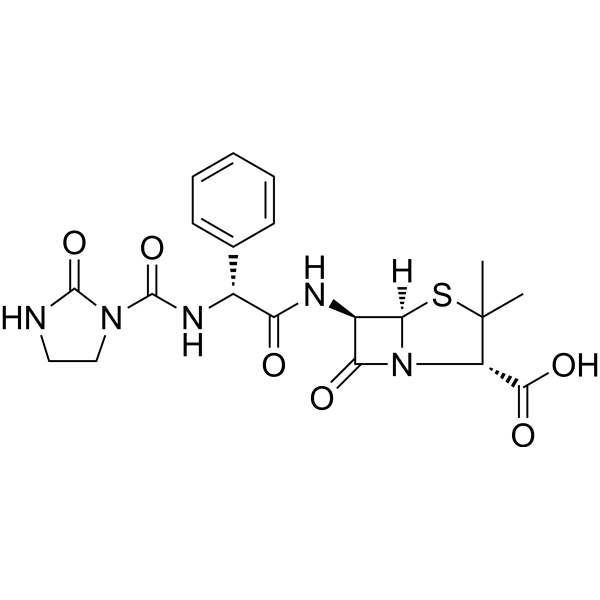
Azlocillin
Based on 1 publication(s) in Google Scholar
Azlocillin, an antibiotic, is a semisynthetic penicillin, and has broad-spectrum antibacterial activity. Azlocillin is active against drug-tolerant B. burgdorferi sensu stricto JLB31 infection.
For research use only. We do not sell to patients.
- Purity : 98.06%
- CAS No.: 37091-66-0
- Formula: C20H23N5O6S
- Molecular Weight:461.49
-
Storage:
4°C, protect from light
* In solvent : -80°C, 6 months; -20°C, 1 month (protect from light)

To place orders, for customer services and technical support, please contact: MedChemExpress USA
Tel: 609-228-6898 E-mail: [email protected] [email protected]


-
 Biological Activity
-
Chemical Information
-
Solvent & Solubility
- Protocols
- Purity & Documentation
- References
-
 Help & FAQs



Publications Citing Use of MedChemExpress (MCE) Azlocillin
MoreAll Parasite Isoforms
MoreAll Antibiotic Isoforms
More

Biological Activity
Description
Clinical Trial
| NCT Number | Sponsor | Condition | Start Date |
Phase

|
|---|---|---|---|---|
| NCT01329991 | 2011-05 | PHASE1 |


Chemical Information
-
CAS No. 37091-66-0
-
Appearance Solid
-
Molecular Weight 461.49
-
Formula C20H23N5O6S
-
Color White to off-white
-
SMILES
OC([C@@H]1N(C2=O)[C@]([C@@H]2NC([C@@H](C3=CC=CC=C3)NC(N(CCN4)C4=O)=O)=O)([H])SC1(C)C)=O
-
Shipping
Room temperature in continental US; may vary elsewhere.
-
Storage
4°C, protect from light
* In solvent : -80°C, 6 months; -20°C, 1 month (protect from light)


Publications (1)
-
Journal Impact Factor
-
Most Recent
-
J Exp Clin Cancer Res
Genomic profiling of a collection of patient-derived xenografts and cell lines identified ixabepilone as an active drug against chemo-resistant osteosarcoma. [Abstract]2025 Jul 8;44(1):195. PMID: 40624718


Solvent & Solubility
In Vitro:
DMSO : 115 mg/mL (249.19 mM; Need ultrasonic; Hygroscopic DMSO has a significant impact on the solubility of product, please use newly opened DMSO)
Please refer to the solubility information to select the appropriate solvent. Once prepared, please aliquot and store the solution to prevent product inactivation from repeated freeze-thaw cycles.
Storage method and period of stock solution: -80°C, 6 months; -20°C, 1 month (protect from light). When stored at -80°C, please use it within 6 months. When stored at -20°C, please use it within 1 month.
Please refer to the solubility information to select the appropriate solvent. Once prepared, please aliquot and store the solution to prevent product inactivation from repeated freeze-thaw cycles.
Storage method and period of stock solution: -80°C, 6 months; -20°C, 1 month (protect from light). When stored at -80°C, please use it within 6 months. When stored at -20°C, please use it within 1 month.
Concentration (start) × Volume (start) = Concentration (final) × Volume (final)


Purity & Documentation
-
Data Sheet (279 KB)
-
SDS (394 KB)
- English - EN (394 KB)
- Français - FR (394 KB)
- Deutsch - DE (394 KB)
- Norwegian - NO (394 KB)
- Español - ES (394 KB)
- Swedish - SV (394 KB)
- Italian - IT (394 KB)
- Korean - KR (394 KB)
- Portuguese - PT (394 KB)
-
Handling Instructions (2659 KB)
References
[1]. Sanders CC. Azlocillin: a new broad spectrum penicillin. J Antimicrob Chemother. 1983 May;11 Suppl B:21-31. [Content Brief]
[2]. Pothineni VR, et al. Azlocillin can be the potential drug candidate against drug-tolerant Borrelia burgdorferi sensu stricto JLB31. Sci Rep. 2020 Mar 2;10(1):3798. [Content Brief]


Complete Stock Solution Preparation Table
Please refer to the solubility information to select the appropriate solvent. Once prepared, please aliquot and store the solution to prevent product inactivation from repeated freeze-thaw cycles.
Storage method and period of stock solution: -80°C, 6 months; -20°C, 1 month (protect from light). When stored at -80°C, please use it within 6 months. When stored at -20°C, please use it within 1 month.
| Optional Solvent | Concentration Solvent Mass | 1 mg | 5 mg | 10 mg | 25 mg |
|---|---|---|---|---|---|
| DMSO | 1 mM | 2.1669 mL | 10.8345 mL | 21.6689 mL | 54.1724 mL |
| 5 mM | 0.4334 mL | 2.1669 mL | 4.3338 mL | 10.8345 mL | |
| 10 mM | 0.2167 mL | 1.0834 mL | 2.1669 mL | 5.4172 mL | |
| 15 mM | 0.1445 mL | 0.7223 mL | 1.4446 mL | 3.6115 mL | |
| 20 mM | 0.1083 mL | 0.5417 mL | 1.0834 mL | 2.7086 mL | |
| 25 mM | 0.0867 mL | 0.4334 mL | 0.8668 mL | 2.1669 mL | |
| 30 mM | 0.0722 mL | 0.3611 mL | 0.7223 mL | 1.8057 mL | |
| 40 mM | 0.0542 mL | 0.2709 mL | 0.5417 mL | 1.3543 mL | |
| 50 mM | 0.0433 mL | 0.2167 mL | 0.4334 mL | 1.0834 mL | |
| 60 mM | 0.0361 mL | 0.1806 mL | 0.3611 mL | 0.9029 mL | |
| 80 mM | 0.0271 mL | 0.1354 mL | 0.2709 mL | 0.6772 mL | |
| 100 mM | 0.0217 mL | 0.1083 mL | 0.2167 mL | 0.5417 mL |


Azlocillin Related Classifications
HY-B0529 Related Classifications
 Powered by Bioz