



N-(α-Linolenoyl) tyrosine

Based on 1 Customer Validation
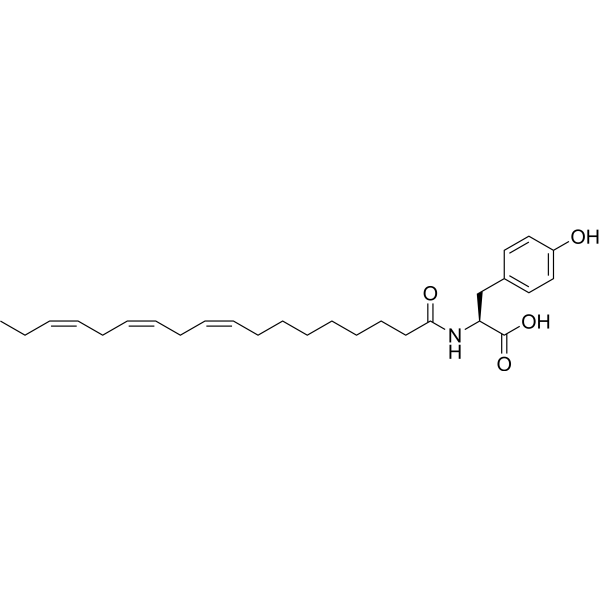
N-(α-Linolenoyl) tyrosine (NLT) is a dopaminergic agonist capable of crossing the blood-brain barrier. N-(α-Linolenoyl) tyrosine increases the level, turnover rate and release amount of dopamine in the striatum. N-(α-Linolenoyl) tyrosine modulates rotational behavior in a rat model with unilateral striatal injury and alleviates excessive blinking symptoms in models induced by dopamine-depleting agents. N-(α-Linolenoyl) tyrosine can be used for research on Parkinson's disease and idiopathic blepharospasm.
For research use only. We do not sell to patients.
- Purity : 98.98%
- CAS No.: 259143-19-6
- Formula: C27H39NO4
- Molecular Weight:441.60
-
Storage:
4°C, sealed storage, away from moisture
* In solvent : -80°C, 6 months; -20°C, 1 month (sealed storage, away from moisture)

To place orders, for customer services and technical support, please contact: MedChemExpress USA
Tel: 609-228-6898 E-mail: [email protected] [email protected]


-
 Biological Activity
-
Chemical Information
- Protocols
- Purity & Documentation
- References
-
 Help & FAQs


-
HY-N1481
Methyl linoleateMITF Inhibitor -
HY-W130610
StearamideCorrosion Inhibitor -
HY-113468
3-O-Methyl-DL-DOPAEndogenous Metabolite -

HY-113468R
3-O-Methyl-DL-DOPA (Standard)Endogenous Metabolite -
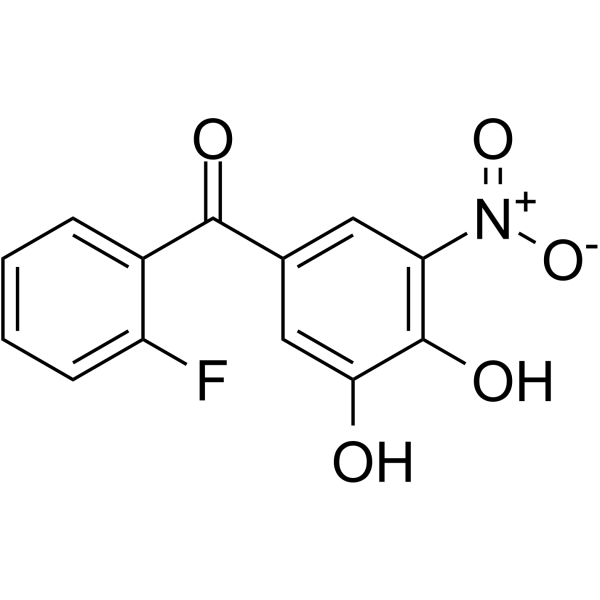
HY-125339
Ro 41-0960COMT Inhibitor -

HY-120963
N-Oleoyl Taurine -
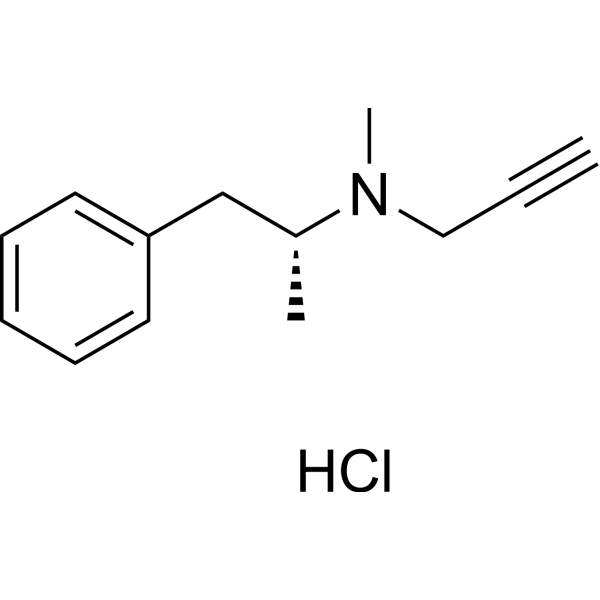
HY-14199
Selegiline hydrochlorideMAO-B Inhibitor -
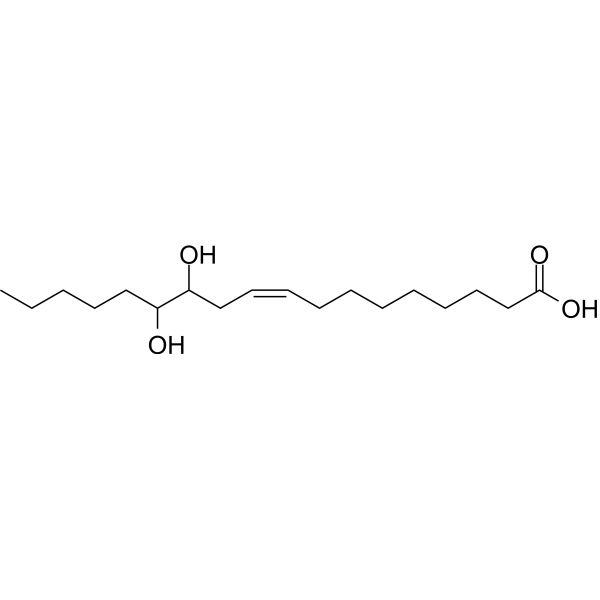
HY-116003
12,13-DiHOMEBAT Activator -
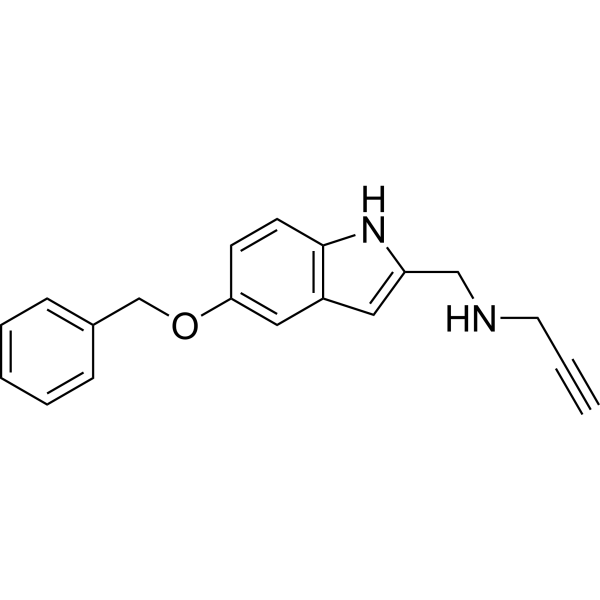
HY-120419
PF9601NMAO-B Inhibitor -
HY-101559
10-Nitrooleic acidNitro Fatty Acid -

HY-W130610R
Stearamide (Standard) -
HY-122504
Linoleoyl glycinePolyunsaturated Fatty Acid
All Dopamine Receptor Isoforms
More

Biological Activity
Description
In Vivo
N-(α-Linolenoyl) tyrosine (25 mg/kg; i.p.; daily; 14 days) completely reverses the exaggerated eye-blinking induced by the dopamine-depleting agent Ro4-1284 in rats[1].
MedChemExpress (MCE) has not independently confirmed the accuracy of these methods. They are for reference only.
-
Animal Model:Sprague-Dawley rat (male, 150-200 g, unilateral left striatal 6-hydroxydopamine lesion-induced Parkinson's disease)[1]
-
Dosage:100 mg/kg
-
Administration:i.p.; single injection
-
Result:Reversed rotational behavior of 6-OH-DA-lesioned rats, inducing 98 left (ipsilateral to lesion) turns and 2 right (contralateral to lesion) turns over 30 minutes, representing 98% ipsilateral turns.
-
Animal Model:Sprague-Dawley rat (male, Ro4-1284-induced benign essential blepharospasm)[1]
-
Dosage:25 mg/kg
-
Administration:i.p.; daily; 14 days
-
Result:Reduced Ro4-1284-induced eye-blinking rate from 19.08 to 5.00 blinks per minute, a level comparable to the normal rat eye-blinking rate of 5.16 blinks per minute.


Chemical Information
-
CAS No. 259143-19-6
-
Appearance Solid
-
Molecular Weight 441.60
-
Formula C27H39NO4
-
Color Off-white to light brown
-
Synonyms
NLT
-
Sequence
{α-Linolenoyl}-Tyr
-
Sequence Shortening
{α-Linolenoyl}-Y
-
Shipping
Room temperature in continental US; may vary elsewhere.
-
Storage
4°C, sealed storage, away from moisture
* In solvent : -80°C, 6 months; -20°C, 1 month (sealed storage, away from moisture)

Protocols
-
Human pluripotent stem cell midbrain dopaminergic neuron differentiation
Human pluripotent stem cells are directed toward midbrain dopaminergic neurons by first inducing a neural floor-plate-like progenitor state, then patterning cells with ventralizing SHH signaling and midbrain/WNT-FGF cues, and finally maturing progenitors into neurons expressing dopaminergic markers such as TH, NURR1/NR4A2, PITX3, DAT/SLC6A3, VMAT2/SLC18A2, GIRK2/KCNJ6, FOXA2, LMX1A, and EN1. The main readouts are loss of pluripotency, acquisition of FOXA2+/LMX1A+ midbrain floor-plate progenitors, emergence of βIII-tubulin+/MAP2+ neurons, and production of TH+ dopaminergic neurons with molecular, dopamine-release, and electrophysiological features of midbrain dopaminergic identity.
-
How to Select a Suitable Non-Mouse Animal Model
Selecting a suitable non-mouse animal model is a structured decision based on the research question, required anatomy or physiology, disease mechanism, endpoint feasibility, translational relevance, and ethical justification. Non-mouse models are preferred when mice cannot reproduce key human-relevant features, such as organ size, surgical anatomy, cardiovascular physiology, neuroanatomy, immune features, pharmacology, toxicology, or long-term clinical procedures. Candidate species may include rats, rabbits, guinea pigs, ferrets, zebrafish, pigs, sheep, goats, dogs, cats, horses, and non-human primates, but each species must be justified by its specific scientific advantage rather than convenience or tradition. Unresolved questions include how to quantify translational superiority across species, how to balance increased biological relevance against higher ethical burden, and when human-derived systems or new approach methodologies should replace animal use.
-
How to Choose the Right Model Animal
Choosing the right model animal is a validity-driven decision in which the species, strain, sex, age, genetic background, disease-induction method, outcome measures, and welfare burden must match the scientific question rather than laboratory tradition or convenience. A model should be selected by judging face validity, construct validity, and predictive validity: whether it resembles the human phenotype, whether it reproduces relevant mechanisms, and whether results are likely to predict human biology or treatment response. Animal studies often fail to translate because of species differences, weak disease resemblance, poor experimental design, inadequate reporting, publication bias, and underuse of randomization, blinding, and sample-size justification. Unresolved questions include how to rank competing models objectively, how much human-disease complexity must be reproduced for a given objective, and when non-animal systems such as organoids, ex vivo tissue, or computational models


Purity & Documentation
-
Data Sheet (266 KB)
-
SDS (394 KB)
- English - EN (394 KB)
- Français - FR (394 KB)
- Deutsch - DE (394 KB)
- Norwegian - NO (394 KB)
- Español - ES (394 KB)
- Swedish - SV (394 KB)
- Italian - IT (394 KB)
- Korean - KR (394 KB)
- Portuguese - PT (394 KB)
-
Handling Instructions (2659 KB)
References

Calculators
Concentration (start) × Volume (start) = Concentration (final) × Volume (final)


N-(α-Linolenoyl) tyrosine Related Classifications
HY-145512 Related Classifications
 Powered by Bioz