



Nifuratel
Based on 3 publication(s) in Google Scholar
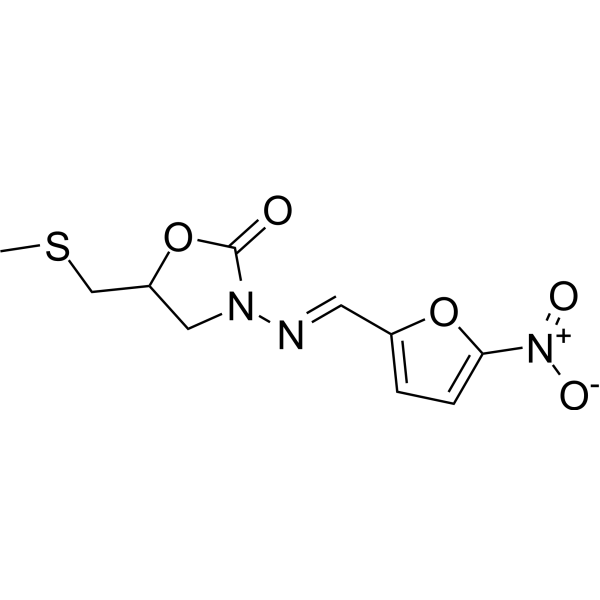
Nifuratel (NF 113) is an orally active broad-spectrum antibiotic with antiprotozoal, antibacterial, anticancer and anti-inflammatory activities, and has good inhibitory effects on Candida and Trichomonas. Nifuratel is also a STAT3 inhibitor, which significantly inhibits the growth and proliferation of human gastric cancer cells and induces apoptosis. In addition, Nifuratel also inhibits mast cell-mediated antigen hypersensitivity reactions and can be used in the study of IgE-mediated allergic diseases.
For research use only. We do not sell to patients.
- Purity : 99.93%
- CAS No.: 4936-47-4
- Formula: C10H11N3O5S
- Molecular Weight:285.28
-
Storage:Powder -20°C, 3 years , 4°C, 2 years ; In solvent -80°C, 2 years , -20°C, 1 year

To place orders, for customer services and technical support, please contact: MedChemExpress USA
Tel: 609-228-6898 E-mail: [email protected] [email protected]


-
 Biological Activity
-
Chemical Information
-
Solvent & Solubility
- Protocols
- Purity & Documentation
- References
-
 Help & FAQs


-
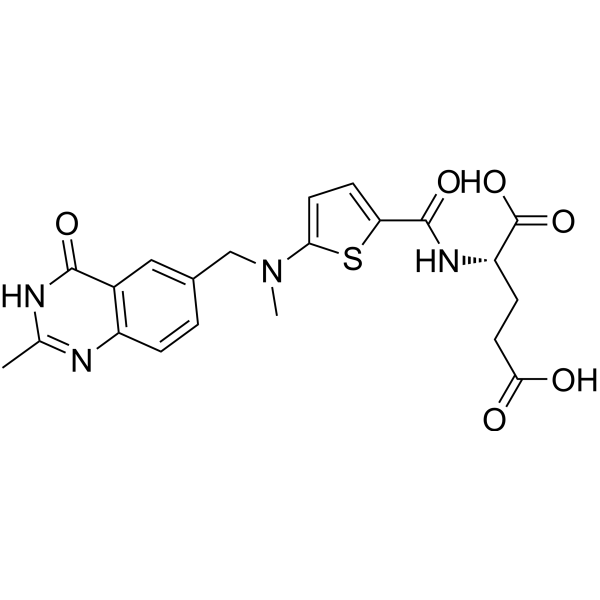
HY-10821
RaltitrexedThymidylate Synthase Inhibitor -
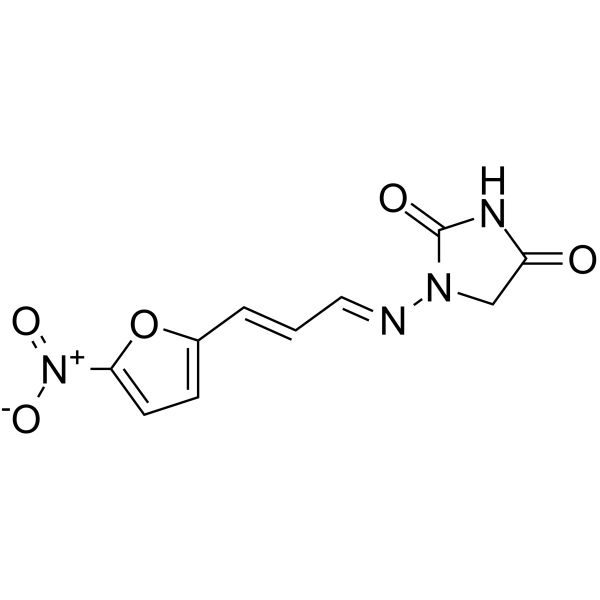
HY-77036
FuraginAntibacterial Agent, Carbonic Anhydrases Inhibitor -

HY-A0059R
Nifuratel (Standard)Bacterial Inhibitor -
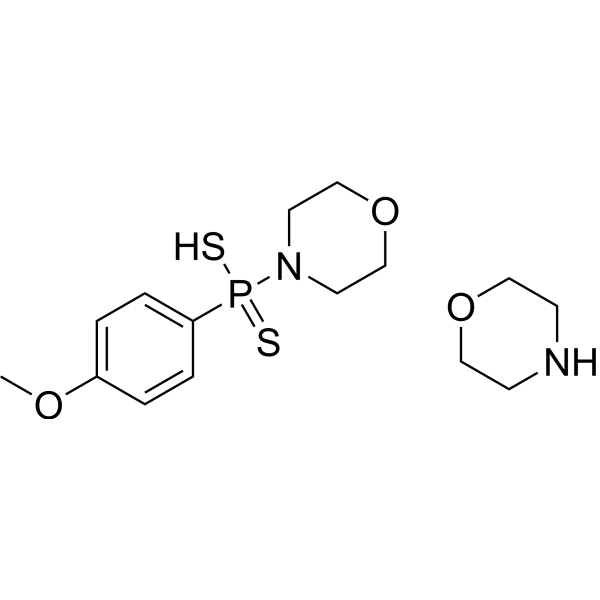
HY-107632
GYY4137H2S Donor -
HY-N0337
Eugenol,98% (stabilized with TBC)Antioxidant -
HY-12651
Primaquine diphosphateAntimalarial Agent -
HY-N6739
BeauvericinAnticancer Fungal Mycotoxin -
HY-N0512
LoganinIiridoid Glycoside -
HY-N0604
Ginsenoside Rh1Endogenous Metabolite -

HY-N0337R
Eugenol (Standard)Antioxidant -
HY-B1064
Clindamycin phosphateLincosamide Antibiotic -
HY-B0367
LornoxicamCOX Inhibitor
Publications Citing Use of MedChemExpress (MCE) Nifuratel
MoreAll Parasite Isoforms
MoreAll Antibiotic Isoforms
More

Biological Activity
Description
In Vitro
Nifuratel kills all Salmonella in RAW264.7 cells at 25 µM. Nifuratel kills all Salmonella in mouse J774.1 cells, avian HD11 cells, and human Hela cells at 50 µM, 100 µM, and 100 µM, respectively[4]. Nifuratel (0-100 µM; 15 h) completely inhibits the growth of SE C50041 strain in broth at a concentration of 100 µM[4]. Nifuratel (10-300 µM; 24 h) dose-dependently reduces colony formation in SGC7901 and BGC-823 cell lines with IC50 values of 169.7 µM and 133.7 µM[5]. Nifuratel (75-300 µM; 24 h) blocks IL-6-induced activation of the STAT3 signaling pathway in SGC-7901 and BGC-823 cell lines[5]. Nifuratel inhibits antigen-induced degranulation in both RBL-2H3 cells and BMMCs in a concentration-dependent manner, with IC50 values of 0.34 µM and 0.9 µM[6]. Nifuratel (0-3 µM; 30 min) dose-dependently inhibits the secretion of histamine from antigen-stimulated mast cells and the release of inflammatory factors TNF-α and IL-4 in antigen-stimulated RBL-2H3 cells, with IC50 values of approximately 0.48 and 0.75 µM[6].
MedChemExpress (MCE) has not independently confirmed the accuracy of these methods. They are for reference only.
-
Cell Line:SGC7901 and BGC-823 gastric cancer cell lines
-
Concentration:75、100 and 300 µM
-
Incubation Time:24 h
-
Result:Induced the arrest of gastric cancer cells in the G2/M phase of the cell cycle.
-
Cell Line:SGC7901 and BGC-823 gastric cancer cell lines
-
Concentration:75、100 and 300 µM
-
Incubation Time:24 h
-
Result:Increased the expression of pro-apoptotic protein Bax and decreased the level of anti-apoptotic protein Bcl-2 in a dose-dependent manner. Reduced phosphorylated STAT3 (P-STAT3) protein levels in SGC-7901 and BGC-823 cell lines at a dose of 300 μM.
-
Cell Line:Antigen-stimulated RBL-2H3 cells
-
Concentration:0、0.3、1、3 µM
-
Incubation Time:30 min
-
Result:Inhibited the phosphorylation of Akt, ERK1/2, JNK and p38 in a concentration-dependent manner. Almost completely inhibited Syk and Syk-mediated signaling pathways at 3 μM concentration.
In Vivo
MedChemExpress (MCE) has not independently confirmed the accuracy of these methods. They are for reference only.
-
Animal Model:IgE-dependent PCA mouse model[6]
-
Dosage:10、30 and 100 mg/kg
-
Administration:Oral gavage (p.o.); IgE (50 ng) was injected subcutaneously into the ear of mice and then orally the next day.
-
Result:Reduced mast cell degranulation in a dose-dependent manner in the ear tissue of the IgE-dependent PCA mouse model.


Chemical Information
-
CAS No. 4936-47-4
-
Appearance Solid
-
Molecular Weight 285.28
-
Formula C10H11N3O5S
-
Color Light yellow to yellow
-
SMILES
O=C1OC(CSC)CN1/N=C/C2=CC=C([N+]([O-])=O)O2
-
Synonyms
NF 113; SAP 113; Methylmercadone
-
Shipping
Room temperature in continental US; may vary elsewhere.
-
Storage
Powder -20°C 3 years 4°C 2 years In solvent -80°C 2 years -20°C 1 year


Publications (3)
-
Journal Impact Factor
-
Most Recent
-
Int J Mol Sci
Miltefosine and Nifuratel Combination: A Promising Therapy for the Treatment of Leishmania donovani Visceral Leishmaniasis. [Abstract]2023 Jan 13;24(2):1635. PMID: 36675150 -
ACS Infect Dis
Ex Vivo Phenotypic Screening of Two Small Repurposing Drug Collections Identifies Nifuratel as a Potential New Treatment against Visceral and Cutaneous Leishmaniasis. [Abstract]2021 Aug 13;7(8):2390-2401. PMID: 34114790 -


Solvent & Solubility
In Vitro:
DMSO : 50 mg/mL (175.27 mM; Need ultrasonic; Hygroscopic DMSO has a significant impact on the solubility of product, please use newly opened DMSO)
H2O : < 0.1 mg/mL (insoluble)
Please refer to the solubility information to select the appropriate solvent. Once prepared, please aliquot and store the solution to prevent product inactivation from repeated freeze-thaw cycles.
Storage method and period of stock solution: -80°C, 2 years; -20°C, 1 year. When stored at -80°C, please use it within 2 years. When stored at -20°C, please use it within 1 year.
Please refer to the solubility information to select the appropriate solvent. Once prepared, please aliquot and store the solution to prevent product inactivation from repeated freeze-thaw cycles.
Storage method and period of stock solution: -80°C, 2 years; -20°C, 1 year. When stored at -80°C, please use it within 2 years. When stored at -20°C, please use it within 1 year.
Concentration (start) × Volume (start) = Concentration (final) × Volume (final)
In Vivo:
Select the appropriate dissolution method based on your experimental animal and administration route.
- For the following dissolution methods, please ensure to first prepare a clear stock solution using an In Vitro approach and then sequentially add co-solvents:
- To ensure reliable experimental results, the clarified stock solution can be appropriately stored based on storage conditions. As for the working solution for In Vivo experiments, it is recommended to prepare freshly and use it on the same day.
- The percentages shown for the solvents indicate their volumetric ratio in the final prepared solution. If precipitation or phase separation occurs during preparation, heat and/or sonication can be used to aid dissolution.
Add each solvent one by one: 10% DMSO 40% PEG300 5% Tween-80 45% Saline
Solubility: ≥ 2.5 mg/mL (8.76 mM); Clear solution
This protocol yields a clear solution of ≥ 2.5 mg/mL (saturation unknown).
Taking 1 mL working solution as an example, add 100 μL DMSO stock solution (25.0 mg/mL) to 400 μL PEG300, and mix evenly; then add 50 μL Tween-80 and mix evenly; then add 450 μL Saline to adjust the volume to 1 mL.
Preparation of Saline: Dissolve 0.9 g sodium chloride in ddH₂O and dilute to 100 mL to obtain a clear Saline solution.
In Vivo Dissolution Calculator
Please enter the basic information of animal experiments:
-
-
-
-
Recommended: Prepare an additional quantity of animals to account for potential losses during experiments.
Please enter your animal formula composition:
-
%DMSO +
Recommended: Keep the proportion of DMSO in working solution below 2% if your animal is weak.
-
%+
-
+%Tween-80 + +
-
%Saline +
The co-solvents required include: DMSO, . All of co-solvents are available by MedChemExpress (MCE). , Tween 80. All of co-solvents are available by MedChemExpress (MCE).
Working solution concentration: 0.22 mg/mL
Method for preparing stock solution: mg drug dissolved in μL DMSO. Stock solution concentration: mg/mL.
1. Take μL DMSO stock solution;
2. Add μL .
μL , mix evenly;
3. Then add μL Tween 80, mix evenly;
4. Then add μL
Please ensure that the stock solution in the first step is dissolved to a clear state, and add co-solvents in sequence. You can use ultrasonic heating (ultrasonic cleaner, recommended frequency 20-40 kHz), vortexing, etc. to assist dissolution.


Purity & Documentation
-
Data Sheet (280 KB)
-
SDS (393 KB)
- English - EN (393 KB)
- Français - FR (393 KB)
- Deutsch - DE (393 KB)
- Norwegian - NO (393 KB)
- Español - ES (393 KB)
- Swedish - SV (393 KB)
- Italian - IT (393 KB)
- Korean - KR (393 KB)
- Portuguese - PT (393 KB)
-
Handling Instructions (2659 KB)
References
[1]. Polatti F. Bacterial vaginosis, Atopobium vaginae and nifuratel. Curr Clin Pharmacol. 2012 Feb 1;7(1):36-40. [Content Brief]
[2]. Nijevitch AA, et al. Helicobacter pylori eradication in childhood after failure of initial treatment: advantage of quadruple therapy withnifuratel to furazolidone. Aliment Pharmacol Ther. 2005 Nov 1;22(9):881-7. [Content Brief]
[3]. Nijevitch AA, et al. Nifuratel-containing initial anti-Helicobacter pylori triple therapy in children. Helicobacter. 2007 Apr;12(2):132-5. [Content Brief]
[4]. Xie T, et al. Nifuratel reduces Salmonella survival in macrophages by extracellular and intracellular antibacterial activity[J]. Microbiology Spectrum, 2023, 11(5): e05147-22. [Content Brief]
[5]. Zheng H, et al. Nifuratel, a novel STAT3 inhibitor with potent activity against human gastric cancer cells[J]. Cancer management and research, 2017: 565-572. [Content Brief]
[6]. Lee J E, et al. Drug repositioning of anti-microbial agent nifuratel to treat mast cell-mediated allergic responses[J]. International Journal of Immunopathology and Pharmacology, 2023, 37: 03946320231202349. [Content Brief]
[7]. Mendling W, et al. Microbiological and pharmaco-toxicological profile of nifuratel and its favourable risk/benefit ratio for the treatment of vulvo-vaginal infections[J]. Arzneimittelforschung, 2002, 52(01): 8-13. [Content Brief]
[8]. Tynan A P, et al. Nifuratel in urinary infections[J]. British Journal of Urology, 1969, 41(3): 271-279. [Content Brief]


Complete Stock Solution Preparation Table
Please refer to the solubility information to select the appropriate solvent. Once prepared, please aliquot and store the solution to prevent product inactivation from repeated freeze-thaw cycles.
Storage method and period of stock solution: -80°C, 2 years; -20°C, 1 year. When stored at -80°C, please use it within 2 years. When stored at -20°C, please use it within 1 year.
| Optional Solvent | Concentration Solvent Mass | 1 mg | 5 mg | 10 mg | 25 mg |
|---|---|---|---|---|---|
| DMSO | 1 mM | 3.5053 mL | 17.5266 mL | 35.0533 mL | 87.6332 mL |
| 5 mM | 0.7011 mL | 3.5053 mL | 7.0107 mL | 17.5266 mL | |
| 10 mM | 0.3505 mL | 1.7527 mL | 3.5053 mL | 8.7633 mL | |
| 15 mM | 0.2337 mL | 1.1684 mL | 2.3369 mL | 5.8422 mL | |
| 20 mM | 0.1753 mL | 0.8763 mL | 1.7527 mL | 4.3817 mL | |
| 25 mM | 0.1402 mL | 0.7011 mL | 1.4021 mL | 3.5053 mL | |
| 30 mM | 0.1168 mL | 0.5842 mL | 1.1684 mL | 2.9211 mL | |
| 40 mM | 0.0876 mL | 0.4382 mL | 0.8763 mL | 2.1908 mL | |
| 50 mM | 0.0701 mL | 0.3505 mL | 0.7011 mL | 1.7527 mL | |
| 60 mM | 0.0584 mL | 0.2921 mL | 0.5842 mL | 1.4606 mL | |
| 80 mM | 0.0438 mL | 0.2191 mL | 0.4382 mL | 1.0954 mL | |
| 100 mM | 0.0351 mL | 0.1753 mL | 0.3505 mL | 0.8763 mL |


Nifuratel Related Classifications
HY-A0059 Related Classifications
 Powered by Bioz