



NSC194598

Based on 1 Customer Validation
NSC194598 is a p53 DNA-binding inhibitor with an IC50 value of 180 nM. NSC194598 inhibits p53 DNA binding and induction of target genesn when p53 is stabilized and activated by irradiation or chemotherapy. NSC194598 can interfere with transcriptional activation of mutated rearranged during transfection (RET) gene, induce apoptosis and G0/G1 phase arrest. NSC194598 can be used for the researches of acute radiation toxicity and medullary thyroid carcinoma.
For research use only. We do not sell to patients.
- Purity: 98.9%
- CAS No.: 5358-76-9
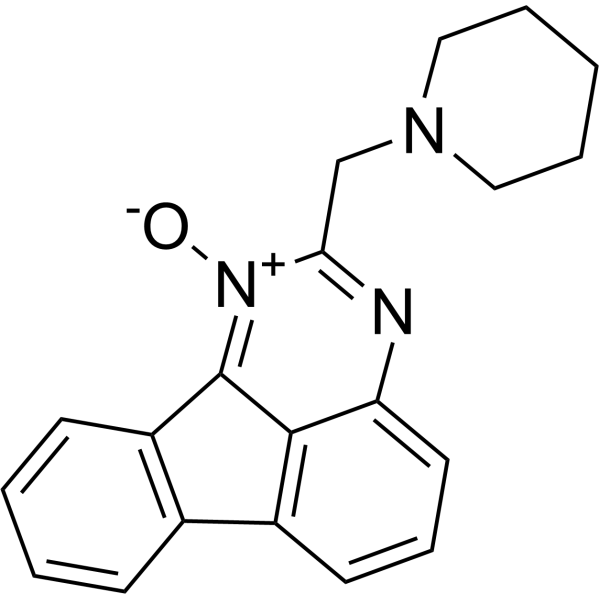
- Formula: C20H19N3O
- Molecular Weight:317.38
-
Storage:Powder -20°C, 3 years , 4°C, 2 years ; In solvent -80°C, 6 months , -20°C, 1 month

To place orders, for customer services and technical support, please contact: MedChemExpress USA
Tel: 609-228-6898 E-mail: [email protected] [email protected]


-
 Biological Activity
-
Chemical Information
-
Solvent & Solubility
- Purity & Documentation
- References
-
 Help & FAQs




Biological Activity
Description
IC50 & Target
[2]|
Caspase 3 |
In Vitro
NSC194598 (1-2 μM; 35 min) inhibits p53, p63γ, and p73β DNA binding[1].
NSC194598 inhibits the DNA-binding activity of p53-Cluc in a cell-free luciferase fragment competition assay with an IC50 of 0.18 μM[1].
NSC194598 inhibits a p53 quadruple mutant (p53-
M133L/V203A/N239Y/N268D) with an IC50 of 0.06 μM[1].
NSC194598 (2-40 μM; 4 h) inhibits IR-induced p53 DNA binding and target gene expression in U2OS cells[1].
NSC194598 (2-40 μM; 8 h) inhibits p21 induction by activated p53A138V in H1299-p53A138V cells without altering p53 levels[1].
NSC194598 (5-20 μM; 32 h) causes weak p53 accumulation and p21 induction in SJSA cells, and inhibits Nutlin-induced p21 expression[1].
NSC194598 (0.5-20 μM) stabilizes the wild-type RET promoter G-quadruplex structure without altering its parallel folding pattern[2].
NSC194598 (0.6-2.5 μg/mL; 24 h) inhibits wild-type RET promoter-driven luciferase activity in HEK293 WT cells by over 60% after 24 h treatment at 2.5 μg/mL, with concentration-dependent effects[2].
NSC194598 (1.2-2.5 μg/mL; 24-48 h) reduces RET mRNA expression in TT cells[2].
NSC194598 (2.5 μM; 24 h) inhibits recruitment of RNA polymerase II, Sp1, and nucleolin to the RET promoter at 2.5 μM for 24 h in TT cells[2].
NSC194598 (0.3-2.5 μg/mL; 24 h) reduces TT cell growth and increases caspase 3 activity[2].
NSC194598 (0.6-2.5 μg/mL; 24 h) induces dose-dependent increases in late apoptotic/necrotic TT cells, and induces G0/G1 phase arrest[2].
MedChemExpress (MCE) has not independently confirmed the accuracy of these methods. They are for reference only.
-
Cell Line:H1299-p53-A138V human lung cancer cells
-
Concentration:2, 5, 10, 20, 40 μM
-
Incubation Time:8 h
-
Result:Inhibited p21 protein expression without changing p53 protein levels.
-
Cell Line:Human medullary thyroid carcinoma TT cells
-
Concentration:1.2, 2.5 μg/mL
-
Incubation Time:24 h, 48 h
-
Result:Reduced RET mRNA expression by 90% at concentrations below 2.5 μg/mL after 24 and 48 h.
-
Cell Line:Human medullary thyroid carcinoma TT cells
-
Concentration:1.2, 2.5 μg/mL
-
Incubation Time:24 h, 48 h
-
Result:Induced corresponding reductions in RET protein levels alongside reduced RET mRNA expression.
-
Cell Line:Human medullary thyroid carcinoma TT cells
-
Concentration:0.3, 0.6, 1.2, 2.5 μg/mL
-
Incubation Time:24 h
-
Result:Reduced cell number to 70% of control at 2.5 μg/mL.
-
Cell Line:Human medullary thyroid carcinoma TT cells
-
Concentration:0.6, 1.2, 2.5 μg/mL
-
Incubation Time:24 h
-
Result:Induced dose-dependent increases in propidium iodide-stained unfixed cells.
-
Cell Line:Human medullary thyroid carcinoma TT cells
-
Concentration:0.6, 1.2, 2.5 μg/mL
-
Incubation Time:24 h
-
Result:Induced a dose-dependent increase in sub-G0/G1 apoptotic cells.
In Vivo
MedChemExpress (MCE) has not independently confirmed the accuracy of these methods. They are for reference only.
-
Animal Model:C57BL/6 (male and female, ~2 months old)[1]
-
Dosage:80 μg
-
Administration:i.p.; single dose, before 8 Gy gamma radiation
-
Result:Produced a statistically significant improvement in survival over 40 days after irradiation.
Did not prevent initial body weight loss but increased the probability of weight recovery after the initial decrease.


Chemical Information
-
CAS No. 5358-76-9
-
Appearance Solid
-
Molecular Weight 317.38
-
Formula C20H19N3O
-
Color Light yellow to yellow
-
SMILES
[O-][N+](C(CN1CCCCC1)=N2)=C3C4=C(C=CC=C4)C5=C3C2=CC=C5
-
Shipping
Room temperature in continental US; may vary elsewhere.
-
Storage
Powder -20°C 3 years 4°C 2 years In solvent -80°C 6 months -20°C 1 month


Solvent & Solubility
In Vitro:
DMSO : 8.3 mg/mL (26.15 mM; Need ultrasonic and warming; Hygroscopic DMSO has a significant impact on the solubility of product, please use newly opened DMSO)
Please refer to the solubility information to select the appropriate solvent. Once prepared, please aliquot and store the solution to prevent product inactivation from repeated freeze-thaw cycles.
Storage method and period of stock solution: -80°C, 6 months; -20°C, 1 month. When stored at -80°C, please use it within 6 months. When stored at -20°C, please use it within 1 month.
Please refer to the solubility information to select the appropriate solvent. Once prepared, please aliquot and store the solution to prevent product inactivation from repeated freeze-thaw cycles.
Storage method and period of stock solution: -80°C, 6 months; -20°C, 1 month. When stored at -80°C, please use it within 6 months. When stored at -20°C, please use it within 1 month.
Concentration (start) × Volume (start) = Concentration (final) × Volume (final)


Purity & Documentation
-
Data Sheet (289 KB)
-
SDS (251 KB)
- English - EN (251 KB)
- Français - FR (251 KB)
- Deutsch - DE (251 KB)
- Norwegian - NO (251 KB)
- Español - ES (251 KB)
- Swedish - SV (251 KB)
- Italian - IT (251 KB)
- Korean - KR (251 KB)
- Portuguese - PT (251 KB)
-
Handling Instructions (2659 KB)
References
[1]. Li Q, et al. Inhibition of p53 DNA binding by a small molecule protects mice from radiation toxicity. Oncogene. 2020;39(29):5187-5200. [Content Brief]
[2]. Shin YJ, et al. Involvement of G-quadruplex structures in regulation of human RET gene expression by small molecules in human medullary thyroid carcinoma TT cells. Oncogene. 2015;34(10):1292-1299. [Content Brief]


Complete Stock Solution Preparation Table
Please refer to the solubility information to select the appropriate solvent. Once prepared, please aliquot and store the solution to prevent product inactivation from repeated freeze-thaw cycles.
Storage method and period of stock solution: -80°C, 6 months; -20°C, 1 month. When stored at -80°C, please use it within 6 months. When stored at -20°C, please use it within 1 month.
| Optional Solvent | Concentration Solvent Mass | 1 mg | 5 mg | 10 mg | 25 mg |
|---|---|---|---|---|---|
| DMSO | 1 mM | 3.1508 mL | 15.7540 mL | 31.5080 mL | 78.7699 mL |
| 5 mM | 0.6302 mL | 3.1508 mL | 6.3016 mL | 15.7540 mL | |
| 10 mM | 0.3151 mL | 1.5754 mL | 3.1508 mL | 7.8770 mL | |
| 15 mM | 0.2101 mL | 1.0503 mL | 2.1005 mL | 5.2513 mL | |
| 20 mM | 0.1575 mL | 0.7877 mL | 1.5754 mL | 3.9385 mL | |
| 25 mM | 0.1260 mL | 0.6302 mL | 1.2603 mL | 3.1508 mL |


NSC194598 Related Classifications
HY-156135 Related Classifications
 Powered by Bioz