



Octamethylcyclotetrasiloxane

Based on 1 Customer Validation
Octamethylcyclotetrasiloxane promotes the anchorage-independent growth of MCF-10A and MCF-10F cells. Octamethylcyclotetrasiloxane induces DNA damage, inhibits the expression of DNA-repairing protein BRCA1 under long-term and high-concentration exposure. Octamethylcyclotetrasiloxane exhibits intrinsic estrogenic activity.
For research use only. We do not sell to patients.
- Purity : 99.86%
- CAS No.: 556-67-2
- Formula: C8H24O4Si4
- Molecular Weight:296.62
-
Storage:Pure form -20°C, 3 years , 4°C, 2 years ; In solvent -80°C, 6 months , -20°C, 1 month


To place orders, for customer services and technical support, please contact: MedChemExpress USA
Tel: 609-228-6898 E-mail: [email protected] [email protected]


-
 Biological Activity
-
Chemical Information
-
Solvent & Solubility
- Protocols
- Purity & Documentation
- References
-
 Help & FAQs


-

HY-W036410
AminopropyltrimethoxysilaneAminosilane Coupling Agent -
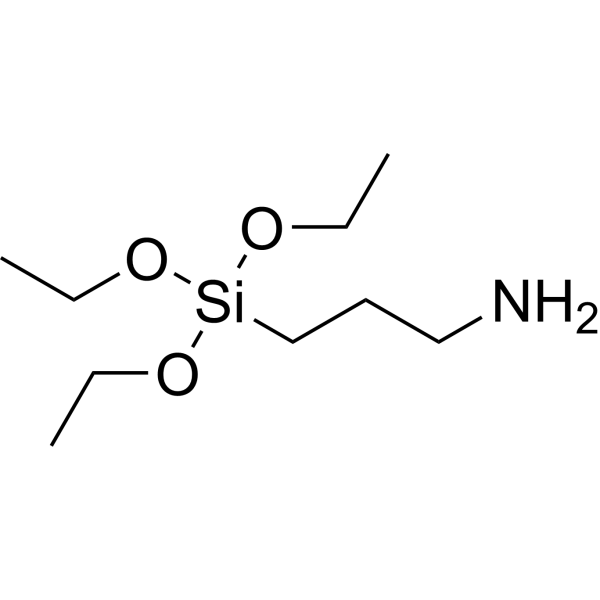
HY-D0175
3-AminopropyltriethoxysilaneSilanization Agent -

HY-W105426
3-(Trimethoxysilyl)propyl methacrylateBiochemical Assay Reagents -
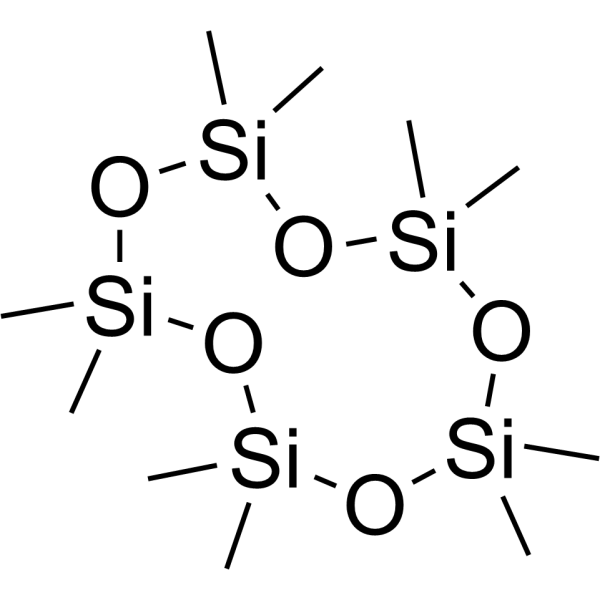
HY-W009051
DecamethylcyclopentasiloxaneSkin Emollient -

HY-Y1410
Triisopropylsilane, 98%Strong Reducing Agent -
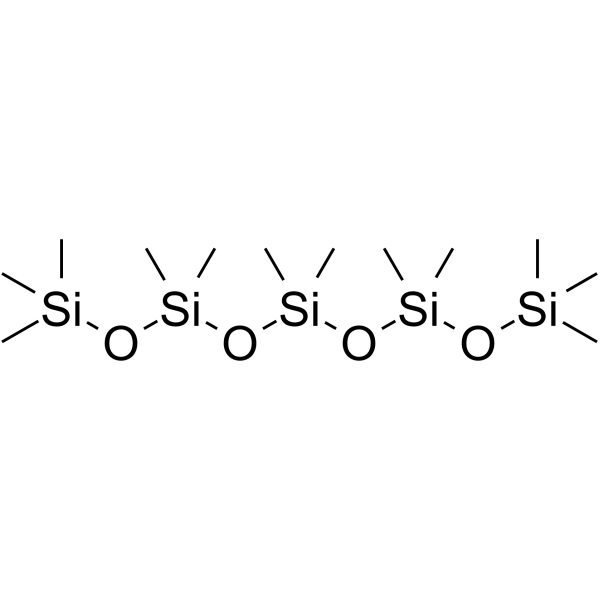
HY-W011035
Dodecamethylpentasiloxane -
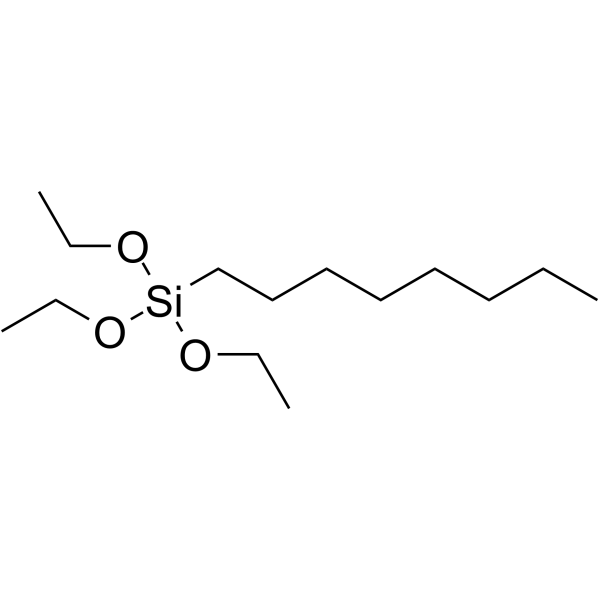
HY-91054
TriethoxyoctylsilaneSilane Coupling Agent -

HY-W009051R
Decamethylcyclopentasiloxane (Standard)Skin Emollient -
HY-Y0147
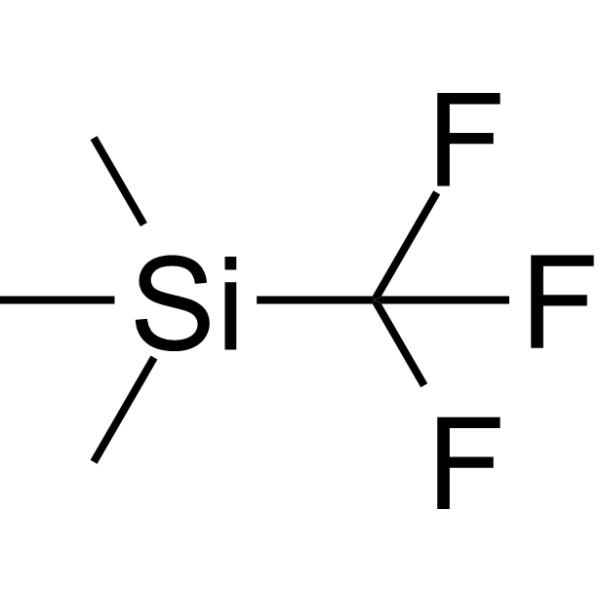
(Trifluoromethyl)trimethylsilaneBiochemical Reagent -

HY-W130266R
2,2,4,4,6,6-Hexamethyl-1,3,5,2,4,6-trioxatrisilinane (Standard) -

HY-123798
N,O-Bis(trimethylsilyl)trifluoroacetamide with trimethylchlorosilaneSilanizing Reagent
All DNA/RNA Synthesis Isoforms
More

Biological Activity
Description


Chemical Information
-
CAS No. 556-67-2
-
Appearance Liquid (Density: 0.9558 g/cm3)
-
Molecular Weight 296.62
-
Formula C8H24O4Si4
-
Color Colorless to light yellow
-
SMILES
C[Si]1(C)O[Si](C)(C)O[Si](C)(C)O[Si](C)(C)O1
-
Shipping
Room temperature in continental US; may vary elsewhere.
-
Storage
Pure form -20°C 3 years 4°C 2 years In solvent -80°C 6 months -20°C 1 month


Solvent & Solubility
In Vitro:
DMSO : 25 mg/mL (84.28 mM; ultrasonic and warming and heat to 60°C; Hygroscopic DMSO has a significant impact on the solubility of product, please use newly opened DMSO)
Please refer to the solubility information to select the appropriate solvent. Once prepared, please aliquot and store the solution to prevent product inactivation from repeated freeze-thaw cycles.
Storage method and period of stock solution: -80°C, 6 months; -20°C, 1 month. When stored at -80°C, please use it within 6 months. When stored at -20°C, please use it within 1 month.
Please refer to the solubility information to select the appropriate solvent. Once prepared, please aliquot and store the solution to prevent product inactivation from repeated freeze-thaw cycles.
Storage method and period of stock solution: -80°C, 6 months; -20°C, 1 month. When stored at -80°C, please use it within 6 months. When stored at -20°C, please use it within 1 month.
Concentration (start) × Volume (start) = Concentration (final) × Volume (final)
In Vivo:
Select the appropriate dissolution method based on your experimental animal and administration route.
- For the following dissolution methods, please ensure to first prepare a clear stock solution using an In Vitro approach and then sequentially add co-solvents:
- To ensure reliable experimental results, the clarified stock solution can be appropriately stored based on storage conditions. As for the working solution for In Vivo experiments, it is recommended to prepare freshly and use it on the same day.
- The percentages shown for the solvents indicate their volumetric ratio in the final prepared solution. If precipitation or phase separation occurs during preparation, heat and/or sonication can be used to aid dissolution.
Add each solvent one by one: 10% DMSO 40% PEG300 5% Tween-80 45% Saline
Solubility: ≥ 2.5 mg/mL (8.43 mM); Clear solution
This protocol yields a clear solution of ≥ 2.5 mg/mL (saturation unknown).
Taking 1 mL working solution as an example, add 100 μL DMSO stock solution (25.0 mg/mL) to 400 μL PEG300, and mix evenly; then add 50 μL Tween-80 and mix evenly; then add 450 μL Saline to adjust the volume to 1 mL.
Preparation of Saline: Dissolve 0.9 g sodium chloride in ddH₂O and dilute to 100 mL to obtain a clear Saline solution.
In Vivo Dissolution Calculator
Please enter the basic information of animal experiments:
-
-
-
-
Recommended: Prepare an additional quantity of animals to account for potential losses during experiments.
Please enter your animal formula composition:
-
%DMSO +
Recommended: Keep the proportion of DMSO in working solution below 2% if your animal is weak.
-
%+
-
+%Tween-80 + +
-
%Saline +
The co-solvents required include: DMSO, . All of co-solvents are available by MedChemExpress (MCE). , Tween 80. All of co-solvents are available by MedChemExpress (MCE).
Working solution concentration: 0.22 mg/mL
Method for preparing stock solution: mg drug dissolved in μL DMSO. Stock solution concentration: mg/mL.
1. Take μL DMSO stock solution;
2. Add μL .
μL , mix evenly;
3. Then add μL Tween 80, mix evenly;
4. Then add μL
Please ensure that the stock solution in the first step is dissolved to a clear state, and add co-solvents in sequence. You can use ultrasonic heating (ultrasonic cleaner, recommended frequency 20-40 kHz), vortexing, etc. to assist dissolution.

Protocols
-
RNA extraction experimental
By lysing cells, releasing RNA, and removing impurities such as proteins and DNA, high-purity RNA products are finally obtained. The commonly used traditional method is the guanidine isothiocyanate/phenol/chloroform method (Trizol), which is suitable for a variety of animal materials including animal tissues, microorganisms, cultured cells, etc., and most plant materials.
-
Soft Agar Colony Formation Assay
Soft agar colony formation assay measures anchorage-independent growth, in which transformed or tumorigenic cells proliferate as colonies in a semisolid agar matrix while many non-transformed adherent cells fail to proliferate without attachment; classic studies showed that growth in semisolid medium correlates with tumorigenicity in nude mice, and later protocol papers describe the method as a stringent in vitro assay for malignant transformation. The readout is the number, size, morphology, or signal intensity of colonies formed within agar after incubation; published formats include manual colony counting after staining, 96-well or 384-well quantitative formats, DNA-binding dye detection, MTT/tetrazolium-based detection, digital image analysis, and PCR-based marker detection from soft agar cultures.
-
Genotoxicity/Mutagenicity Study
The bacterial reverse mutation assay detects point mutations that restore amino-acid prototrophy in auxotrophic Salmonella typhimurium or Escherichia coli tester strains; after exposure to a test article, mutagenic activity is read out as an increased number of revertant colonies on minimal agar compared with the vehicle control. The assay uses tester strains with different mutation targets so that base-substitution and frameshift mutagens can be detected, and testing is performed with and without exogenous mammalian metabolic activation because some chemicals require biotransformation to become mutagenic.


Purity & Documentation
-
Data Sheet (278 KB)
-
SDS (775 KB)
- English - EN (775 KB)
- Français - FR (775 KB)
- Deutsch - DE (775 KB)
- Norwegian - NO (775 KB)
- Español - ES (775 KB)
- Swedish - SV (775 KB)
- Italian - IT (775 KB)
- Korean - KR (775 KB)
- Portuguese - PT (775 KB)
-
Handling Instructions (2659 KB)
References


Complete Stock Solution Preparation Table
Please refer to the solubility information to select the appropriate solvent. Once prepared, please aliquot and store the solution to prevent product inactivation from repeated freeze-thaw cycles.
Storage method and period of stock solution: -80°C, 6 months; -20°C, 1 month. When stored at -80°C, please use it within 6 months. When stored at -20°C, please use it within 1 month.
| Optional Solvent | Concentration Solvent Mass | 1 mg | 5 mg | 10 mg | 25 mg |
|---|---|---|---|---|---|
| DMSO | 1 mM | 3.3713 mL | 16.8566 mL | 33.7132 mL | 84.2829 mL |
| 5 mM | 0.6743 mL | 3.3713 mL | 6.7426 mL | 16.8566 mL | |
| 10 mM | 0.3371 mL | 1.6857 mL | 3.3713 mL | 8.4283 mL | |
| 15 mM | 0.2248 mL | 1.1238 mL | 2.2475 mL | 5.6189 mL | |
| 20 mM | 0.1686 mL | 0.8428 mL | 1.6857 mL | 4.2141 mL | |
| 25 mM | 0.1349 mL | 0.6743 mL | 1.3485 mL | 3.3713 mL | |
| 30 mM | 0.1124 mL | 0.5619 mL | 1.1238 mL | 2.8094 mL | |
| 40 mM | 0.0843 mL | 0.4214 mL | 0.8428 mL | 2.1071 mL | |
| 50 mM | 0.0674 mL | 0.3371 mL | 0.6743 mL | 1.6857 mL | |
| 60 mM | 0.0562 mL | 0.2809 mL | 0.5619 mL | 1.4047 mL | |
| 80 mM | 0.0421 mL | 0.2107 mL | 0.4214 mL | 1.0535 mL |


Octamethylcyclotetrasiloxane Related Classifications
HY-W116007 Related Classifications
 Powered by Bioz