



ODN 1018
Based on 2 publication(s) in Google Scholar
ODN 1018 (1018 ISS) is a TLR9 agonist and immune modulator. ODN 1018 exhibits adjuvant activity and augments CD8+ T cell responses with LNP-encapsulated OVA peptides. ODN 1018 triggers sustained suppression of allergic airway inflammation. ODN 1018 can be used for the research of allergic asthma and systemic lupus erythematosus.
For research use only. We do not sell to patients.
- Purity : 99.28%
- CAS No.: 937402-51-2
- Molecular Weight:7150.00
-
Storage:
-20°C, sealed storage, away from moisture
* In solvent : -80°C, 6 months; -20°C, 1 month (sealed storage, away from moisture)


To place orders, for customer services and technical support, please contact: MedChemExpress USA
Tel: 609-228-6898 E-mail: [email protected] [email protected]


-
 Biological Activity
-
Chemical Information
-
Solvent & Solubility
- Protocols
- Purity & Documentation
- References
-
 Help & FAQs



Publications Citing Use of MedChemExpress (MCE) ODN 1018
More Customer Validation & Images

-
In Vivo Efficacy Study
-
In Vivo Efficacy Study


Biological Activity
Description
IC50 & Target
|
TLR9 |
In Vitro
ODN 1018 (0.7 μM) stimulates proliferation and IL-6 production in purified human B cells, and this stimulation is inhibited by IRS at 0.35-0.7 μM[3].
ODN 1018 (0.7 μM; 48 h) activates mouse splenocytes to produce IL-6 via TLR9, and this activation is dose-dependently inhibited by IRS 869 at 0.0875-0.7 μM[3].
MedChemExpress (MCE) has not independently confirmed the accuracy of these methods. They are for reference only. Further protocols information, click here.
In Vivo
ODN 1018 (20 μg; intranasally; weekly; 1-17 weeks) induces sustained suppression of allergic airway inflammation in ragweed-sensitized mice, with 5 weekly doses sufficient for durable effects associated with TReg induction[2].
ODN 1018 (50 μg; s.c.) induces a lethal TLR9-mediated inflammatory response in D-galactosamine-pretreated BALB/c mice[3].
ODN 1018 (25 μg; s.c.) stimulates TLR9-mediated cytokine (IL-6, IL-12) production in BALB/c mice[3].
MedChemExpress (MCE) has not independently confirmed the accuracy of these methods. They are for reference only.
-
Animal Model:BALB/c (6-8 week old female, ragweed-sensitized allergic asthma model)[2]
-
Dosage:20 μg
-
Administration:intranasally; weekly; 1, 3, 5, 8, 12, 13, 16, or 17 weeks
-
Result:Suppressed bronchoalveolar lavage (BAL) eosinophilia, BAL IL-4, IL-5, IL-13 levels, and lung Th2-associated genes (Il13, Ccl11, Gob5, Fizz1) through 13 subsequent weekly ragweed exposures (12 weekly treatments).
Induced significant, lasting reduction of Th2-mediated responses (5 weekly treatments); Upregulated lung regulatory T cell (TReg)-associated genes (Foxp3, Il10, Tgfb1, Lag3, Tnfrsf4, Il2ra) and increased TReg activity (CD4+CD25+ T cells from treated mice suppressed CD4+CD25- T cell proliferation more effectively than those from ragweed-only mice) (16 weekly treatments).
Induced a moderate Th1 shift (progressive increase in lung Ifng, Cxcl9, Cxcl10 expression) but Th2 suppression did not require IFN-γ; Prevented ragweed-pulsed bone marrow dendritic cells from restoring Th2 responses.


Chemical Information
-
CAS No. 937402-51-2
-
Appearance Solid
-
Molecular Weight 7150.00
-
Color White to off-white
-
SMILES
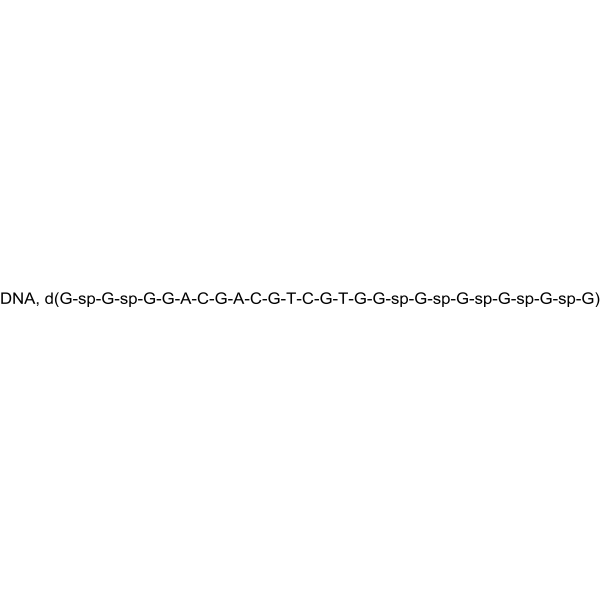
[DNA, d(P-thio)(T-G-A-C-T-G-T-G-A-A-C-G-T-T-C-G-A-G-A-T-G-A)]
-
Synonyms
1018 ISS
-
Sequence
DNA, d(P-thio)(T-G-A-C-T-G-T-G-A-A-C-G-T-T-C-G-A-G-A-T-G-A)
-
Shipping
Room temperature in continental US; may vary elsewhere.
-
Storage
-20°C, sealed storage, away from moisture
* In solvent : -80°C, 6 months; -20°C, 1 month (sealed storage, away from moisture)


Publications (2)
-
Journal Impact Factor
-
Most Recent
-
Nature
2025 May;641(8061):202-210. PMID: 40140567
ODN 1018 purchased from MedChemExpress. Usage Cited in: Nature. 2025 May;641(8061):202-210. [Abstract]
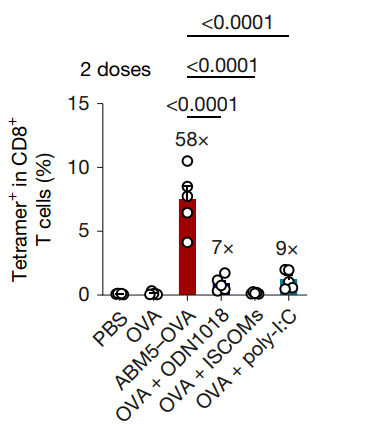
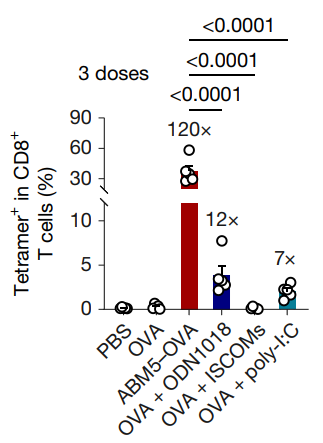
Mice were immunized with ABM5-OVA, or OVA peptide with or without 10 μg of ODN1018, ISCOMs or poly-I:C on days 0 and 14.
ODN 1018 purchased from MedChemExpress. Usage Cited in: Nature. 2025 May;641(8061):202-210. [Abstract]
Mice were immunized with ABM5-OVA, or OVA peptide with or without 10 μg of ODN1018, ISCOMs or poly-I:C on days 0 and 28.
-
J Ethnopharmacol
Elucidating the anti-HSV-2 mechanism of Longdan Xiegan Decoction via the TLR9 signaling pathway: A multi-omics perspective. [Abstract]2026 Jun 12:364:121470. PMID: 41791624


Solvent & Solubility
In Vitro:
H2O : ≥ 100 mg/mL (13.99 mM)
* "≥" means soluble, but saturation unknown.
Please refer to the solubility information to select the appropriate solvent. Once prepared, please aliquot and store the solution to prevent product inactivation from repeated freeze-thaw cycles.
Storage method and period of stock solution: -80°C, 6 months; -20°C, 1 month (sealed storage, away from moisture). When stored at -80°C, please use it within 6 months. When stored at -20°C, please use it within 1 month.
* Note: If you choose water as the stock solution, please dilute it to the working solution, then filter and sterilize it with a 0.22 μm filter before use.
Please refer to the solubility information to select the appropriate solvent. Once prepared, please aliquot and store the solution to prevent product inactivation from repeated freeze-thaw cycles.
Storage method and period of stock solution: -80°C, 6 months; -20°C, 1 month (sealed storage, away from moisture). When stored at -80°C, please use it within 6 months. When stored at -20°C, please use it within 1 month.
* Note: If you choose water as the stock solution, please dilute it to the working solution, then filter and sterilize it with a 0.22 μm filter before use.
Concentration (start) × Volume (start) = Concentration (final) × Volume (final)

Protocols
-
Ovalbumin-Induced Allergic Airway Inflammation
Ovalbumin-induced allergic airway inflammation is a mouse model in which systemic sensitization to ovalbumin, usually with aluminum hydroxide adjuvant, is followed by airway ovalbumin challenge to induce allergic airway inflammation, eosinophil recruitment, mucus production, serum antigen-specific IgE, Th2 cytokine responses, and airway hyperresponsiveness to methacholine. The model is used to study allergen-driven airway inflammation and asthma-like immune responses, but it does not reproduce every feature of human asthma. The main readouts are bronchoalveolar lavage fluid cellularity, lung histopathology, airway hyperresponsiveness, serum OVA-specific IgE, and cytokines such as IL-4, IL-5, and IL-13 in bronchoalveolar lavage fluid or lung samples. Eosinophilia and Th2 cytokines reflect allergic type 2 inflammation, while methacholine responsiveness provides a functional airway-reactivity endpoint.
-
Research Protocol for Inflammation-related Diseases
The NLRP3 inflammasome is a cytosolic innate immune signaling platform that integrates priming signals and danger-signal activation to promote caspase-1 activation, maturation of IL-1β and IL-18, and gasdermin D-mediated pyroptotic cell death. The core experimental logic is to determine whether inflammatory disease phenotypes are driven by increased NLRP3 expression, ASC-containing inflammasome assembly, caspase-1 cleavage, GSDMD cleavage, and extracellular release of IL-1β/IL-18 rather than by nonspecific cell injury alone. The pathway is strongly linked to inflammation-related disease phenotypes because monosodium urate crystals activate NALP3/NLRP3 inflammasome signaling in gout-like crystal inflammation, cholesterol crystals activate NLRP3 inflammasomes in atherogenesis models, and DSS-induced intestinal inflammation has been reported to involve NLRP3 inflammasome activity. However, experimental colitis studies also show context-dependent protective effects of NLRP3 inflammasome co
-
Research Protocol for Cancer Immunology
Cancer immunology studies how the immune system recognizes, suppresses, edits, or fails to eliminate malignant cells through tumor antigen release, antigen presentation, T-cell priming, immune trafficking, tumor-cell killing, and feedback inhibition in the tumor microenvironment. The cancer-immunity cycle links tumor antigenicity, dendritic-cell priming, CD8+ T-cell infiltration, cytotoxic function, and immune-checkpoint regulation to tumor rejection or immune escape. Immune-checkpoint pathways such as PD-1/PD-L1 and CTLA-4 suppress antitumor T-cell activity and can be therapeutically blocked, but many tumors remain resistant because of poor antigen presentation, weak T-cell infiltration, suppressive myeloid cells, regulatory T cells, and tumor-intrinsic immune-exclusion programs. Unresolved questions include which immune-cell states predict response, how tumor-intrinsic pathways exclude immune cells, how myeloid suppression limits checkpoint blockade, and which combination strategies


Purity & Documentation
-
Data Sheet (271 KB)
-
SDS (252 KB)
- English - EN (252 KB)
- Français - FR (252 KB)
- Deutsch - DE (252 KB)
- Norwegian - NO (252 KB)
- Español - ES (252 KB)
- Swedish - SV (252 KB)
- Italian - IT (252 KB)
- Korean - KR (252 KB)
- Portuguese - PT (252 KB)
-
Handling Instructions (2242 KB)
References
[1]. Wang X, et al. STING agonist-based ER-targeting molecules boost antigen cross-presentation. Nature. 2025;641(8061):202-210. [Content Brief]
[2]. Campbell JD, et al. A limited CpG-containing oligodeoxynucleotide therapy regimen induces sustained suppression of allergic airway inflammation in mice. Thorax. 2014;69(6):565-573. [Content Brief]
[3]. Barrat FJ, et al. Development of TLR inhibitors for the treatment of autoimmune diseases. Immunol Rev. 2008;223:271-283. [Content Brief]


Complete Stock Solution Preparation Table
Please refer to the solubility information to select the appropriate solvent. Once prepared, please aliquot and store the solution to prevent product inactivation from repeated freeze-thaw cycles.
Storage method and period of stock solution: -80°C, 6 months; -20°C, 1 month (sealed storage, away from moisture). When stored at -80°C, please use it within 6 months. When stored at -20°C, please use it within 1 month.
| Optional Solvent | Concentration Solvent Mass | 1 mg | 5 mg | 10 mg | 25 mg |
|---|---|---|---|---|---|
| H2O | 1 mM | 0.1399 mL | 0.6993 mL | 1.3986 mL | 3.4965 mL |
| 5 mM | 0.0280 mL | 0.1399 mL | 0.2797 mL | 0.6993 mL | |
| 10 mM | 0.0140 mL | 0.0699 mL | 0.1399 mL | 0.3497 mL |
* Note: If you choose water as the stock solution, please dilute it to the working solution, then filter and sterilize it with a 0.22 μm filter before use.


ODN 1018 Related Classifications
HY-150724 Related Classifications
 Powered by Bioz