



Omodenbamab

Based on 1 Customer Validation
Omodenbamab is an anti-SpA (Staphylococcal protein A) human monoclonal antibody with a KD value of 0.0467 nM. Omodenbamab circumvents a key S. aureus evasion mechanism by targeting the cell wall moiety Protein A (SpA). Omodenbamab can be used in research of S. aureus bloodstream infection.
Nur für Forschungszwecke. Wir verkaufen nicht an Patienten.
- Reinheit : 96.77%
- CAS. Nr.: 2241724-48-9
- Molecular Weight:156.08 kDa
-
Speicherung:
Please store the product under the recommended conditions in the Certificate of Analysis.


To place orders, for customer services and technical support, please contact: MedChemExpress USA
Tel: 609-228-6898 E-mail: [email protected] [email protected]


-
 Biologische Aktivität
-
Chemical Information
- Protokoll
- Reinheit & Dokumentation
- Verweise
-
 Help & FAQs




Biologische Aktivität
Beschreibung
Isotype
Human IgG3 kappa
Recommend Isotype Controls
Species Reactivity
Human
IC50 & Target
staphylococcal protein A
In Vitro
Omodenbamab (514-G3) binds to S. aureus and leaves the Fc region exposed for FcγR1A receptor binding[1]. Omodenbamab (10 μg/mL; 30 min, 1.5 hr, and 2.5 hr) supports the opsonophagocytic killing of S. aureus by human blood cells[1].
MedChemExpress (MCE) has not independently confirmed the accuracy of these methods. They are for reference only.
In Vivo
MedChemExpress (MCE) has not independently confirmed the accuracy of these methods. They are for reference only.
-
Animal Model:Balb/C mice with MRSA in a bacteremia model[1]
-
Dosage:2.5 mg/mice and 10 mg/mice
-
Administration:Intravenous injection
-
Result:Increased mouse Balb/C mice with MRSA in a bacteremia model survival.
Clinical Trial
| NCT Number | Sponsor | Condition | Start Date |
Phase

|
|---|---|---|---|---|
| NCT01329991 | 2011-05 | PHASE1 |
Gene ID
Accession
Conjugated
Unconjugated
Reconsititution
The product can be reconstituted/diluted with sterile PBS or saline.
Format
-
Human IgG3 kappa
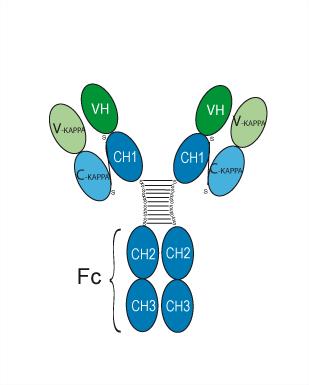
Anwendung
ELISA, FACS, Functional assay


Chemical Information
-
CAS. Nr. 2241724-48-9
-
Appearance Liquid
-
Molecular Weight 156.08 kDa
-
Color Colorless to light yellow
-
SMILES
[Omodenbamab]
-
Synonyms
514-G3
-
Versand
Shipping with dry ice.
-
Formulation
Please refer to the lot-specific COA for specific buffer information.
-
Speicherung
Please store the product under the recommended conditions in the Certificate of Analysis.


Reinheit & Dokumentation
-
Data Sheet (259 KB)
-
SDS (251 KB)
- English - EN (251 KB)
- Français - FR (251 KB)
- Deutsch - DE (251 KB)
- Norwegian - NO (251 KB)
- Español - ES (251 KB)
- Swedish - SV (251 KB)
- Italian - IT (251 KB)
- Korean - KR (251 KB)
- Portuguese - PT (251 KB)
-
Inhibitory Antibodies User Guide (603 KB)
Verweise

Calculators
Konzentration (Stammlösung) × Volumen (Stammlösung) = Konzentration (Ziellösung) × Volumen (Ziellösung)


Omodenbamab Related Classifications
HY-P99770 Related Classifications
 Powered by Bioz