



Osteostatin (human)
Osteostatin (human), a fragment of parathyroid hormone-related protein (PTHrP) 107-139, promotes bone repair in animal models of bone defects and prevents bone erosion in inflammatory arthritis.
연구목적의 판매만을 진행합니다. 환자를 대상으로 한 판매는 하지 않습니다.
- CAS No.: 137348-10-8
- 화학식: C142H228N42O58
- 분자량:3451.58
-
보관:
Please store the product under the recommended conditions in the Certificate of Analysis.

To place orders, for customer services and technical support, please contact: MedChemExpress USA
Tel: 609-228-6898 E-mail: [email protected] [email protected]


-
 Biological Activity
-
Chemical Information
- Protocol
- 순도&문서
- References
-
 Help & FAQs




Biological Activity
제품 설명
In Vitro
Osteostatin (100, 250 and 500 nM) decreases the differentiation of osteoclasts in a concentration-dependent manner, but it does not modify the resorptive ability of mature osteoclasts. In addition, Osteostatin decreases the mRNA levels of cathepsin K, osteoclast associated Ig-like receptor (OSCAR) and NFATc1[1].
Osteostatin (human) potentiates the bioactivity of mesoporous glass scaffolds containing Zn2+ ions in human mesenchymal stem cell cultures[2].
MedChemExpress (MCE) has not independently confirmed the accuracy of these methods. They are for reference only. Further protocols information, click here.


Chemical Information
-
CAS No. 137348-10-8
-
분자량 3451.58
-
화학식 C142H228N42O58
-
Synonyms
Human PTHrP(107-139)
-
Sequence
Thr-Arg-Ser-Ala-Trp-Leu-Asp-Ser-Gly-Val-Thr-Gly-Ser-Gly-Leu-Glu-Gly-Asp-His-Leu-Ser-Asp-Thr-Ser-Thr-Thr-Ser-Leu-Glu-Leu-Asp-Ser-Arg
-
Sequence Shortening
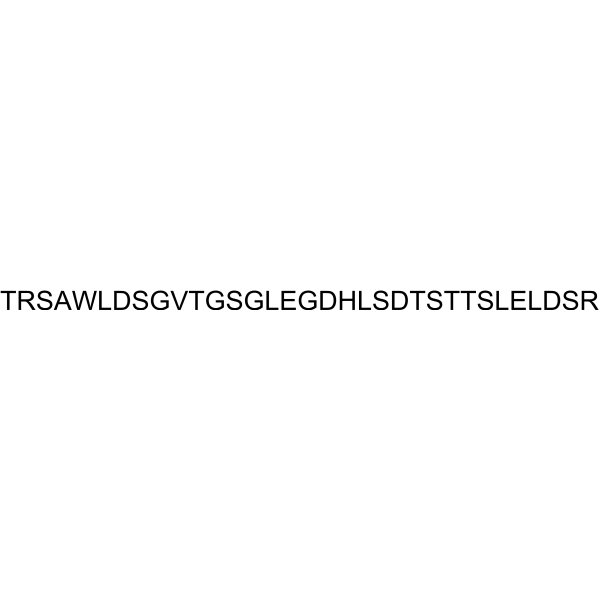
TRSAWLDSGVTGSGLEGDHLSDTSTTSLELDSR
-
선적
Room temperature in continental US; may vary elsewhere.
-
보관
Please store the product under the recommended conditions in the Certificate of Analysis.

Protocol
-
Collagen-Induced Arthritis
Collagen-induced arthritis (CIA) is an autoimmune murine model of rheumatoid arthritis in which immunization with type II collagen (CII) emulsified in an adjuvant induces a T cell- and autoantibody-driven inflammatory arthritis characterized by synovial hyperplasia, immune cell infiltration, and joint destruction. The model typically relies on genetically susceptible mouse strains (e. g. , DBA/1) and reproduces key features of human rheumatoid arthritis, including anti-collagen immune responses and progressive joint inflammation. Disease onset generally occurs within ~3-4 weeks after immunization, depending on antigen/adjuvant combinations and protocol variation. The immunopathology is driven by adaptive immune activation against CII, leading to systemic and local joint inflammation mediated by pro-inflammatory cytokines and effector immune cells, making CIA a standard preclinical platform for evaluating immunomodulatory and anti-arthritic interventions.
-
Research Protocol for Endocrine Diseases
Endocrine diseases often arise from disrupted hormone production, hormone signaling, or target-tissue responsiveness; for diabetes-focused endocrine disease models, insulin signaling regulates glucose uptake, hepatic glucose output, lipid metabolism, and β-cell compensation. Type 2 diabetes develops through interacting defects in insulin resistance, β-cell dysfunction, adipose inflammation, hepatic glucose overproduction, altered incretin signaling, and ectopic lipid metabolism. A major unresolved question is whether endocrine dysfunction is driven primarily by target-tissue insulin resistance, intrinsic β-cell failure, immune/inflammatory stress, or combined multi-organ failure that differs by disease stage.


순도&문서
References
[1]. Lidia Ibáñez, et al. Osteostatin Inhibits M-CSF+RANKL-Induced Human Osteoclast Differentiation by Modulating NFATc1. Int J Mol Sci. 2022 Aug 1;23(15):8551. [Content Brief]
[2]. C Heras, et al. Osteostatin potentiates the bioactivity of mesoporous glass scaffolds containing Zn2+ ions in human mesenchymal stem cells. Acta Biomater. 2019 Apr 15;89:359-371. [Content Brief]

Calculators
Concentration (start) × Volume (start) = Concentration (final) × Volume (final)


Osteostatin (human) Related Classifications
HY-P4800 Related Classifications
 Powered by Bioz