



PDI-IN-3

Based on 1 Customer Validation
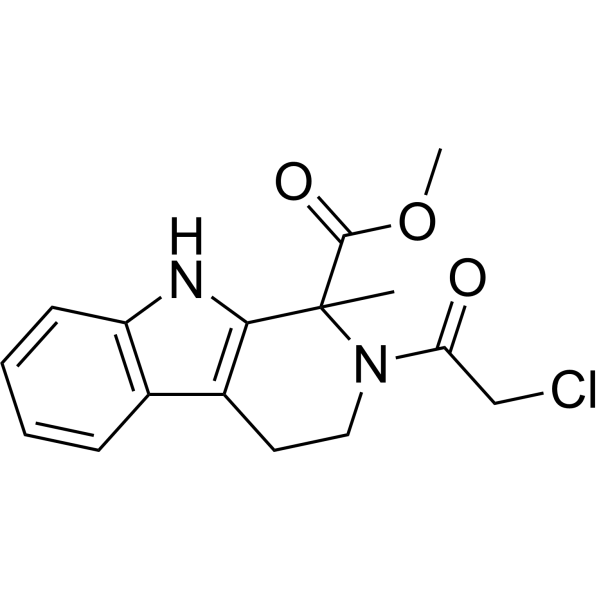
PDI-IN-3 (compound 16F16) is a protein disulfide isomerase (PDI) inhibitor. PDI-IN-3 inhibits cell viability.
Nos produits utilisent uniquement pour la recherche. Nous ne vendons pas aux patients.
- Pureté : 98.69%
- CAS No.: 922507-80-0
- Formule: C16H17ClN2O3
- Masse moléculaire:320.77
-
Stockage:Powder -20°C, 3 years , 4°C, 2 years ; In solvent -80°C, 6 months , -20°C, 1 month

To place orders, for customer services and technical support, please contact: MedChemExpress USA
Tel: 609-228-6898 E-mail: [email protected] [email protected]


-
 Activité biologique
-
Chemical Information
-
Solvant et solubilité
- Protocole
- Pureté et documentation
- Références
-
 Help & FAQs


-
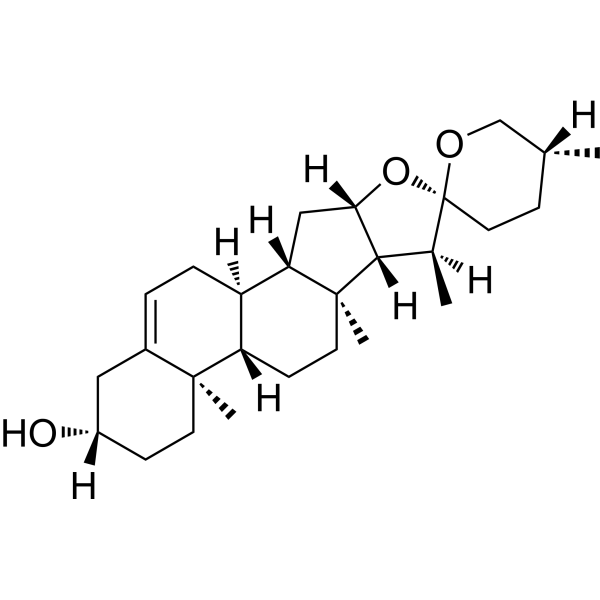
HY-N0177
DiosgeninSTAT Inhibitor -
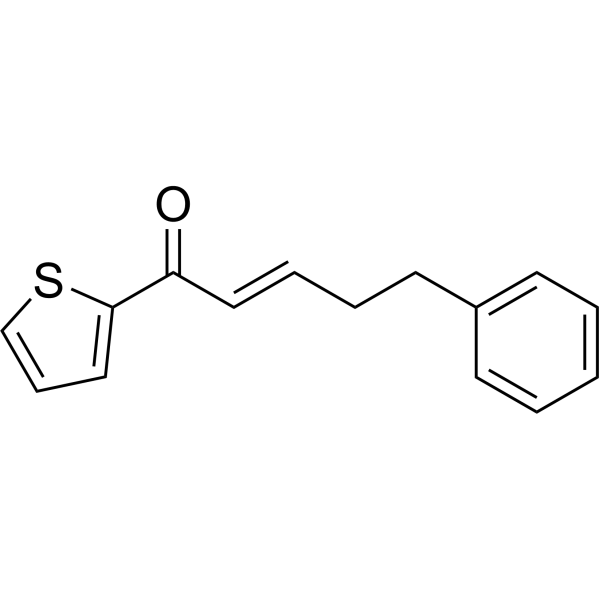
HY-145468
GPR52 antagonist-1GPR52 Antagonist -
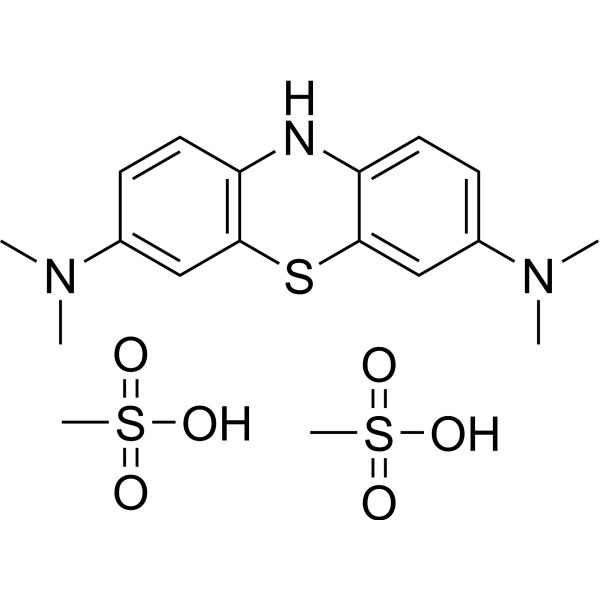
HY-19948
Leucomethylene blue mesylateTau Aggregation Inhibitor -

HY-W020576
Rivastigmine metaboliteMetabolite Produced -

HY-W206016
3-Aminosalicylic acidHydroxybenzoic Acid Compound -
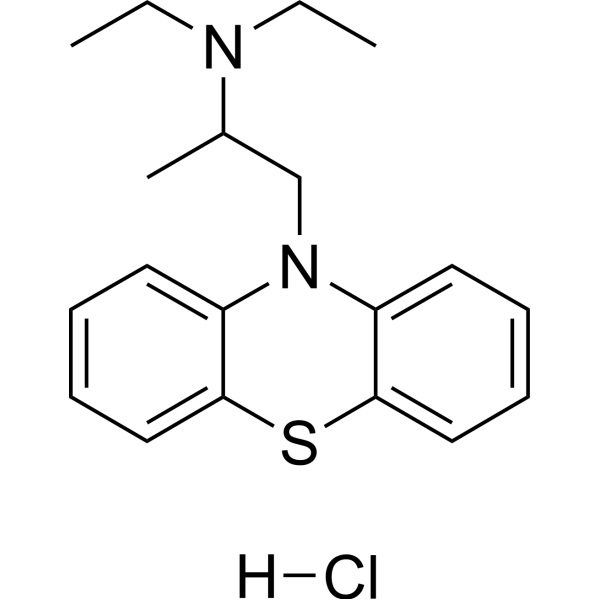
HY-107922
Ethopropazine hydrochlorideBChE/NMDA/mAChR Antagonist -

HY-W020576R
Rivastigmine metabolite (Standard)AChE Inhibitor -

HY-107922R
Ethopropazine hydrochloride (Standard)BChE/NMDA/mAChR Antagonist


Activité biologique
Description
In Vitro
PDI-IN-3 (compound 16F16) (0.1, 1, 10, 100 µM; 48 h) inhibits cell viability in htt-Q25 and htt-Q103 cells[1].
PDI-IN-3 (1, 2, 3, 4, 10 µM) suppress htt-N90Q73-induced toxicity in brain slice MSNs (medium spiny neurons)[1].
MedChemExpress (MCE) has not independently confirmed the accuracy of these methods. They are for reference only.
-
Cell Line:htt-Q25, htt-Q103 cells
-
Concentration:0.1, 1, 10, 100 µM
-
Incubation Time:48 h
-
Result:Inhibited cell growth in a dose-dependent manner.


Chemical Information
-
CAS No. 922507-80-0
-
Appearance Solid
-
Masse moléculaire 320.77
-
Formule C16H17ClN2O3
-
Color White to off-white
-
SMILES
O=C(C1(C)C2=C(CCN1C(CCl)=O)C3=C(C=CC=C3)N2)OC
-
Livraison
Room temperature in continental US; may vary elsewhere.
-
Stockage
Powder -20°C 3 years 4°C 2 years In solvent -80°C 6 months -20°C 1 month


Solvant et solubilité
In Vitro:
DMSO : 50 mg/mL (155.87 mM; Need ultrasonic; Hygroscopic DMSO has a significant impact on the solubility of product, please use newly opened DMSO)
Please refer to the solubility information to select the appropriate solvent. Once prepared, please aliquot and store the solution to prevent product inactivation from repeated freeze-thaw cycles.
Storage method and period of stock solution: -80°C, 6 months; -20°C, 1 month. When stored at -80°C, please use it within 6 months. When stored at -20°C, please use it within 1 month.
Please refer to the solubility information to select the appropriate solvent. Once prepared, please aliquot and store the solution to prevent product inactivation from repeated freeze-thaw cycles.
Storage method and period of stock solution: -80°C, 6 months; -20°C, 1 month. When stored at -80°C, please use it within 6 months. When stored at -20°C, please use it within 1 month.
Concentration (start) × Volume (start) = Concentration (final) × Volume (final)
In Vivo:
Select the appropriate dissolution method based on your experimental animal and administration route.
- For the following dissolution methods, please ensure to first prepare a clear stock solution using an In Vitro approach and then sequentially add co-solvents:
- To ensure reliable experimental results, the clarified stock solution can be appropriately stored based on storage conditions. As for the working solution for In Vivo experiments, it is recommended to prepare freshly and use it on the same day.
- The percentages shown for the solvents indicate their volumetric ratio in the final prepared solution. If precipitation or phase separation occurs during preparation, heat and/or sonication can be used to aid dissolution.
Add each solvent one by one: 10% DMSO 40% PEG300 5% Tween-80 45% Saline
Solubility: ≥ 1.25 mg/mL (3.90 mM); Clear solution
This protocol yields a clear solution of ≥ 1.25 mg/mL (saturation unknown).
Taking 1 mL working solution as an example, add 100 μL DMSO stock solution (12.5 mg/mL) to 400 μL PEG300, and mix evenly; then add 50 μL Tween-80 and mix evenly; then add 450 μL Saline to adjust the volume to 1 mL.
Preparation of Saline: Dissolve 0.9 g sodium chloride in ddH₂O and dilute to 100 mL to obtain a clear Saline solution.
Add each solvent one by one: 10% DMSO 90% (20% SBE-β-CD in Saline)
Solubility: ≥ 1.25 mg/mL (3.90 mM); Clear solution
This protocol yields a clear solution of ≥ 1.25 mg/mL (saturation unknown).
Taking 1 mL working solution as an example, add 100 μL DMSO stock solution (12.5 mg/mL) to 900 μL 20% SBE-β-CD in Saline, and mix evenly.
Preparation of 20% SBE-β-CD in Saline (4°C, storage for one week): 2 g SBE-β-CD powder is dissolved in 10 mL Saline, completely dissolve until clear.
In Vivo Dissolution Calculator
Please enter the basic information of animal experiments:
-
-
-
-
Recommended: Prepare an additional quantity of animals to account for potential losses during experiments.
Please enter your animal formula composition:
-
%DMSO +
Recommended: Keep the proportion of DMSO in working solution below 2% if your animal is weak.
-
%+
-
+%Tween-80 + +
-
%Saline +
The co-solvents required include: DMSO, . All of co-solvents are available by MedChemExpress (MCE). , Tween 80. All of co-solvents are available by MedChemExpress (MCE).
Working solution concentration: 0.22 mg/mL
Method for preparing stock solution: mg drug dissolved in μL DMSO. Stock solution concentration: mg/mL.
1. Take μL DMSO stock solution;
2. Add μL .
μL , mix evenly;
3. Then add μL Tween 80, mix evenly;
4. Then add μL
Please ensure that the stock solution in the first step is dissolved to a clear state, and add co-solvents in sequence. You can use ultrasonic heating (ultrasonic cleaner, recommended frequency 20-40 kHz), vortexing, etc. to assist dissolution.


Pureté et documentation
-
Fiche technique (276 KB)
-
SDS (251 KB)
- English - EN (251 KB)
- Français - FR (251 KB)
- Deutsch - DE (251 KB)
- Norwegian - NO (251 KB)
- Español - ES (251 KB)
- Swedish - SV (251 KB)
- Italian - IT (251 KB)
- Korean - KR (251 KB)
- Portuguese - PT (251 KB)
-
Instruction de manipulation (2659 KB)
Références


Complete Stock Solution Preparation Table
Please refer to the solubility information to select the appropriate solvent. Once prepared, please aliquot and store the solution to prevent product inactivation from repeated freeze-thaw cycles.
Storage method and period of stock solution: -80°C, 6 months; -20°C, 1 month. When stored at -80°C, please use it within 6 months. When stored at -20°C, please use it within 1 month.
| Optional Solvent | Concentration Solvent Mass | 1 mg | 5 mg | 10 mg | 25 mg |
|---|---|---|---|---|---|
| DMSO | 1 mM | 3.1175 mL | 15.5875 mL | 31.1750 mL | 77.9375 mL |
| 5 mM | 0.6235 mL | 3.1175 mL | 6.2350 mL | 15.5875 mL | |
| 10 mM | 0.3117 mL | 1.5587 mL | 3.1175 mL | 7.7937 mL | |
| 15 mM | 0.2078 mL | 1.0392 mL | 2.0783 mL | 5.1958 mL | |
| 20 mM | 0.1559 mL | 0.7794 mL | 1.5587 mL | 3.8969 mL | |
| 25 mM | 0.1247 mL | 0.6235 mL | 1.2470 mL | 3.1175 mL | |
| 30 mM | 0.1039 mL | 0.5196 mL | 1.0392 mL | 2.5979 mL | |
| 40 mM | 0.0779 mL | 0.3897 mL | 0.7794 mL | 1.9484 mL | |
| 50 mM | 0.0623 mL | 0.3117 mL | 0.6235 mL | 1.5587 mL | |
| 60 mM | 0.0520 mL | 0.2598 mL | 0.5196 mL | 1.2990 mL | |
| 80 mM | 0.0390 mL | 0.1948 mL | 0.3897 mL | 0.9742 mL | |
| 100 mM | 0.0312 mL | 0.1559 mL | 0.3117 mL | 0.7794 mL |


PDI-IN-3 Related Classifications
HY-124866 Related Classifications
 Powered by Bioz