



Phytic acid dodecasodium hydrate
Based on 1 publication(s) in Google Scholar
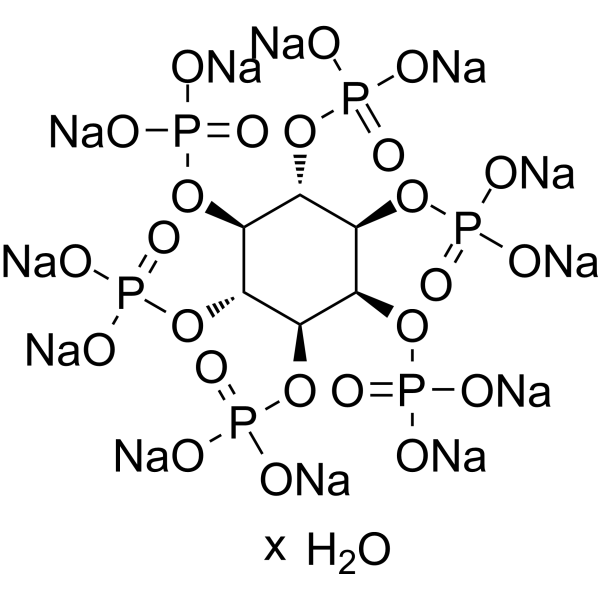
Phytic acid (Inositol hexaphosphate) dodecasodium hydrate is a phosphorus storage compound of seeds and cereal grains. Phytic acid dodecasodium hydrate is known as a food inhibitor, which has a strong ability to chelate multivalent metal ions, specially zinc, calcium, iron and as with protein residue. Phytic acid dodecasodium hydrate inhibits the enzymatic superoxide source xanthine oxidase (XO), and has antioxidative, neuroprotective, anti-inflammatory effects.
For research use only. We do not sell to patients.
- Purity : 99.9%
- CAS No.: 123408-98-0
- Formula: C6H6O24P6.H2O.12Na
-
Storage:
4°C, sealed storage, away from moisture
* In solvent : -80°C, 6 months; -20°C, 1 month (sealed storage, away from moisture)

To place orders, for customer services and technical support, please contact: MedChemExpress USA
Tel: 609-228-6898 E-mail: [email protected] [email protected]


-
 Biological Activity
-
Chemical Information
-
Solvent & Solubility
- Protocols
- Purity & Documentation
- References
-
 Help & FAQs


Publications Citing Use of MedChemExpress (MCE) Phytic acid dodecasodium hydrate
MoreAll Endogenous Metabolite Isoforms
More

Biological Activity
Description
IC50 & Target
Xanthine oxidase[3]
In Vitro
Phytic acid dodecasodium hydrate (myo-Inositol) inhibits the formation of uric acid from xanthine with an IC50 of about 30 mM. The generation of the superoxide is greatly affected by Phytic acid dodecasodium salt hydrate; the IC50 is about 6 mM, indicating that the superoxide generating domain of XO is more sensitive to phytic acid[3].
MedChemExpress (MCE) has not independently confirmed the accuracy of these methods. They are for reference only. Further protocols information, click here.


Chemical Information
-
CAS No. 123408-98-0
-
Appearance Solid
-
Formula C6H6O24P6.H2O.12Na
-
Color White to off-white
-
SMILES
O=P(O[Na])(O[Na])O[C@H]1[C@H]([C@H]([C@H](OP(O[Na])(O[Na])=O)[C@@H](OP(O[Na])(O[Na])=O)[C@@H]1OP(O[Na])(O[Na])=O)OP(O[Na])(O[Na])=O)OP(O[Na])(O[Na])=O.[x].O
-
Synonyms
Inositol hexaphosphate dodecasodium hydrate; SNF472 dodecasodium hydrate
-
Structure Classification
-
Initial Source
-
Shipping
Room temperature in continental US; may vary elsewhere.
-
Storage
4°C, sealed storage, away from moisture
* In solvent : -80°C, 6 months; -20°C, 1 month (sealed storage, away from moisture)


Publications (1)
-
Journal Impact Factor
-
Most Recent


Solvent & Solubility
In Vitro:
H2O : ≥ 250 mg/mL
* "≥" means soluble, but saturation unknown.
In Vivo:
For the following dissolution methods, please prepare the working solution directly:
It is recommended to prepare fresh solutions and use them promptly within a short period of time.
The percentages shown for the solvents indicate their volumetric ratio in the final prepared solution. If precipitation or phase separation occurs during preparation, heat and/or sonication can be used to aid dissolution.
Add each solvent one by one: PBS
Solubility: 100 mg/mL; Clear solution; Need ultrasonic

Protocols
-
Research Protocol for Inflammation-related Diseases
The NLRP3 inflammasome is a cytosolic innate immune signaling platform that integrates priming signals and danger-signal activation to promote caspase-1 activation, maturation of IL-1β and IL-18, and gasdermin D-mediated pyroptotic cell death. The core experimental logic is to determine whether inflammatory disease phenotypes are driven by increased NLRP3 expression, ASC-containing inflammasome assembly, caspase-1 cleavage, GSDMD cleavage, and extracellular release of IL-1β/IL-18 rather than by nonspecific cell injury alone. The pathway is strongly linked to inflammation-related disease phenotypes because monosodium urate crystals activate NALP3/NLRP3 inflammasome signaling in gout-like crystal inflammation, cholesterol crystals activate NLRP3 inflammasomes in atherogenesis models, and DSS-induced intestinal inflammation has been reported to involve NLRP3 inflammasome activity. However, experimental colitis studies also show context-dependent protective effects of NLRP3 inflammasome co


Purity & Documentation
-
Data Sheet (291 KB)
-
SDS (252 KB)
- English - EN (252 KB)
- Français - FR (252 KB)
- Deutsch - DE (252 KB)
- Norwegian - NO (252 KB)
- Español - ES (252 KB)
- Swedish - SV (252 KB)
- Italian - IT (252 KB)
- Korean - KR (252 KB)
- Portuguese - PT (252 KB)
-
Handling Instructions (2659 KB)
References
[1]. Zhou JR, et al. Phytic acid in health and disease. Crit Rev Food Sci Nutr. 1995 Nov;35(6):495-508. [Content Brief]
[2]. Gupta RK, et al. Reduction of phytic acid and enhancement of bioavailable micronutrients in food grains. J Food Sci Technol. 2015 Feb;52(2):676-84. [Content Brief]
[3]. Muraoka S, et al. Inhibition of xanthine oxidase by phytic acid and its antioxidative action. Life Sci. 2004 Feb 13;74(13):1691-700. [Content Brief]
[4]. Lv Y, et al. Phytic acid attenuates inflammatory responses and the levels of NF-κB and p-ERK in MPTP-induced Parkinson's disease model of mice. Neurosci Lett. 2015 Jun 15;597:132-6. [Content Brief]

Calculators
Concentration (start) × Volume (start) = Concentration (final) × Volume (final)


Phytic acid dodecasodium hydrate Related Classifications
HY-N0814A Related Classifications
 Powered by Bioz