



Prazosin-d8 hydrochloride

Based on 1 Customer Validation
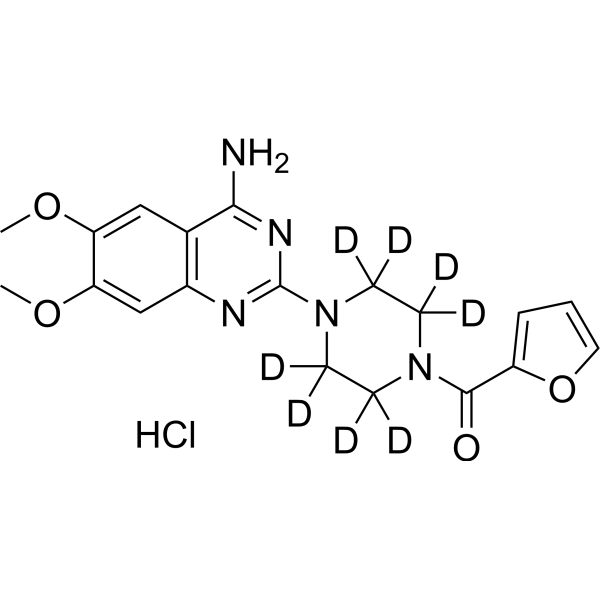
Prazosin-d8 hydrochloride is the deuterated-labeled Prazosin hydrochloride (HY-B0193A). Prazosin hydrochloride is a well-tolerated, CNS-active α1-adrenergic receptor antagonist for the research of high blood pressure and alcohol use disorders. Prazosin hydrochloride potently inhibits Norepinephrine (NE)-stimulated 45Ca efflux with an IC50 of 0.15 nM.Prazosin hydrochloride inhibits organic cation transporters OCT-1 and OCT-3 with IC50s of 1.8, and 13 μM, respectively.
For research use only. We do not sell to patients.
- Purity : 99.78%
- CAS No.: 1189508-34-6
- Formula: C19H14D8ClN5O4
- Molecular Weight:427.91
-
Storage:
4°C, sealed storage, away from moisture and light
* In solvent : -80°C, 6 months; -20°C, 1 month (sealed storage, away from moisture and light)

To place orders, for customer services and technical support, please contact: MedChemExpress USA
Tel: 609-228-6898 E-mail: [email protected] [email protected]


-
 Biological Activity
-
Chemical Information
- Protocols
- Purity & Documentation
- References
-
 Help & FAQs


All Adrenergic Receptor Isoforms
More

Biological Activity
Description
In Vitro
Stable heavy isotopes of hydrogen, carbon, and other elements have been incorporated into drug molecules, largely as tracers for quantitation during the drug development process. Deuteration has gained attention because of its potential to affect the pharmacokinetic and metabolic profiles of drugs.
MedChemExpress (MCE) has not independently confirmed the accuracy of these methods. They are for reference only. Further protocols information, click here.
Application
1. This compound can be used as a tracer
2. This compound can be used as an internal standard for quantitative analysis by NMR, GC-MS, or LC-MS.


Chemical Information
-
CAS No. 1189508-34-6
-
Unlabeled CAS 19237-84-4
-
Appearance Solid
-
Molecular Weight 427.91
-
Formula C19H14D8ClN5O4
-
Color White to off-white
-
SMILES
NC1=NC(N2C([2H])([2H])C([2H])([2H])N(C([2H])([2H])C2([2H])[2H])C(C3=CC=CO3)=O)=NC4=C1C=C(OC)C(OC)=C4.Cl
-
Shipping
Room temperature in continental US; may vary elsewhere.
-
Storage
4°C, sealed storage, away from moisture and light
* In solvent : -80°C, 6 months; -20°C, 1 month (sealed storage, away from moisture and light)

Protocols
-
Cell Cytotoxicity Assay
Cytotoxicity assays are usually based on the assessment of cell membrane damage, which can also be indirectly detected by measuring cell viability. Detection methods include MTT assay, CKK-8 assay, LDH assay and ATP assay, etc.


Purity & Documentation
-
Data Sheet (274 KB)
-
SDS (393 KB)
- English - EN (393 KB)
- Français - FR (393 KB)
- Deutsch - DE (393 KB)
- Norwegian - NO (393 KB)
- Español - ES (393 KB)
- Swedish - SV (393 KB)
- Italian - IT (393 KB)
- Korean - KR (393 KB)
- Portuguese - PT (393 KB)
-
Handling Instructions (2659 KB)
References
[1]. Dennis D Rasmussen, et al. The alpha1-adrenergic receptor antagonist, prazosin, reduces alcohol drinking in alcohol-preferring (P) rats. Alcohol Clin Exp Res. 2009 Feb;33(2):264-72. [Content Brief]
[2]. W S Colucci, et al. Nonlinear relationship between alpha 1-adrenergic receptor occupancy and norepinephrine-stimulated calcium flux in cultured vascular smooth muscle cells.Mol Pharmacol. 1985 May;27(5):517-24. [Content Brief]
[3]. Deborah L White, et al. OCT-1-mediated influx is a key determinant of the intracellular uptake of imatinib but not nilotinib (AMN107): reduced OCT-1 activity is the cause of low in vitro sensitivity to imatinib.Blood. 2006 Jul 15;108(2):697-704. [Content Brief]
[4]. Jing Zhang, et al. Prazosin inhibits the proliferation, migration and invasion, but promotes the apoptosis of U251 and U87 cells via the PI3K/AKT/mTOR signaling pathway. Exp Ther Med. 2020 Aug;20(2):1145-1152. [Content Brief]

Calculators
Concentration (start) × Volume (start) = Concentration (final) × Volume (final)


Prazosin-d8 hydrochloride Related Classifications
HY-B0193AS Related Classifications
 Powered by Bioz