



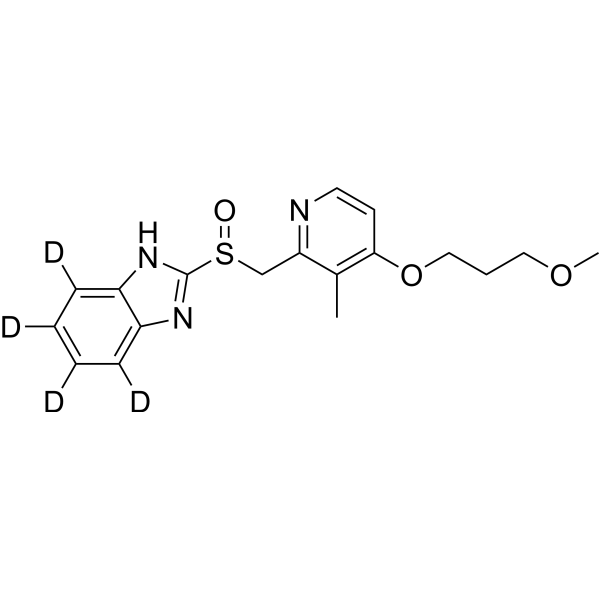
Rabeprazole-d4

Based on 1 Customer Validation
Rabeprazole-d4 is a deuterium labeled Rabeprazole. Rabeprazole is a second-generation proton pump inhibitor (PPI) that irreversibly inactivates gastric H+/K+-ATPase. Rabeprazole induces apoptosis. Rabeprazole acts as an uridine nucleoside ribohydrolase (UNH) inhibitor with an IC50 of 0.3 μM. Rabeprazole can be used for the research of gastric ulcerations and gastroesophageal reflux.
Nur für Forschungszwecke. Wir verkaufen nicht an Patienten.
- Reinheit : 95.0%
- CAS. Nr.: 934295-48-4
- Formel: C18H17D4N3O3S
- Molecular Weight:363.47
-
Speicherung:
Store at room temperature 3 years.
In solvent -80°C, 2 years , -20°C, 1 year

To place orders, for customer services and technical support, please contact: MedChemExpress USA
Tel: 609-228-6898 E-mail: [email protected] [email protected]


-
 Biologische Aktivität
-
Chemical Information
-
Lösungsmittel & Löslichkeit
- Protokoll
- Reinheit & Dokumentation
- Verweise
-
 Help & FAQs




Biologische Aktivität
Beschreibung
IC50 & Target
Anwendung
1. This compound can be used as a tracer
2. This compound can be used as an internal standard for quantitative analysis by NMR, GC-MS, or LC-MS.


Chemical Information
-
CAS. Nr. 934295-48-4
-
Unlabeled CAS 117976-89-3
-
Appearance Solid
-
Molecular Weight 363.47
-
Formel C18H17D4N3O3S
-
SMILES
COCCCOC(C=CN=C1CS(C2=NC3=C([2H])C([2H])=C([2H])C([2H])=C3N2)=O)=C1C
-
Synonyms
LY307640-d4
-
Versand
Room temperature in continental US; may vary elsewhere.
-
Speicherung
Store at room temperature 3 years
In solvent -80°C 2 years -20°C 1 year


Lösungsmittel & Löslichkeit
In Vitro:
DMSO : 20.83 mg/mL (57.31 mM; Need ultrasonic and warming; Hygroscopic DMSO has a significant impact on the solubility of product, please use newly opened DMSO)
Please refer to the solubility information to select the appropriate solvent. Once prepared, please aliquot and store the solution to prevent product inactivation from repeated freeze-thaw cycles.
Storage method and period of stock solution: -80°C, 2 years; -20°C, 1 year. When stored at -80°C, please use it within 2 years. When stored at -20°C, please use it within 1 year.
Please refer to the solubility information to select the appropriate solvent. Once prepared, please aliquot and store the solution to prevent product inactivation from repeated freeze-thaw cycles.
Storage method and period of stock solution: -80°C, 2 years; -20°C, 1 year. When stored at -80°C, please use it within 2 years. When stored at -20°C, please use it within 1 year.
Konzentration (Stammlösung) × Volumen (Stammlösung) = Konzentration (Ziellösung) × Volumen (Ziellösung)


Reinheit & Dokumentation
-
Data Sheet (271 KB)
-
SDS (393 KB)
- English - EN (393 KB)
- Français - FR (393 KB)
- Deutsch - DE (393 KB)
- Norwegian - NO (393 KB)
- Español - ES (393 KB)
- Swedish - SV (393 KB)
- Italian - IT (393 KB)
- Korean - KR (393 KB)
- Portuguese - PT (393 KB)
-
Handling Instructions (2659 KB)
Verweise
[1]. Tara A Shea, et al. Identification of Proton-Pump Inhibitor Drugs That Inhibit Trichomonas Vaginalis Uridine Nucleoside Ribohydrolase. Bioorg Med Chem Lett. 2014 Feb 15;24(4):1080-4. [Content Brief]
[2]. Mengli Gu, et al. Rabeprazole Exhibits Antiproliferative Effects on Human Gastric Cancer Cell Lines. Oncol Lett. 2014 Oct;8(4):1739-1744. [Content Brief]
[3]. Aly A M Shaalan, et al. Supplement With Calcium or Alendronate Suppresses Osteopenia Due to Long Term Rabeprazole Treatment in Female Mice: Influence on Bone TRAP and Osteopontin Levels. Front Pharmacol. 2020 May 13;11:583. [Content Brief]


Complete Stock Solution Preparation Table
Please refer to the solubility information to select the appropriate solvent. Once prepared, please aliquot and store the solution to prevent product inactivation from repeated freeze-thaw cycles.
Storage method and period of stock solution: -80°C, 2 years; -20°C, 1 year. When stored at -80°C, please use it within 2 years. When stored at -20°C, please use it within 1 year.
| Optional Solvent | Concentration Solvent Mass | 1 mg | 5 mg | 10 mg | 25 mg |
|---|---|---|---|---|---|
| DMSO | 1 mM | 2.7513 mL | 13.7563 mL | 27.5126 mL | 68.7815 mL |
| 5 mM | 0.5503 mL | 2.7513 mL | 5.5025 mL | 13.7563 mL | |
| 10 mM | 0.2751 mL | 1.3756 mL | 2.7513 mL | 6.8781 mL | |
| 15 mM | 0.1834 mL | 0.9171 mL | 1.8342 mL | 4.5854 mL | |
| 20 mM | 0.1376 mL | 0.6878 mL | 1.3756 mL | 3.4391 mL | |
| 25 mM | 0.1101 mL | 0.5503 mL | 1.1005 mL | 2.7513 mL | |
| 30 mM | 0.0917 mL | 0.4585 mL | 0.9171 mL | 2.2927 mL | |
| 40 mM | 0.0688 mL | 0.3439 mL | 0.6878 mL | 1.7195 mL | |
| 50 mM | 0.0550 mL | 0.2751 mL | 0.5503 mL | 1.3756 mL |


Rabeprazole-d4 Related Classifications
HY-B0656S Related Classifications
 Powered by Bioz