



RAGE antagonist peptide TFA
Based on 6 publication(s) in Google Scholar
RAGE antagonist peptide TFA is an advanced glycation end products (RAGE) antagonist. RAGE antagonist peptide TFA prevents RAGE from binding with several of its most important ligands, including HMGB-1, S100P, and S100A4. RAGE antagonist peptide TFA possesses anti-tumor and anti-inflammatory activities.
연구목적의 판매만을 진행합니다. 환자를 대상으로 한 판매는 하지 않습니다.
- Purity : 99.41%
- 화학식: C59H102F3N13O19S
- 분자량:1386.58
-
보관:
Sealed storage, away from moisture.
Powder -80°C, 2 years , -20°C, 1 year* In solvent : -80°C, 6 months; -20°C, 1 month (sealed storage, away from moisture)

To place orders, for customer services and technical support, please contact: MedChemExpress USA
Tel: 609-228-6898 E-mail: [email protected] [email protected]


-
 Biological Activity
-
Chemical Information
-
용액&용해도
- Protocol
- 순도&문서
- References
-
 Help & FAQs


Publications Citing Use of MedChemExpress (MCE) RAGE antagonist peptide TFA
More Customer Validation & Images

-
Flow Cytometry
-
WB
-
Flow Cytometry
-
WB
-
Cell Imaging/Staining


Biological Activity
제품 설명
In Vitro
In Vivo
RAGE antagonist peptide TFA (RAP) reduces the growth and metastasis of pancreatic tumors and also inhibited glioma tumor growth[1].
In mice bearing asthma, RAGE antagonist peptide TFA (RAP; 4 mg/kg; i.p.) blunts airway reactivity, airway inflammation and goblet cell metaplasia, and decreases release of Th2 cytokines. RAGE antagonist peptide TFA also reduces total, cytoplasmic and nuclear levels of β-catenin, enhances β-catenin phosphorylation at Ser33/37/Thr41, which triggers ubiquitination, down-regulated expression of β-catenin targeted genes, and tends to keep β-catenin at the cytomembrane, shifting β-catenin from a signalling active pattern to an adhesive function[2].
MedChemExpress (MCE) has not independently confirmed the accuracy of these methods. They are for reference only.
-
Animal Model:Cancer cells expressing the NFκB-luc reporter implanted into immune-deficient mice[1].
-
Dosage:100 µg
-
Administration:Intratumoral delivery (or intraperitoneally).
-
Result:Systemic administration caused a substantial reduction (p<0.05) in the NFκB signal 5 h after injection.


Chemical Information
-
Appearance Solid
-
분자량 1386.58
-
화학식 C59H102F3N13O19S
-
Color White to off-white
-
Sequence Shortening
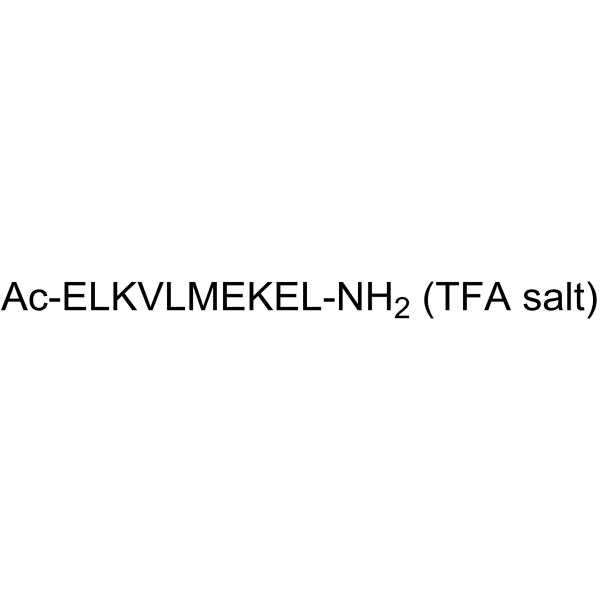
Ac-ELKVLMEKEL-NH2
-
선적
Room temperature in continental US; may vary elsewhere.
-
보관
Sealed storage, away from moisture
Powder -80°C 2 years -20°C 1 year * In solvent : -80°C, 6 months; -20°C, 1 month (sealed storage, away from moisture)


Publications (6)
-
Journal Impact Factor
-
Most Recent
-
Int J Biol Sci
Inhibition of the HMGB1/RAGE axis protects against cisplatin-induced ototoxicity via suppression of inflammation and oxidative stress. [Abstract]2024 Jan 1;20(2):784-800. PMID: 38169643 -
Cell Commun Signal
Neutrophil extracellular traps induced by the hypoxic microenvironment in gastric cancer augment tumour growth. [Abstract]2023 May 1;21(1):86. PMID: 37127629
RAGE antagonist peptide TFA purchased from MedChemExpress. Usage Cited in: Cell Commun Signal. 2023 May 1;21(1):86. [Abstract]
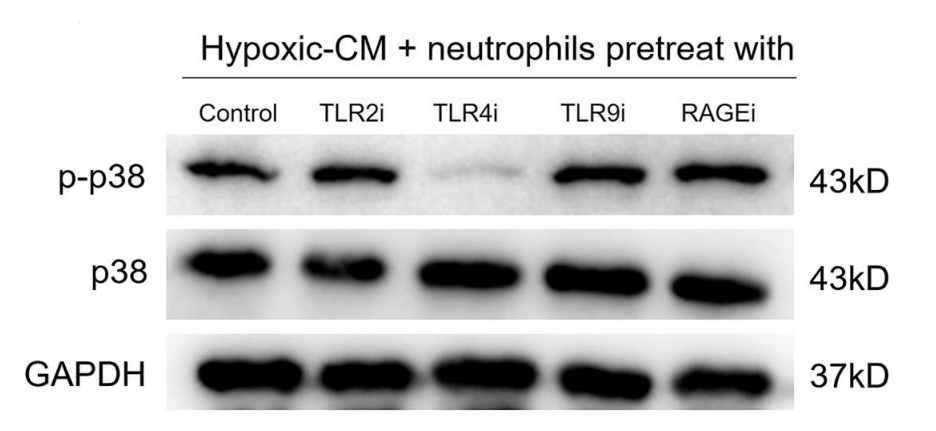
Neutrophils isolated from healthy individuals were pretreated with inhibitors of TLR2 (HY-112146; MMG-11), TLR4 (HY-107575; TLR4-IN-C34 ), TLR9 (HY-131952; TLR7/8/9-IN-1) and RAGE (HY-P2268; RAGE antagonist peptide) for 1 h prior to coculture with hypoxic-CM from GC cells, and the p-p38 level in neutrophils was measured by western blotting.
RAGE antagonist peptide TFA purchased from MedChemExpress. Usage Cited in: Cell Commun Signal. 2023 May 1;21(1):86. [Abstract]
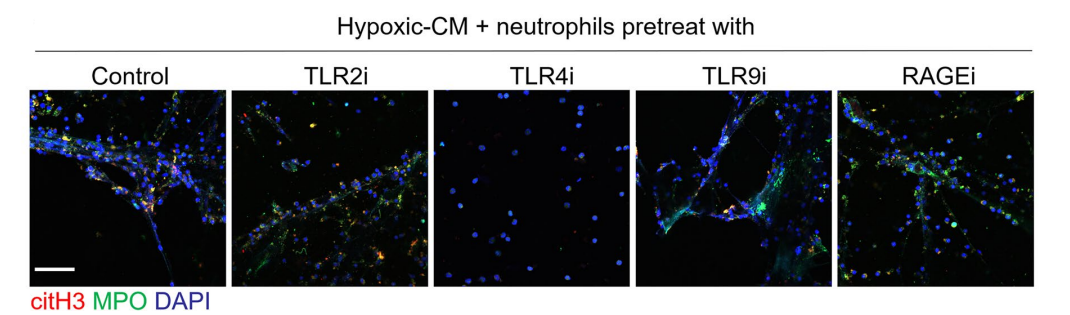
Neutrophils isolated from healthy individuals were pretreated with inhibitors of TLR2 (HY-112146; MMG-11), TLR4 (HY-107575; TLR4-IN-C34 ), TLR9 (HY-131952; TLR7/8/9-IN-1) and RAGE (HY-P2268; RAGE antagonist peptide) for 1 h prior to coculture with hypoxic-CM from GC cells, and the NET formation was detected with MPO and citH3 staining. Magnification: 20 × . Scale bars: 50 μm. All values are the means ± SDs. ns = not significant, **P < 0.01
-
-
J Immunol
2025 Jun 28:vkaf125. PMID: 40580518 -
Adv Biol (Weinh)
HMGB1 Derived from the Pyroptotic Microenvironment Promotes Macrophage Extracellular Traps in Hirschsprung-Associated Enterocolitis. [Abstract]2025 Sep;9(9):e00761. PMID: 40464207
RAGE antagonist peptide TFA purchased from MedChemExpress. Usage Cited in: Adv Biol (Weinh). 2025 Sep;9(9):e00761. [Abstract]
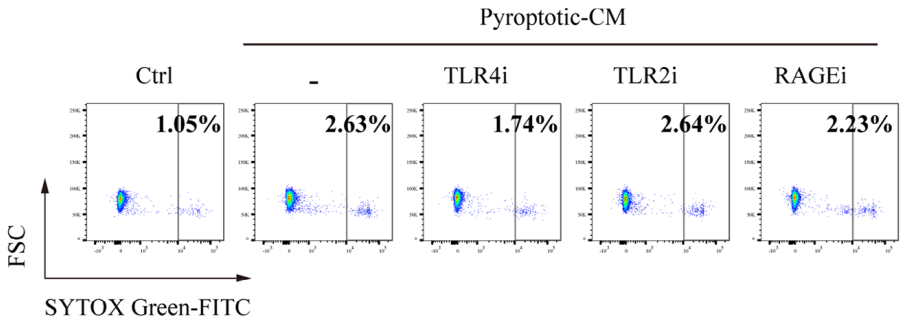
The MET formation of macrophages pretreated with inhibitors of TLR2 (HY‐112146; MMG-11), TLR4 (HY‐11109; Resatorvid) and RAGE (HY‐P2268; RAGE antagonist peptide) prior to incubation with pyroptotic‐CM was evaluated with SYTOX Green staining and detected by flow cytometry.
RAGE antagonist peptide TFA purchased from MedChemExpress. Usage Cited in: Adv Biol (Weinh). 2025 Sep;9(9):e00761. [Abstract]
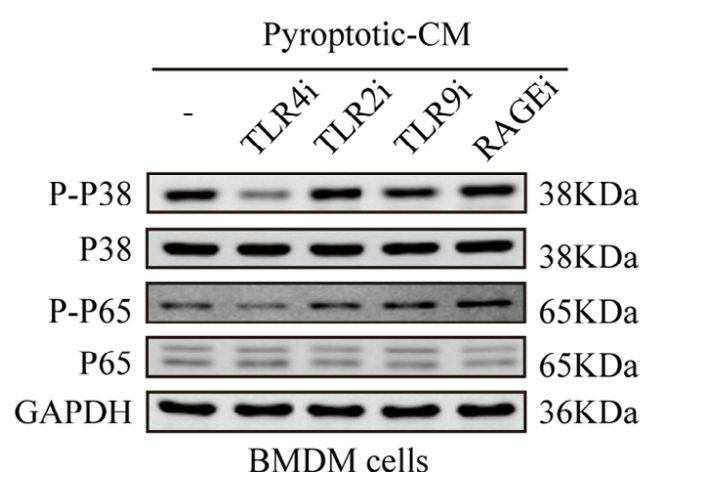
Macrophages were pretreated with inhibitors of TLR2 (MMG-11; HY‐112146), TLR4 (Resatorvid; HY‐11109), TLR9 (TLR7/8/9-IN-1; HY-131952) and RAGE (RAGE antagonist peptide; HY‐P2268) prior to coculture with pyroptotic‐CM, and the p‐p38 and p‐p65 levels in macrophages were measured by western blotting.
RAGE antagonist peptide TFA purchased from MedChemExpress. Usage Cited in: Adv Biol (Weinh). 2025 Sep;9(9):e00761. [Abstract]
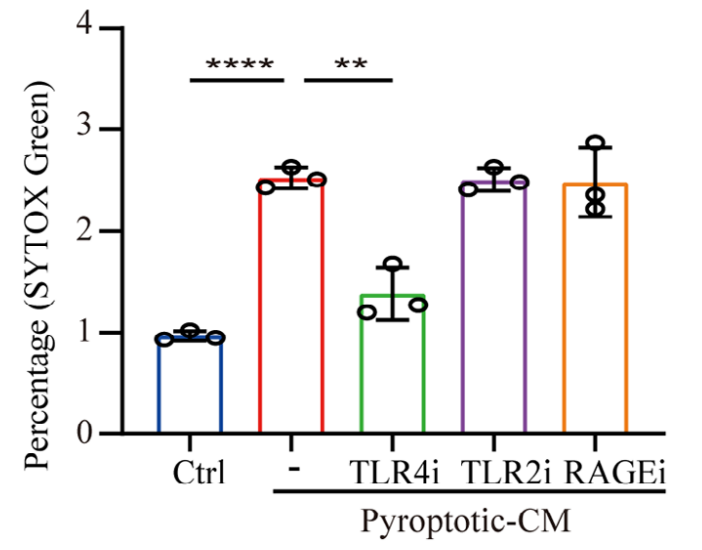
The MET formation of macrophages pretreated with inhibitors of (MMG-11; HY‐112146), TLR4 (Resatorvid; HY‐11109) and RAGE (RAGE antagonist peptide; HY‐P2268) prior to incubation with pyroptotic‐CM was detected by flow cytometry.
-


용액&용해도
In Vitro:
DMSO : ≥ 50 mg/mL (36.06 mM; Hygroscopic DMSO has a significant impact on the solubility of product, please use newly opened DMSO)
H2O : 14.29 mg/mL (10.31 mM; Need ultrasonic)
* "≥" means soluble, but saturation unknown.
Please refer to the solubility information to select the appropriate solvent. Once prepared, please aliquot and store the solution to prevent product inactivation from repeated freeze-thaw cycles.
Storage method and period of stock solution: -80°C, 6 months; -20°C, 1 month (sealed storage, away from moisture). When stored at -80°C, please use it within 6 months. When stored at -20°C, please use it within 1 month.
* Note: If you choose water as the stock solution, please dilute it to the working solution, then filter and sterilize it with a 0.22 μm filter before use.
Please refer to the solubility information to select the appropriate solvent. Once prepared, please aliquot and store the solution to prevent product inactivation from repeated freeze-thaw cycles.
Storage method and period of stock solution: -80°C, 6 months; -20°C, 1 month (sealed storage, away from moisture). When stored at -80°C, please use it within 6 months. When stored at -20°C, please use it within 1 month.
* Note: If you choose water as the stock solution, please dilute it to the working solution, then filter and sterilize it with a 0.22 μm filter before use.
Concentration (start) × Volume (start) = Concentration (final) × Volume (final)

Protocol
-
Research Protocol for Inflammation-related Diseases
The NLRP3 inflammasome is a cytosolic innate immune signaling platform that integrates priming signals and danger-signal activation to promote caspase-1 activation, maturation of IL-1β and IL-18, and gasdermin D-mediated pyroptotic cell death. The core experimental logic is to determine whether inflammatory disease phenotypes are driven by increased NLRP3 expression, ASC-containing inflammasome assembly, caspase-1 cleavage, GSDMD cleavage, and extracellular release of IL-1β/IL-18 rather than by nonspecific cell injury alone. The pathway is strongly linked to inflammation-related disease phenotypes because monosodium urate crystals activate NALP3/NLRP3 inflammasome signaling in gout-like crystal inflammation, cholesterol crystals activate NLRP3 inflammasomes in atherogenesis models, and DSS-induced intestinal inflammation has been reported to involve NLRP3 inflammasome activity. However, experimental colitis studies also show context-dependent protective effects of NLRP3 inflammasome co


순도&문서
-
Data Sheet (271 KB)
-
SDS (252 KB)
- English - EN (252 KB)
- Français - FR (252 KB)
- Deutsch - DE (252 KB)
- Norwegian - NO (252 KB)
- Español - ES (252 KB)
- Swedish - SV (252 KB)
- Italian - IT (252 KB)
- Korean - KR (252 KB)
- Portuguese - PT (252 KB)
-
Handling Instructions (2659 KB)
References
[1]. Thiruvengadam Arumugam, et al. S100P-derived RAGE antagonistic peptide reduces tumor growth and metastasis. Clin Cancer Res. 2012 Aug 15;18(16):4356-64. [Content Brief]
[2]. Lihong Yao, et al. The receptor for advanced glycation end products is required for β-catenin stabilization in a chemical-induced asthma model. Br J Pharmacol. 2016 Sep;173(17):2600-13. [Content Brief]


Complete Stock Solution Preparation Table
Please refer to the solubility information to select the appropriate solvent. Once prepared, please aliquot and store the solution to prevent product inactivation from repeated freeze-thaw cycles.
Storage method and period of stock solution: -80°C, 6 months; -20°C, 1 month (sealed storage, away from moisture). When stored at -80°C, please use it within 6 months. When stored at -20°C, please use it within 1 month.
| Optional Solvent | Concentration Solvent Mass | 1 mg | 5 mg | 10 mg | 25 mg |
|---|---|---|---|---|---|
| H2O / DMSO | 1 mM | 0.7212 mL | 3.6060 mL | 7.2120 mL | 18.0300 mL |
| 5 mM | 0.1442 mL | 0.7212 mL | 1.4424 mL | 3.6060 mL | |
| 10 mM | 0.0721 mL | 0.3606 mL | 0.7212 mL | 1.8030 mL | |
| DMSO | 15 mM | 0.0481 mL | 0.2404 mL | 0.4808 mL | 1.2020 mL |
| 20 mM | 0.0361 mL | 0.1803 mL | 0.3606 mL | 0.9015 mL | |
| 25 mM | 0.0288 mL | 0.1442 mL | 0.2885 mL | 0.7212 mL | |
| 30 mM | 0.0240 mL | 0.1202 mL | 0.2404 mL | 0.6010 mL |
* Note: If you choose water as the stock solution, please dilute it to the working solution, then filter and sterilize it with a 0.22 μm filter before use.


RAGE antagonist peptide TFA Related Classifications
HY-P2268A Related Classifications
 Powered by Bioz