



HGF Protein, Mouse (HEK293, His)

Based on 1 Customer Validation
HGF Protein, a potent mitogen, stimulates mature hepatocyte cell growth and acts as a hepatotrophic factor for various tissues. As an activating ligand for MET receptor tyrosine kinase, HGF binds and promotes dimerization, activating MAPK signaling through TMPRSS13 cleavage. Structurally, HGF comprises alpha and beta chains connected by a disulfide bond. Interaction with SRPX2 enhances its mitogenic activity. HGF Protein, Mouse (HEK293, His) is the recombinant mouse-derived HGF protein, expressed by HEK293 , with C-6*His labeled tag.
- Species: Mouse
- Source: HEK293
-
Storage:Stored at -20°C for 2 years from date of receipt. After reconstitution, it is stable at 4°C for 1 week or -20°C for longer (with carrier protein). It is recommended to freeze aliquots at -20°C or -80°C for extended storage.


To place orders, for customer services and technical support, please contact: MedChemExpress USA
Tel: 609-228-6898 E-mail: [email protected] [email protected]


-
 Biological Activity
-
Technical Parameters
-
Product Properties
- Documentation
- Help & FAQs


-

HY-P7067
EGF Protein, Mouse -
HY-P7066
FGF-2 Protein, Mouse (145a.a) -
HY-P7170
KGF-2/FGF-10 Protein, Mouse -
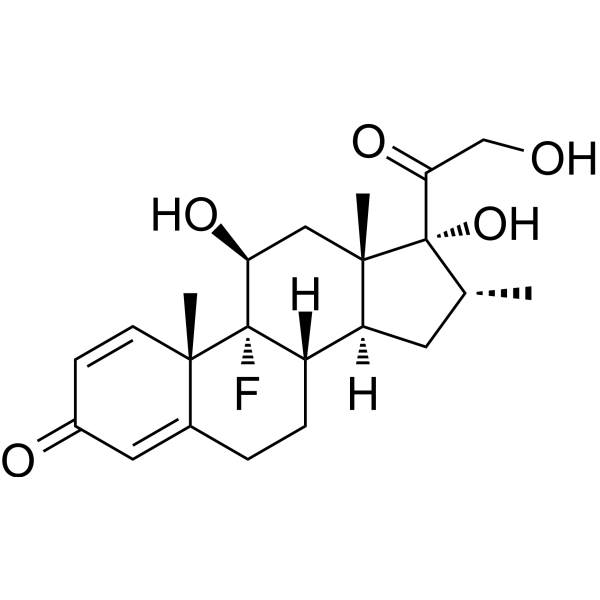
HY-14648
Dexamethasone -
HY-P7087
PDGF-BB Protein, Mouse -
HY-P70627
HGF Protein, Human (HEK293, His) -
HY-P7044
IL-6 Protein, Human -
HY-P7121
HGF Protein, Human (CHO) -
HY-P70590
EGF Protein, Mouse (His) -
HY-P70452
Wnt3a Protein, Mouse (His) -
HY-P70590AF
Animal-Free EGF Protein, Mouse (His)


Biological Activity
Description
HGF Protein, a potent mitogen, stimulates mature hepatocyte cell growth and acts as a hepatotrophic factor for various tissues. As an activating ligand for MET receptor tyrosine kinase, HGF binds and promotes dimerization, activating MAPK signaling through TMPRSS13 cleavage. Structurally, HGF comprises alpha and beta chains connected by a disulfide bond. Interaction with SRPX2 enhances its mitogenic activity. HGF Protein, Mouse (HEK293, His) is the recombinant mouse-derived HGF protein, expressed by HEK293 , with C-6*His labeled tag.
Background
HGF protein is a potent mitogen that stimulates the growth of mature parenchymal hepatocyte cells and acts as a hepatotrophic factor for a wide range of tissues and cell types. It functions as an activating ligand for the receptor tyrosine kinase MET, binding to it and facilitating its dimerization. HGF also activates MAPK signaling through the cleavage and activation of TMPRSS13. Structurally, HGF is composed of an alpha chain and a beta chain joined by a disulfide bond. Additionally, it interacts with SRPX2, promoting increased mitogenic activity of HGF.
Verified Bioactivity
Measured in a cell proliferation assay using mIMCD-3 mouse epithelial cells. The ED50 this effect is 5.0-15.0 ng/mL.
MCE Validation Data
-
Purity - SDS-PAGE
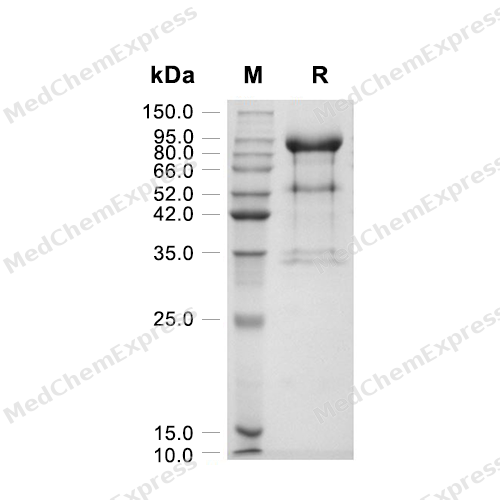
Purity - SDS-PAGE
-
Bioactivity - Cell-Based Assay
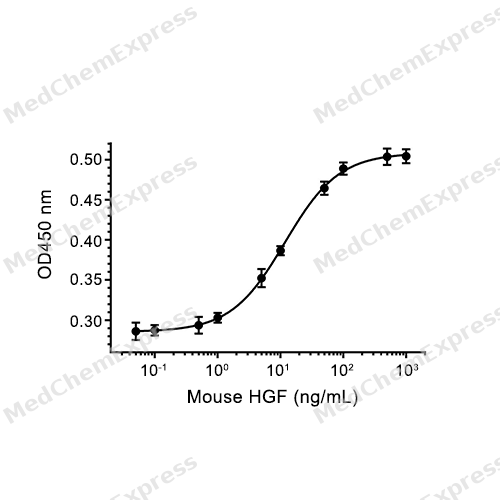
Bioactivity - Cell-Based Assay


Technical Parameters
-
Species Mouse
-
Source HEK293
-
Tag C-6*His
-
Accession
Q08048-1 (Q33-L728)
-
Molecular Construction
-
N-term
-
HGF (Q33-L728)
Accession # Q848-1 -
His
-
C-term
-
-
Protein Length
Full Length of Isoform-1
-
Synonyms
HGF; Hepatocyte Growth Factor (Hepapoietin A; Scatter Factor); Prev. DFNB39; Lung Fibroblast-Derived Mitogen; HPTA; Hepatopoietin-A; SF; Scatter Factor; F-TCF; Deafness, Autosomal Recessive 39; HGFB; Hepatopoietin A; Hepatocyte Growth Factor; Fibroblast-D
-
AA Sequence
QKKRRNTLHEFKKSAKTTLTKEDPLLKIKTKKVNSADECANRCIRNRGFTFTCKAFVFDKSRKRCYWYPFNSMSSGVKKGFGHEFDLYENKDYIRNCIIGKGGSYKGTVSITKSGIKCQPWNSMIPHEHSFLPSSYRGKDLQENYCRNPRGEEGGPWCFTSNPEVRYEVCDIPQCSEVECMTCNGESYRGPMDHTESGKTCQRWDQQTPHRHKFLPERYPDKGFDDNYCRNPDGKPRPWCYTLDPDTPWEYCAIKTCAHSAVNETDVPMETTECIQGQGEGYRGTSNTIWNGIPCQRWDSQYPHKHDITPENFKCKDLRENYCRNPDGAESPWCFTTDPNIRVGYCSQIPKCDVSSGQDCYRGNGKNYMGNLSKTRSGLTCSMWDKNMEDLHRHIFWEPDASKLNKNYCRNPDDDAHGPWCYTGNPLIPWDYCPISRCEGDTTPTIVNLDHPVISCAKTKQLRVVNGIPTQTTVGWMVSLKYRNKHICGGSLIKESWVLTARQCFPARNKDLKDYEAWLGIHDVHERGEEKRKQILNISQLVYGPEGSDLVLLKLARPAILDNFVSTIDLPSYGCTIPEKTTCSIYGWGYTGLINADGLLRVAHLYIMGNEKCSQHHQGKVTLNESELCAGAEKIGSGPCEGDYGGPLICEQHKMRMVLGVIVPGRGCAIPNRPGIFVRVAYYAKWIHKVILTYKL
-
Predicted Molecular Mass
79.3 kDa
-
Molecular Weight
Approximately 94-99 kDa (α+β subunit) & 63-65 kDa (α subunit) & 31-34 kDa (β subunit), based on SDS-PAGE under reducing conditions, due to the glycosylation.
-
Glycosylation
Yes
-
Purity
≥ 90%, as determined by reducing SDS-PAGE.


Product Properties
Lyophilized powder
1.Lyophilized from a 0.22 μm filtered solution of PBS, pH 7.4.
2.Lyophilized from a 0.22 μm filtered solution of 20 mM PB, 150 mM NaCl, pH 7.4.
3.Lyophilized from a 0.22 μm filtered solution of PBS, pH 7.4, 8% trehalose.
Please refer to the lot-specific COA for specific buffer information.
<1 EU/μg, determined by LAL method.
It is not recommended to reconstitute to a concentration less than 100 μg/mL in ddH2O. For long term storage it is recommended to add a carrier protein (0.1% BSA, 5% HSA, 10% FBS or 5% Trehalose).
Stored at -20°C for 2 years from date of receipt. After reconstitution, it is stable at 4°C for 1 week or -20°C for longer (with carrier protein). It is recommended to freeze aliquots at -20°C or -80°C for extended storage.
Room temperature in continental US; may vary elsewhere.


Documentation
-
Data Sheet (240 KB)
-
SDS (252 KB)
- English - EN (252 KB)
- Français - FR (252 KB)
- Deutsch - DE (252 KB)
- Norwegian - NO (252 KB)
- Español - ES (252 KB)
- Swedish - SV (252 KB)
- Italian - IT (252 KB)
- Korean - KR (252 KB)
- Portuguese - PT (252 KB)
-
Handling Instructions (2659 KB)

Calculators
Concentration (start) × Volume (start) = Concentration (final) × Volume (final)


 Powered by Bioz

