



Transferrin Protein, Human (HEK293, His)

Based on 1 Customer Validation
Transferrin proteins, iron-binding transporters, bind two Fe(3+) ions and an anion, usually bicarbonate. They transport iron from absorption and heme degradation sites to storage and utilization locations. Serum transferrin may impact cell proliferation. In microbial infection, Neisseria species utilize transferrin as an iron source, capturing and extracting iron for their metabolic needs. Transferrin Protein, Human (HEK293, His) is the recombinant human-derived Transferrin protein, expressed by HEK293 , with C-His labeled tag.
- Species: Human
- Source: HEK293
-
Storage:Stored at -20°C for 2 years from date of receipt. After reconstitution, it is stable at 4°C for 1 week or -20°C for longer (with carrier protein). It is recommended to freeze aliquots at -20°C or -80°C for extended storage.


To place orders, for customer services and technical support, please contact: MedChemExpress USA
Tel: 609-228-6898 E-mail: [email protected] [email protected]


-
 Biological Activity
-
Technical Parameters
-
Product Properties
- Documentation
- Help & FAQs


-

HY-P0035
Insulin (human)Recombinant Human Insulin -
HY-B0166
L-Ascorbic acidAntioxidant -
HY-N0583
HydrocortisoneGlucocorticoid Receptor Agonist -
HY-A0070A
LiothyronineTIGIT/PVR Blocker -

HY-P71069
TFRC Protein, Human (HEK293, His) -
HY-P73276
LIF Protein, Human (HEK293) -
HY-P7109
EGF Protein, Human -
HY-P73243
Insulin Protein, Human (P.pastoris) -
HY-P7512
Annexin A1/ANXA1 Protein, Human


Biological Activity
Description
Transferrin proteins, iron-binding transporters, bind two Fe(3+) ions and an anion, usually bicarbonate. They transport iron from absorption and heme degradation sites to storage and utilization locations. Serum transferrin may impact cell proliferation. In microbial infection, Neisseria species utilize transferrin as an iron source, capturing and extracting iron for their metabolic needs. Transferrin Protein, Human (HEK293, His) is the recombinant human-derived Transferrin protein, expressed by HEK293 , with C-His labeled tag.
Background
Transferrins, as iron-binding transport proteins, have the capacity to bind two Fe(3+) ions in conjunction with an anion, typically bicarbonate. They play a pivotal role in transporting iron from sites of absorption and heme degradation to locations designated for storage and utilization. Additionally, serum transferrin may exert influence over cell proliferation. In the context of microbial infection, transferrin serves as an iron source for Neisseria species, which adeptly capture the protein and extract iron for their own metabolic needs.
Verified Bioactivity
1.Measured by its binding ability in a functional ELISA. Immobilized Human Transferrin at 2 μg/mL (100 μL/well) can bind Biotinylated Human Transferrin R. The ED50 for this effect is 10.21 ng/mL.
2. Measured in a cell proliferation assay using HepG2 Human Hepatocellular Carcinoma Cells. The ED50 for this effect is 21.49 μg/mL, corresponding to a spec ific activity is 46.533 U/mg.
3.Measured by the ability of the immobilized protein to support the adhesion of HEK293 human embryonic kidney cells. The ED50 for this effect is 0.1817 μg/mL, corresponding to a specific activity is 5503.58 units/mg.
4.Loaded Recombinant Human Transferrin on SA Biosensor, can bind Recombinant Human TfR (N-6His) with an affinity constant of 50-250 nM as determined in BLI assay.
MCE Validation Data
-
Purity - SDS-PAGE
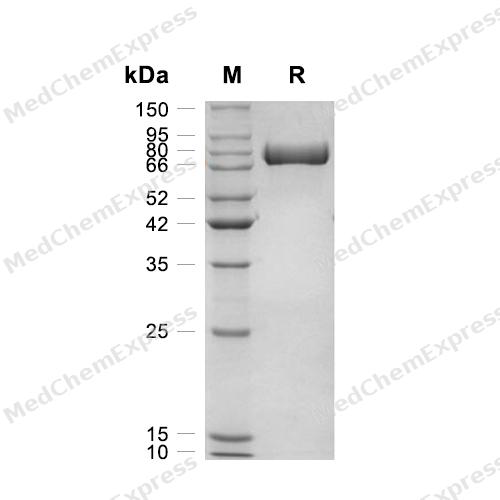
Purity - SDS-PAGE
-
Bioactivity - ELISA
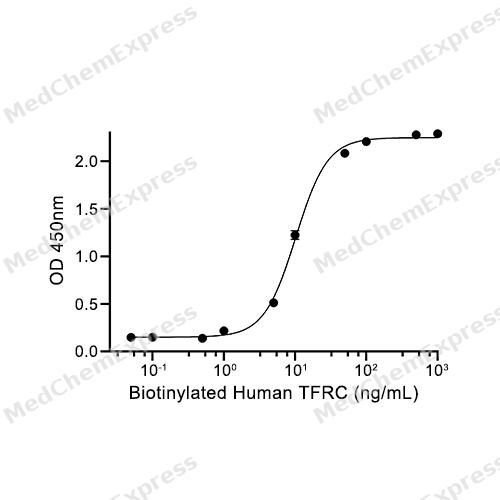
Bioactivity - ELISA


Technical Parameters
-
Species Human
-
Source HEK293
-
Tag C-His
-
Accession
P02787/AAA61140.1/NP_001054.1 (V20-P698)
-
Molecular Construction
-
N-term
-
Transferrin (V20-P698)
Accession # P02787 -
His
-
C-term
-
-
Protein Length
Full Length of Mature Protein
-
Synonyms
TF; Epididymis Secretory Sperm Binding Protein Li 71p; Transferrin; CDNA FLJ54029, Highly Similar To Serotransferrin; Serotransferrin; Transferrin, Isoform CRA_c; Beta-1 Metal-Binding Globulin; TF Protein; Siderophilin; HEL-S-71p; PRO1557; TFQTL1; PRO2086
-
AA Sequence
VPDKTVRWCAVSEHEATKCQSFRDHMKSVIPSDGPSVACVKKASYLDCIRAIAANEADAVTLDAGLVYDAYLAPNNLKPVVAEFYGSKEDPQTFYYAVAVVKKDSGFQMNQLRGKKSCHTGLGRSAGWNIPIGLLYCDLPEPRKPLEKAVANFFSGSCAPCADGTDFPQLCQLCPGCGCSTLNQYFGYSGAFKCLKDGAGDVAFVKHSTIFENLANKADRDQYELLCLDNTRKPVDEYKDCHLAQVPSHTVVARSMGGKEDLIWELLNQAQEHFGKDKSKEFQLFSSPHGKDLLFKDSAHGFLKVPPRMDAKMYLGYEYVTAIRNLREGTCPEAPTDECKPVKWCALSHHERLKCDEWSVNSVGKIECVSAETTEDCIAKIMNGEADAMSLDGGFVYIAGKCGLVPVLAENYNKSDNCEDTPEAGYFAIAVVKKSASDLTWDNLKGKKSCHTAVGRTAGWNIPMGLLYNKINHCRFDEFFSEGCAPGSKKDSSLCKLCMGSGLNLCEPNNKEGYYGYTGAFRCLVEKGDVAFVKHQTVPQNTGGKNPDPWAKNLNEKDYELLCLDGTRKPVEEYANCHLARAPNHAVVTRKDKEACVHKILRQQQHLFGSNVTDCSGNFCLFRSETKDLLFRDDTVCLAKLHDRNTYEKYLGEEYVKAVGNLRKCSTSSLLEACTFRRP
-
Predicted Molecular Mass
76.2 kDa
-
Molecular Weight
Approximately 68-90 kDa, based on SDS-PAGE under reducing conditions, due to the glycosylation.
-
Glycosylation
Yes
-
Purity
≥ 95%, as determined by reducing SDS-PAGE.


Product Properties
Lyophilized powder
1.Lyophilized from a 0.22 μm filtered solution of PBS, 5% sucrose, 5% mannitol, 0.02% Tween 80, pH 7.4.
2.Lyophilized from a 0.22 μm filtered solution of 20 mM PB, 150 mM NaCl, pH 7.4.
3.Lyophilized from a 0.22 μm filtered solution of PBS, pH 7.4.
Please refer to the lot-specific COA for specific buffer information.
<1 EU/μg, determined by LAL method.
It is not recommended to reconstitute to a concentration less than 100 μg/mL in ddH2O. For long term storage it is recommended to add a carrier protein (0.1% BSA, 5% HSA, 10% FBS or 5% Trehalose).
Stored at -20°C for 2 years from date of receipt. After reconstitution, it is stable at 4°C for 1 week or -20°C for longer (with carrier protein). It is recommended to freeze aliquots at -20°C or -80°C for extended storage.
Room temperature in continental US; may vary elsewhere.


Documentation
-
Data Sheet (240 KB)
-
SDS (252 KB)
- English - EN (252 KB)
- Français - FR (252 KB)
- Deutsch - DE (252 KB)
- Norwegian - NO (252 KB)
- Español - ES (252 KB)
- Swedish - SV (252 KB)
- Italian - IT (252 KB)
- Korean - KR (252 KB)
- Portuguese - PT (252 KB)
-
Handling Instructions (2659 KB)

Calculators
Concentration (start) × Volume (start) = Concentration (final) × Volume (final)


 Powered by Bioz

