



Remdesivir-d4
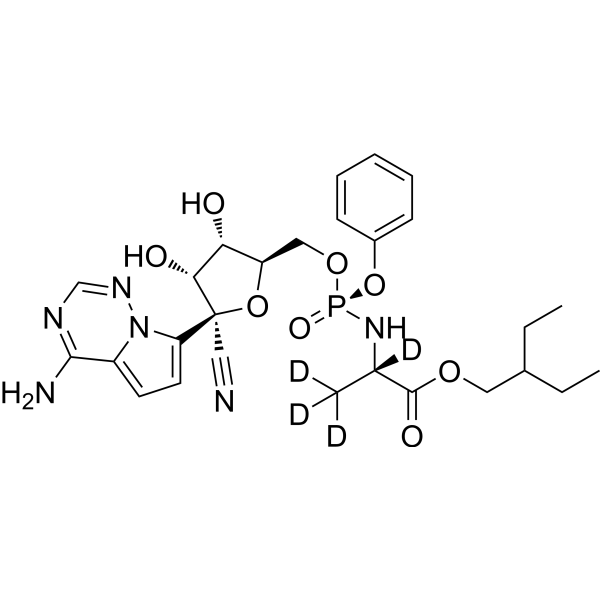
Remdesivir-d4 (GS-5734-d4) is deuterium labeled Remdesivir (HY-104077). Remdesivir (GS-5734) is a nucleoside analogue with effective antiviral activity. Remdesivir can inhibit the synthesis of viral DNA or RNA. Remdesivir can be used for the research of infection, such as SARS-CoV and MHV infection.
For research use only. We do not sell to patients.
- Formula: C27H31D4N6O8P
- Molecular Weight:606.60
-
Storage:Powder -20°C, 3 years ; In solvent -80°C, 6 months , -20°C, 1 month

To place orders, for customer services and technical support, please contact: MedChemExpress USA
Tel: 609-228-6898 E-mail: [email protected] [email protected]


-
 Biological Activity
-
Chemical Information
- Protocols
- Purity & Documentation
- References
-
 Help & FAQs


All DNA/RNA Synthesis Isoforms
More

Biological Activity
Description
In Vitro
Stable heavy isotopes of hydrogen, carbon, and other elements have been incorporated into drug molecules, largely as tracers for quantitation during the drug development process. Deuteration has gained attention because of its potential to affect the pharmacokinetic and metabolic profiles of drugs.
MedChemExpress (MCE) has not independently confirmed the accuracy of these methods. They are for reference only.
Application
1. This compound can be used as a tracer
2. This compound can be used as an internal standard for quantitative analysis by NMR, GC-MS, or LC-MS.


Chemical Information
-
Unlabeled CAS 1809249-37-3
-
Appearance Solid
-
Molecular Weight 606.60
-
Formula C27H31D4N6O8P
-
Color White to off-white
-
SMILES
O=C(OCC(CC)CC)[C@@](C([2H])([2H])[2H])([2H])N[P@@](OC1=CC=CC=C1)(OC[C@H]2O[C@@](C#N)(C3=CC=C4C(N)=NC=NN43)[C@H](O)[C@@H]2O)=O
-
Synonyms
GS-5734-d4
-
Shipping
Room temperature in continental US; may vary elsewhere.
-
Storage
Powder -20°C 3 years In solvent -80°C 6 months -20°C 1 month


Purity & Documentation
-
Data Sheet (272 KB)
-
SDS (251 KB)
- English - EN (251 KB)
- Français - FR (251 KB)
- Deutsch - DE (251 KB)
- Norwegian - NO (251 KB)
- Español - ES (251 KB)
- Swedish - SV (251 KB)
- Italian - IT (251 KB)
- Korean - KR (251 KB)
- Portuguese - PT (251 KB)
-
Handling Instructions (2659 KB)
References
[1]. Agostini ML, et al. Coronavirus Susceptibility to the Antiviral Remdesivir (GS-5734) Is Mediated by the Viral Polymerase and the Proofreading Exoribonuclease. MBio. 2018 Mar 6;9(2). pii: e00221-18. [Content Brief]
[2]. Wang M, et al. Remdesivir and chloroquine effectively inhibit the recently emerged novel coronavirus (2019-nCoV) in vitro. Cell Res. 2020 Mar;30(3):269-271. [Content Brief]
[3]. Hu H, et al. Optimization of the Prodrug Moiety of Remdesivir to Improve Lung Exposure/Selectivity and Enhance Anti-SARS-CoV-2 Activity. J Med Chem. 2022 Sep 22;65(18):12044-12054. [Content Brief]

Calculators
Concentration (start) × Volume (start) = Concentration (final) × Volume (final)


Remdesivir-d4 Related Classifications
HY-104077S1 Related Classifications
 Powered by Bioz