



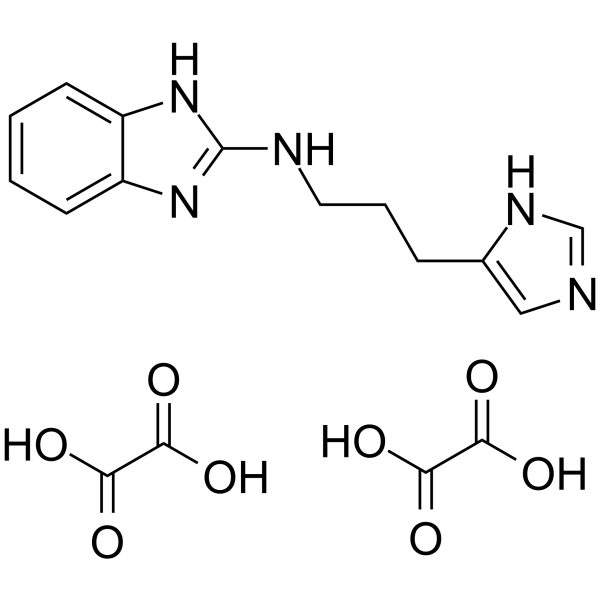
ROS 234 dioxalate
ROS 234 dioxalate is a potent H3 antagonist, with a pKB of 9.46 for Guinea-pig ileum H3-receptor, a pKi of 8.90 for Rat cerebral cortex H3-receptor, and a ED50 of 19.12 mg/kg (ip) in ex vivo of Rat cerebral cortex. ROS 234 dioxalate diaplays poor central access.
Nos produits utilisent uniquement pour la recherche. Nous ne vendons pas aux patients.
- CAS No.: 1781941-93-2
- Formule: C17H19N5O8
- Masse moléculaire:421.36
-
Stockage:
Please store the product under the recommended conditions in the Certificate of Analysis.

To place orders, for customer services and technical support, please contact: MedChemExpress USA
Tel: 609-228-6898 E-mail: [email protected] [email protected]


-
 Activité biologique
-
Chemical Information
- Protocole
- Pureté et documentation
- Références
-
 Help & FAQs


Voir tous les produits spécifiques à Isoform Histamine Receptor
More

Activité biologique
Description
IC50 & Target
|
H2 Receptor 8.90 (pKi, Rat cerebral cortex H3-receptor) |
In Vivo
MedChemExpress (MCE) has not independently confirmed the accuracy of these methods. They are for reference only.


Chemical Information
-
CAS No. 1781941-93-2
-
Masse moléculaire 421.36
-
Formule C17H19N5O8
-
SMILES
O=C(O)C(O)=O.O=C(O)C(O)=O.C1(NCCCC2=CN=CN2)=NC3=CC=CC=C3N1
-
Livraison
Room temperature in continental US; may vary elsewhere.
-
Stockage
Please store the product under the recommended conditions in the Certificate of Analysis.

Protocole
-
ROS/oxidative-stress fluorescent staining
ROS/oxidative-stress fluorescent staining uses cell-permeant fluorogenic probes that become fluorescent after oxidation inside cells or tissues; commonly used examples include DCFH-DA/DCFDA for broad cellular oxidant detection, DHE for superoxide-related signal detection, MitoSOX for mitochondrial superoxide-related signal detection, and CellROX probes for oxidative-stress-associated fluorescence readouts. The assay detects probe oxidation rather than a single ROS species unless the probe and analysis method have been chemically validated for that species. DCFH-DA enters cells, is deacetylated by intracellular esterases to DCFH, and produces fluorescent DCF after oxidation, so the readout is used as an operational measure of total cellular oxidative stress rather than a species-specific ROS measurement. DHE and MitoSOX can report superoxide-related oxidation, but red fluorescence alone can include non-specific ethidium-like oxidation products; HPLC or optimized spectral approaches are


Pureté et documentation
Références
[1]. Ballabeni V, et al. CNS access of selected H3-antagonists: ex vivo binding study in rats. Inflamm Res. 2002 Apr;51 Suppl 1:S55-6. [Content Brief]
[2]. Mor M, et al. Synthesis, biological activity, QSAR and QSPR study of 2-aminobenzimidazole derivatives as potent H3-antagonists. Bioorg Med Chem. 2004 Feb 15;12(4):663-74. [Content Brief]

Calculators
Concentration (start) × Volume (start) = Concentration (final) × Volume (final)


ROS 234 dioxalate Related Classifications
HY-107563A Related Classifications
 Powered by Bioz