235 Results for "

Progesterone

" in MedChemExpress (MCE) Product Catalog:
Products (235)

235 Results for "Progesterone" in MCE Product Catalog:

Cat. No.: HY-P702292
Purity:  ≥ 90%, as determined by reducing SDS-PAGE.
Synonyms: PAEP; PP14 Protein (Placental Protein 14); Progestagen Associated Endometrial Protein; Zona-Binding Inhibitory Factor-1; Glycodelin; Alpha Uterine Protein; PP14; Placental Protein 14; PAEG; Glycodelin-A; GD; Glycodelin-S; Progesterone-Associated Endometri
Species:  
Virus
Source:  
E. coli Cell-free
loading...
    loading...
Cat. No.: HY-P703871
Purity:  ≥ 95%, as determined by reducing SDS-PAGE.
Synonyms: PAEP; PP14 Protein (Placental Protein 14); Progestagen Associated Endometrial Protein; Zona-Binding Inhibitory Factor-1; Glycodelin; Alpha Uterine Protein; PP14; Placental Protein 14; PAEG; Glycodelin-A; GD; Glycodelin-S; Progesterone-Associated Endometri
Species:  
Virus
Source:  
HEK293
loading...
    loading...
Cat. No.: HY-P704068
Purity:  ≥ 95%, as determined by reducing SDS-PAGE.
Synonyms: PAEP; PP14 Protein (Placental Protein 14); Progestagen Associated Endometrial Protein; Zona-Binding Inhibitory Factor-1; Glycodelin; Alpha Uterine Protein; PP14; Placental Protein 14; PAEG; Glycodelin-A; GD; Glycodelin-S; Progesterone-Associated Endometri
Species:  
Virus
Source:  
HEK293
loading...
    loading...
Cat. No.: HY-B0084S4
Synonyms: STS 557-13C,15N,d4
Dienogest-13C,15N,d4 (STS 557-13C,15N,d4) is the 13C, 15N and deuterium labeled isotope of Dienogest (HY-B0084). Dienogest (STS-557) is an orally active and selective progesterone receptor agonist that effectively reduces the gene expression of COX-2, mPGES-1 and aromatase. Dienogest also inhibits the mRNA and protein expression of PGE2 synthase and the activation of NF-κB. Dienogest can be used in studies of endometriosis, menopause and menorrhagia .
loading...
    loading...
Cat. No.: HY-N15362
CAS No.: 570-50-3
5α-Pregnane-3β,17α,20α-triol is an endogenous steroid compound. 5α-Pregnane-3β,17α,20α-triol is the metabolite of Pregnenolone (HY-B0151) or Progesterone (HY-N0437). 5α-Pregnane-3β,17α,20α-triol is promising for research of the endocrine function of the placenta and the mechanisms related to steroid hormone metabolism during pregnancy .
loading...
    loading...
Cat. No.: HY-B1012R
CAS No.: 152-43-2
Synonyms: W-3566 (Standard)
Quinestrol (Standard) is the analytical standard of Quinestrol (HY-B1012). This product is intended for research and analytical applications. Quinestrol (W-3566) is an orally effective synthetic estrogen compound that acts on CYP3A4, CYP1A2, and GnRH. Quinestrol interferes with GnRH release and disrupts the hypothalamic-pituitary-ovarian axis. Quinestrol downregulates the gene expression of follicle-stimulating hormone β and luteinizing hormone β, induces oxidative stress, damages reproductive organs, reduces sperm density and motility, increases sperm malformation rate, and alters the levels of sex hormones such as testosterone, luteinizing hormone, estradiol, and progesterone. Quinestrol can be used in studies related to reproductive function regulation .
loading...
    loading...
Cat. No.: HY-W490804
CAS No.: 2971-36-0
Research Areas:  

Metabolic Disease

HPTE is the active in vivo metabolite of Methoxychlor (HY-B1873), and acts as an inhibitor of 3β‑HSD and 17β‑HSD3. HPTE binds to the substrate-binding pocket of 3β‑HSD in a non-competitive manner, but competitively occupies the coenzyme NAD +-binding site, thereby inhibiting the conversion of pregnenolone to progesterone. HPTE binds to the androstenedione-binding pocket (the substrate pocket) of 17β‑HSD3 in a non-competitive manner, and competitively occupies the coenzyme NADPH-binding site, thus blocking the conversion of androstenedione to testosterone. HPTE interferes with androgen biosynthesis in Leydig cells by inhibiting the activities of these two key steroidogenic enzymes. HPTE can be used in studies related to androgen biosynthesis .
loading...
    loading...
Cat. No.: HY-P85433
Synonyms: ST13; AAG2; FAM10A1; HIP; SNC6; Hsc70-interacting protein; Hip; Aging-associated protein 2; Progesterone receptor-associated p48 protein; Protein FAM10A1; Putative tumor suppressor ST13; Renal carcinoma antigen NY-REN-33; Suppression of tum

Host:  

Mouse

Application:  

WB, IHC-P, ICC/IF

Reactivity:  

Human, Bovine, Dog, Pig

loading...
    loading...
Cat. No.: HY-187614
CAS No.: 1597-68-8
Target:  

Cytochrome P450

Research Areas:  

Endocrinology

6α-Fluorotestosterone is a non-aromatizable aromatase inhibitor, with IC50 values of 115 nM and 580 nM against human and rat aromatase, respectively. 6α-Fluorotestosterone binds to the substrate site of human aromatase P450arom with a Ki of 150 nM, but is not aromatized into estrogen. In vivo, 6α-Fluorotestosterone maintains sexual behavior in castrated male rats (with an effect comparable to that of testosterone), induces defeminization of sexual development, and inhibits nuclear translocation of hypothalamic estrogen receptors; its pro-mating effect is blocked by the aromatase inhibitors ATD and Fadrozole (HY-14247A). Combined with Progesterone (HY-N0437), 6α-Fluorotestosterone induces lordosis behavior in ovariectomized female rats. 6α-Fluorotestosterone can be used in studies related to anovulatory infertility and sexual behavior regulation .
loading...
    loading...
Cat. No.: HY-W738639
CAS No.: 379-68-0
Synonyms: 18-OH-DOC; 11-Deoxy-18-hydroxycorticosterone
18-Hydroxy-11-deoxy corticosterone (18-OH-DOC) is a mineralocorticoid whose synthesis is regulated by adrenocorticotropic hormone (ACTH) and angiotensin II. 18-Hydroxy-11-deoxy corticosterone is an intermediate in the metabolism of progesterone and plays an important role in regulating blood pressure and water-salt balance. Continuous infusion of 18-Hydroxy-11-deoxy corticosterone can increase systolic blood pressure in rats, and plasma levels of 18-Hydroxy-11-deoxy corticosterone are significantly elevated in the db/db mouse model of type 2 diabetes, suggesting its potential involvement in metabolic dysregulation and diabetes-related regulation. 18-Hydroxy-11-deoxy corticosterone holds promise for research in areas such as hypertension, diabetes, and other related fields .
loading...
    loading...
Cat. No.: HY-158101R
CAS No.: 2446928-30-7
Synonyms: CC-94676 (Standard)
Research Areas:  

Cancer

BMS-986365 (Standard) is the analytical standard of BMS-986365 (HY-158101). This product is intended for research and analytical applications. BMS-986365 (CC-94676) is an orally active and selective targeted androgen receptor (AR) PROTAC degrader (DC50 of 10-40 nM). BMS-986365 is capable of inducing cereblon (CRBN) E3 ligase-dependent ubiquitination and degradation of the androgen receptor (AR), as well as various AR mutants. BMS-986365 shows no degradation of the close AR family members estrogen receptor (ER), progesterone receptor (PR), and glucocorticoid receptor (GR). BMS-986365 shows significant in vivo potency, degrading AR, inhibiting AR signaling, and restricting tumor growth in animal models of advanced prostate cancer. BMS-986365 can be used for the study of metastatic castration-resistant prostate cancer (mCRPC) .
loading...
    loading...
Cat. No.: HY-141764S
CAS No.: 1794780-53-2
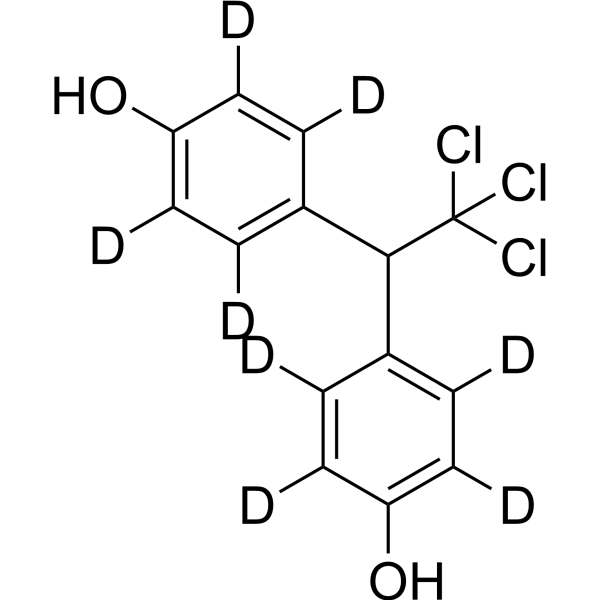
2,2-Bis(p-hydroxyphenyl)-1,1,1-trichloroethane-d8 is the deuterated-labeled HPTE (HY-W490804). HPTE is the active in vivo metabolite of Methoxychlor (HY-B1873), and acts as an inhibitor of 3β‑HSD and 17β‑HSD3. HPTE binds to the substrate-binding pocket of 3β‑HSD in a non-competitive manner, but competitively occupies the coenzyme NAD +-binding site, thereby inhibiting the conversion of pregnenolone to progesterone. HPTE binds to the androstenedione-binding pocket (the substrate pocket) of 17β‑HSD3 in a non-competitive manner, and competitively occupies the coenzyme NADPH-binding site, thus blocking the conversion of androstenedione to testosterone. HPTE interferes with androgen biosynthesis in Leydig cells by inhibiting the activities of these two key steroidogenic enzymes. HPTE can be used in studies related to androgen biosynthesis .
loading...
    loading...
Cat. No.: HY-P80401
Synonyms: AIG6, FKBP51, FKBP5, Peptidyl-prolyl cis-trans isomerase FKBP5, PPIase FKBP5, 51 kDa FK506-binding protein, 54 kDa Progesterone receptor-associated immunophilin, Androgen-regulated protein 6, FF1 antigen, FK506-binding protein 5, FKBP54, HSP90-binding immunophilin, Rotamase, 51 kDa FKBP, FKBP-51, FKBP-5, p54

Host:  

Rabbit

Application:  

WB, IHC-P, IP, FC

Reactivity:  

Human, Rat

loading...
    loading...
Cat. No.: HY-P87541
Synonyms: AIG6, FKBP51, FKBP5, Peptidyl-prolyl cis-trans isomerase FKBP5, PPIase FKBP5, 51 kDa FK506-binding protein, 54 kDa Progesterone receptor-associated immunophilin, Androgen-regulated protein 6, FF1 antigen, FK506-binding protein 5, FKBP54, HSP90-binding immunophilin, Rotamase, 51 kDa FKBP, FKBP-51, FKBP-5, p54

Host:  

Rabbit

Application:  

WB, IHC-P, IHC-F, IF-Tissue, FC, ICC/IF

Reactivity:  

Human, Rat

loading...
    loading...
Cat. No.: HY-L074
3,404 compounds

Breast cancer is the most frequent cancer among women, impacting 2.1 million women each year, and also causes the greatest number of cancer-related deaths among women. Surgery is usually the first type of treatment for breast cancer, which is usually followed by chemotherapy or radiotherapy or, in some cases, hormone or targeted therapies, especially for metastatic breast cancer (MBC).

Breast cancer is a heterogeneous disease, which is categorized into 3 major subtypes based on the presence or absence of molecular markers for estrogen or progesterone receptors and human epidermal growth factor 2 (ERBB2; formerly HER2): hormone receptor positive/ERBB2 negative (70% of patients), ERBB2 positive (15%-20%), and triple-negative (tumors lacking all 3 standard molecular markers; 15%). Different intrinsic subtypes exhibit different tumor behavior with different prognoses, and may require specific targeted therapies to maximize treatment effectiveness. Otherwise, some signaling pathways also play important roles in the development of breast cancer, such as NF-κB Signaling Pathway, TGF-beta Signaling Pathway, PI3K/AKT/mTOR signaling pathway and Notch Signaling Pathway. These signaling pathways offer ideal targets for development of new targeted therapies for breast cancer.

MCE supplies a unique collection of 3,404 compounds with identified and potential anti-breast cancer activity. MCE Anti-Breast Cancer Compound Library is a useful tool for anti-breast cancer drugs screening.

