
250 Results for "

self-assemble

" in MedChemExpress (MCE) Product Catalog:
Products (250)

250 Results for "self-assemble" in MCE Product Catalog:

Cat. No.: HY-112624H
CAS No.: 9004-54-0
Synonyms: Dextran 2; Dextran D2; Dextran T2(MW 1600-2400)
Dextran T2 (Dextran 2; Dextran T2(MW 1600-2400)) is a natural high molecular weight polysaccharide, the glycosidic bonds in its structure can be recognized by endo-dextranase and exo-dextranase. Dextran T2 (MW 2,000) breaks the glycosidic bonds in the enzymatic hydrolysis mechanism, releasing products such as D-glucose, Isomaltose (IM2), and Isomaltotriose (IM3). Dextran T2 (MW 2,000) can be used as a model substrate to characterize the catalytic properties of dextranase (such as optimal pH, temperature and product specificity), and to study enzymatic mechanism research and polysaccharide degradation pathways in glycobiology. The Dextran series of compounds are also a natural polysaccharide drug carrier, which can be connected to drugs through covalent bonding methods such as ester bonds, amide bonds or click chemistry, or self-assembled to form carriers such as nanoparticles and hydrogels. Dextran is biodegradable and biocompatible, and can achieve targeted delivery and controlled release of drugs. Dextran derivatives can prolong drug half-life, increase local concentration and reduce immune clearance activity .
loading...
    loading...
Cat. No.: HY-P10701
CAS No.: 581799-39-5
Q11 peptide is a β-sheet-forming peptide that plays an important role in self-assembly and targeted applications. As a scaffold peptide, Q11 peptide can display immunogenic epitopes and is widely used in peptide-based immune vaccine research. Additionally, Q11 peptide can be conjugated with MUC1 glycopeptides for the study of self-assembling, adjuvant-free MUC1 glycopeptide vaccines. Q11 peptide holds great potential for research in the field of cancer immunology .
loading...
    loading...
Cat. No.: HY-141613S
Synonyms: (2S,8R,19Z)DOPS-d3 ammonium
(2S,8R,19Z)1,2-Dioleoyl-sn-glycero-3-phospho-L-serine-d3 ammonium ((2S,8R,19Z)DOPS-d3 ammonium) is the deuterium labeled (2S,8R,19Z)1,2-Dioleoyl-sn-glycero-3-phospho-L-serine ammonium (HY-141613). 1,2-Dioleoyl-sn-glycero-3-phospho-L-serine sodium (DOPS-NA) is a ubstitute for Phosphoserine/phosphatidylserine. 1,2-Dioleoyl-sn-glycero-3-phospho-L-serine sodium can be used together with DOPC and DOPE in lipid mixtures for the synthesis of liposomes. 1,2-Dioleoyl-sn-glycero-3-phospho-L-serine sodium can self-assemble into single-layer or double-layer membrane structures, similar to cell membranes, and possesses high membrane fluidity and flexibility. 1,2-Dioleoyl-sn-glycero-3-phospho-L-serine is widely applied in membrane biology, cell membrane research, lipid preparation, and drug delivery systems .
loading...
    loading...
Cat. No.: HY-185721
CAS No.: 25191-14-4
Synonyms: Polyguanylic acid
Target:  

DNA/RNA Synthesis

Research Areas:  

Others

Poly (G) (Polyguanylic acid) is a high-molecular-weight synthetic ribopolynucleotide. In the presence of Na + or K + ions, Poly (G) undergoes time-dependent structural modification, gradually self-assembling from a single strand into large G-quadruplex aggregates. Poly (G) undergoes cooperative secondary structure dissociation under alkaline conditions, but its secondary structure can withstand high temperatures up to 100°C and is resistant to snake venom diesterase at low Na + concentrations. Poly (G) forms stable 1:1 complexes with polycytidylic acid or poly 5-bromocytidylic acid, but does not bind to polyinosinic acid or polyadenylic acid. Poly (G) can be applied to studies on the interactions between drugs and G-rich DNA fragments in electrochemical biosensors .
loading...
    loading...
Cat. No.: HY-P11902
Research Areas:  

Cancer

IRS1 is an integrin-targeted, ROS-responsive self-assembling peptide prodrug molecule with selective anti-cancer activity against integrin-overexpressing tumor cells. IRS1 contains an RGD motif for integrin binding, can covalently bind to DR4/DR5, and promotes DR4/DR5 aggregation. After oxidation by ROS, IRS1 undergoes a morphological transition from nanoparticles to nanofibers, exposes the pharmacophore of Chlorambucil (HY-13593), disrupts cell membrane integrity, activates the extrinsic apoptosis pathway, and can penetrate and inhibit the three-dimensional uveal melanoma spheroid model. IRS1 can be used for the research of uveal melanoma .
loading...
    loading...
Cat. No.: HY-W013159R
CAS No.: 33430-61-4
Synonyms: 5′-dGMP disodium (Standard)
2'-Deoxyguanosine 5'-monophosphate (disodium) (Standard) is the analytical standard of 2'-Deoxyguanosine 5'-monophosphate (disodium) (HY-W013159). This product is intended for research and analytical applications. 2'-Deoxyguanosine 5'-monophosphate (5′-dGMP) disodium is a mononucleotide having guanine as the nucleobase. 2'-Deoxyguanosine 5'-monophosphate disodium is a reactant involved in analysis of self-assembling in solution and nucleation/growth of G-qudruplexes, nucleophilic trapping and reductive alkylation. 2'-Deoxyguanosine 5'-monophosphate disodium can be used as an oxidizable target. 2'-Deoxyguanosine 5'-monophosphate disodium is a nucleic acid guanosine triphosphate (GTP) derivative and is a nucleotide precursor used in DNA synthesis .
loading...
    loading...
Cat. No.: HY-P2632
CAS No.: 289042-25-7
Synonyms: RADA16
Research Areas:  

Neurological Disease

RAD16-I (RADA16) is a non-directed self-assembling peptide hydrogel. Under physiological conditions, RAD16-I spontaneously forms a three-dimensional nanofiber network that mimics the extracellular matrix, and possesses excellent properties such as high water content, biocompatibility and degradability. RAD16-I serves as an ideal scaffold for three-dimensional cell culture. RAD16-I not only maintains cell viability and induces self-organization, but also supports cell adhesion, proliferation, differentiation and insulin secretion, effectively stabilizes islet clusters and promotes directed differentiation of the cardiac lineage. RAD16-I can construct a cell-friendly nano-microenvironment for research related to diseases such as myocardial infarction and diabetes .
loading...
    loading...
Cat. No.: HY-W013159S
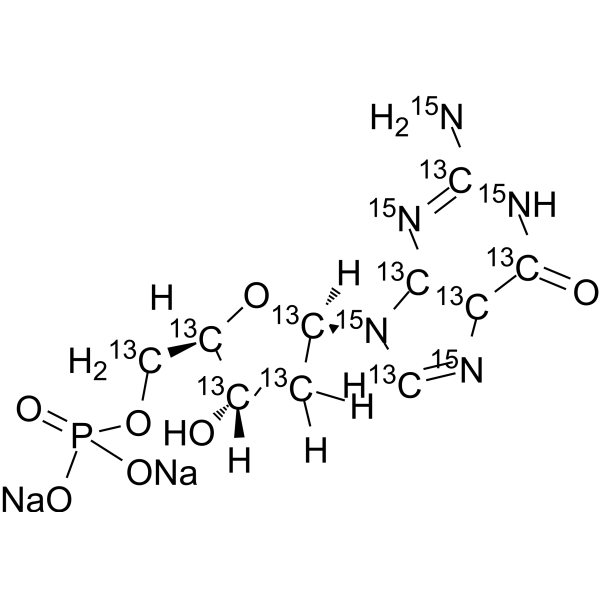
Synonyms: 5′-dGMP-13C10,15N5 disodium
2'-Deoxyguanosine 5'-monophosphate- 13C10, 15N5 (dGMP- 13C10, 15N5) disodium is the 13C and 15N labeled 2'-Deoxyguanosine 5'-monophosphate disodium (HY-W013159). 2'-Deoxyguanosine 5'-monophosphate (5′-dGMP) disodium is a mononucleotide having guanine as the nucleobase. 2'-Deoxyguanosine 5'-monophosphate disodium is a reactant involved in analysis of self-assembling in solution and nucleation/growth of G-qudruplexes, nucleophilic trapping and reductive alkylation. 2'-Deoxyguanosine 5'-monophosphate disodium can be used as an oxidizable target. 2'-Deoxyguanosine 5'-monophosphate disodium is a nucleic acid guanosine triphosphate (GTP) derivative and is a nucleotide precursor used in DNA synthesis .
loading...
    loading...
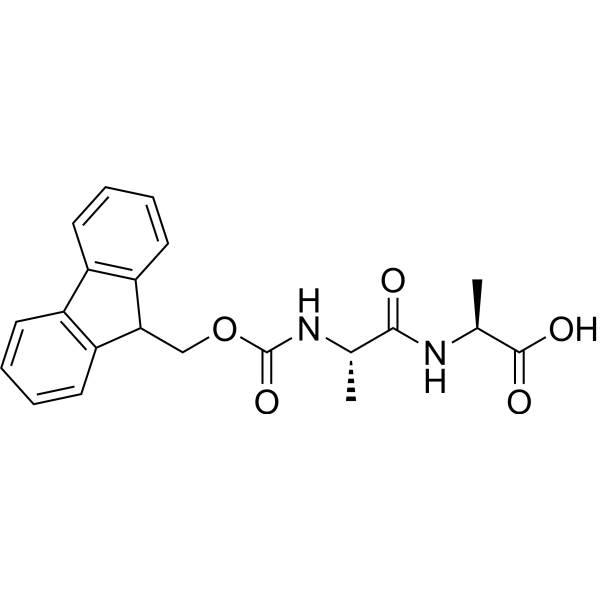
Cat. No.: HY-W048825
CAS No.: 87512-31-0
Research Areas:  

Others

Fmoc-Ala-Ala-OH is a self-assembling fluorenylmethoxycarbonyl dipeptide, a small amphiphilic building block composed of a dipeptide linked to a fluorenylmethoxycarbonyl (Fmoc) group. Under conditions of pH < 4, Fmoc-Ala-Ala-OH spontaneously assembles to form a nanofiber network, constructing a hydrogel scaffold with a water content exceeding 99% (w/w). The fibers have a diameter of approximately 22 nm, matching the size of extracellular matrix (ECM) components. Fmoc-Ala-Ala-OH supports cell adhesion, proliferation, and maintains of cell phenotype. Fmoc-Ala-Ala-OH's function is to mimic the ECM, providing a 3D growth microenvironment for cells, and Fmoc-Ala-Ala-OH is primarily used in tissue engineering and 3D cell culture, particularly suitable for in vitro culture studies of cells such as chondrocytes[1] .
loading...
    loading...
Cat. No.: HY-P2632C
Research Areas:  

Neurological Disease

RAD16-I, free acid TFA is a derivative of RADA16 (HY-P2632), with no Ac and NH2 modifications at both ends, and it has the same function as RADA16. RAD16-I, free acid TFA is a non-directed self-assembling peptide hydrogel. Under physiological conditions, RAD16-I, free acid TFA spontaneously forms a three-dimensional nanofiber network that mimics the extracellular matrix, and possesses excellent properties such as high water content, biocompatibility and degradability. RAD16-I, free acid TFA serves as an ideal scaffold for three-dimensional cell culture. RAD16-I, free acid TFA not only maintains cell viability and induces self-organization, but also supports cell adhesion, proliferation, differentiation and insulin secretion, effectively stabilizes islet clusters and promotes directed differentiation of the cardiac lineage. RAD16-I, free acid TFA can construct a cell-friendly nano-microenvironment for research related to diseases such as myocardial infarction and diabetes .
loading...
    loading...

